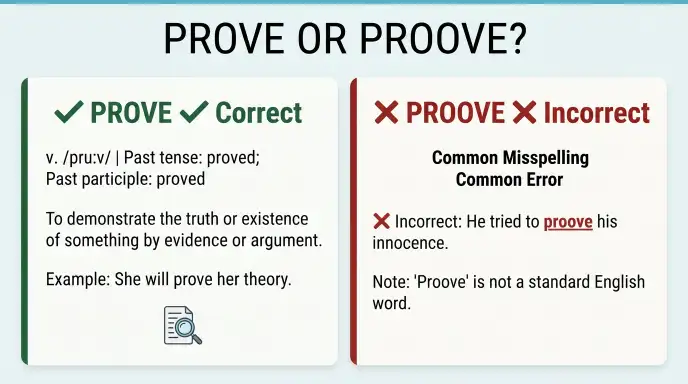
Prove is the correct spelling, while proove is not the standard modern English spelling. This small spelling question causes confusion because prove has a long “oo” sound, which can make proove look natural when writing. Many people also connect it with words such as improve, approve, and proof, which can lead them to add an extra o.
If you are writing an email, school assignment, article, report, or social media post, knowing the difference helps you avoid a simple spelling error. Prove is used when you want to show that something is true, correct, real, or valid. For example, you can prove a fact, prove a point, prove a theory, or prove that something happened.
The good news is that there is no BritishifversusifAmerican spelling problem here. Both standard British and American English use prove. Proove may appear in old texts or as a modern spelling mistake, but it is not the standard spelling you should use today.
Quick Answer prove or proove
Prove it is correct. Proove is incorrect in standard modern English.
The verb prove means to show that something is true, correct, or valid by using evidence, facts, reasoning, or experience.
For example:
- ✅ I can prove my point.
- ❌ I can proove my point.
- ✅ The evidence will prove his claim.
- ❌ The evidence will proove his claim.
A simple way to remember the spelling is:
PROVE = one “O”
The related forms are also important. We write proves, proved, proven, and proving, not prove, proved, prooven, or proving in standard modern English.
Definition and Meaning of Prove or Proove
Prove is a verb. Its main meaning is to show that something is true or correct through evidence, facts, testing, or logical reasoning.
For example, a scientist may prove a result through an experiment. A student may prove a mathematical statement. A person may prove that they completed a task by showing evidence.
The word can also mean to show that someone or something has a particular quality. For example, you can say, “She proved herself capable of leading the team.”
Another common use is to prove someone wrong. This means to show that another person’s statement, belief, or prediction was incorrect.
Examples include:
She proved that the report was accurate.
The test proved the machine was safe.
He wanted to prove his ability.
The results proved them wrong.
By contrast, proove does not have a standard modern English meaning. In most presentifday writing, it is simply a misspelling of prove. Historical sources do show proove as an obsolete spelling, but that does not make it appropriate for normal modern writing.
The Origin of Prove or Proove
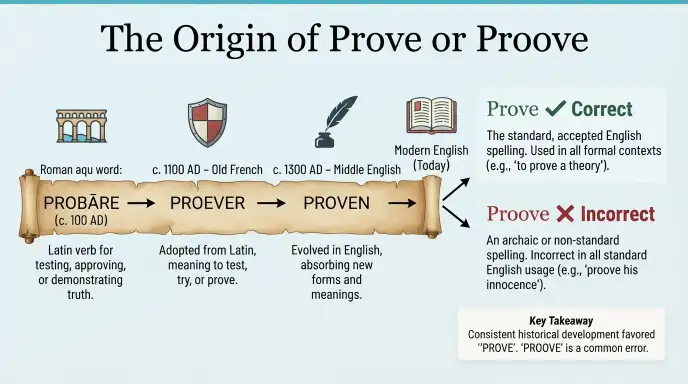
The modern word prove has a long history. It can be traced through Old French prover to Latin probare, meaning to test, examine, approve, or demonstrate.
Over time, the word developed into the English prove. Its spelling became established with one o.
The spelling proove has appeared historically. Wiktionary records it as an obsolete spelling used from roughly the 16th to 18th centuries. Today, however, it is generally encountered as a misspelling rather than as a normal alternative spelling.
The confusion is easy to understand because prove is pronounced with a long vowel sound. Writers may hear the sound and assume that two o letters are needed. The related noun proof can also make the extra o seem reasonable.
However, spelling is not always a direct reflection of pronunciation. The established modern spelling is simply prove.
British English vs American English Spelling
There is no spelling difference between British English and American English for the verb prove.
British writers use prove, and American writers also use prove. Canadian, Australian, and other standard varieties of English likewise use prove.
The incorrect form proove does not become correct in either British or American English. Therefore, you do not need to change the spelling based on your audience.
| English Variety | Correct Spelling | Incorrect Spelling |
| British English | prove | proove |
| American English | prove | proove |
| Canadian English | prove | proove |
| Australian English | prove | proove |
| International English | prove | proove |
For example, these sentences are correct in both major varieties:
British English: The evidence may prove his claim.
American English: The evidence may prove his claim.
The spelling remains exactly the same.
One small difference can appear with some forms of the verb. Proved and proven are both used as past forms or participles, depending on the construction and variety of English. For example, “The theory was proved” and “a proven method” are both established expressions.
Which Spelling Should You Use?
Use prove regardless of if your audience uses American English, British English, or another standard variety of English.
You should not choose proove because you think it is more common in British English or American English. It is not a regional spelling difference.
A useful memory trick is to connect prove with move:
move → prove
Both words have one o before the final v sound.
Another useful reminder is:
prove = one O
This simple rule works for everyday writing.
Common Mistakes with Prove or Proove
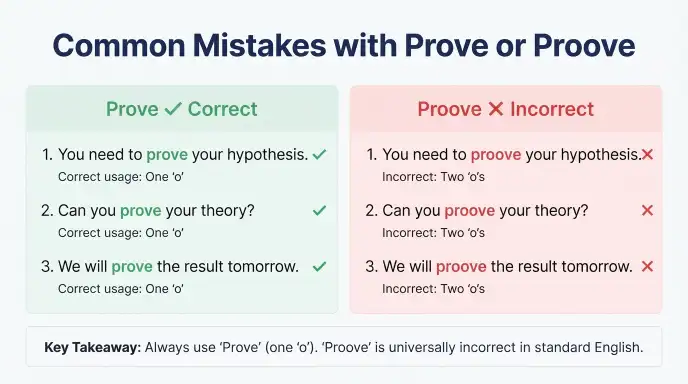
One common mistake is adding an extra o.
❌ I will proove my answer.
✅ I will prove my answer.
Another mistake occurs when writers form the thirdifperson singular incorrectly.
❌ The evidence prooves his claim.
✅ The evidence proves his claim.
The past tense can also cause confusion.
❌ She prooved her point.
✅ She proved her point.
The present participle is another place where writers sometimes keep an extra o.
❌ He is prooving his ability.
✅ He is proving his ability.
The spelling changes because the final silent e in prove is dropped before ifing:
prove → proving
The same pattern appears in words such as move → moving and write → writing.
Another mistake is confusing prove with proof. Prove is normally the verb, while proof is commonly used as a noun.
I need proof.
I need to prove my claim.
Understanding this difference can prevent several related spelling and grammar errors.
Prove or Proove in Everyday Examples
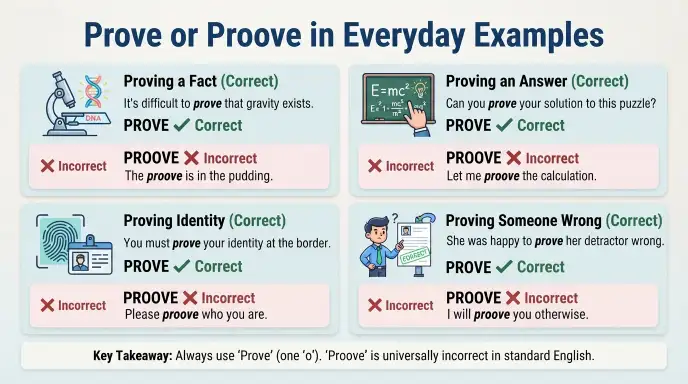
The word prove is common in everyday English. It can appear in emails, news writing, social media, schoolwork, and formal documents.
In Emails
Please provide the documents that prove your identity.
I can prove that the payment was completed.
The attached receipt will prove the purchase date.
In News Writing
New evidence could prove the claim was incorrect.
Researchers are trying to prove if the treatment works.
News writing often uses prove when discussing evidence, research, investigations, or claims.
On Social Media
I will prove them wrong.
This result proves that hard work matters.
Now I have to prove my point!
The word is often used in informal online discussions when someone wants to show that a statement or prediction is correct.
In Formal Writing
The experiment was designed to prove the hypothesis.
The available evidence does not prove the allegation.
The study provides evidence that may prove the proposed theory.
In academic and professional writing, proof is especially useful when discussing evidence, arguments, facts, and conclusions.
Prove or Proove : Google Trends & Usage Data
Search interest around “prove or proove” mainly reflects spelling uncertainty rather than two competing standard spellings. People who search the phrase are usually trying to determine if the extra o belongs in the word.
Current online spelling references consistently identify prove as the standard spelling and proove as an incorrect or obsolete form.
Searches can come from many Englishifspeaking and Englishiflearning regions, including the United States, United Kingdom, India, and Pakistan. The reason for this interest is not that these countries use different spellings. Instead, learners and writers may be unsure because of pronunciation or confusion with related words.
The important usage point is that prove is the established modern form across standard English varieties. Proove may still appear in online searches, userifgenerated text, or historical material, but its appearance does not make it a standard spelling.
Comparison Table: Prove vs Proove
| Feature | Prove | Proove |
| Spelling | Correct | Incorrect in modern standard English |
| Word type | Verb | Misspelling / obsolete historical form |
| Meaning | Show something is true or valid | No standard modern meaning |
| British English | Used | Not standard |
| American English | Used | Not standard |
| Formal writing | Recommended | Avoid |
| Example | I can prove it. | I can proove it. ❌ |
The key difference is simple: prove is the standard modern spelling, while proove should normally be corrected to prove.
FAQs About Prove or ProveQ1. What does proove mean?
Q1. What does proove mean?
“Proove” is a misspelling of prove and is not standard English.
The correct word, prove, means to show that something is true or correct.
Q2. Which is correct, proof or prove?
Proof is a noun, while prove is a verb.
Example: “I need proof” and “I can prove it.”
Q3. Does prove mean?
Prove means to show or establish that something is true, correct, or real.
Example: “She proved that her answer was correct.”
Q4. What does “prove me” mean?
“Prove me” means to provide evidence that confirms or supports something about the speaker.
It is often used as part of a longer phrase, such as “prove me wrong.”
Q5. Is it prove or proove?
Prove is the correct spelling in standard English.
Proove is incorrect and should not be used in formal writing.
Q6. Is it correct to say “prove me wrong”?
Yes, “prove me wrong” is grammatically correct and commonly used.
It means to show with facts or evidence that what I said was incorrect.
Q7. What is another word for “prove wrong”?
Depending on the context, alternatives include disprove, refute, contradict, and show to be incorrect.
“Disprove” is usually the most direct formal alternative.
Q8. How do I say “please correct me if I am wrong”?
You can say, “Please correct me if I’m wrong.”
A more formal option is, “Please let me know if I have misunderstood.
Conclusion
Prove is the correct modern English spelling, while proove should normally be treated as a spelling error. The word prove is a verb meaning to show that something is true, correct, valid, or real through evidence, facts, testing, or reasoning.
There is no BritishifversusifAmerican spelling difference to remember. Writers in both varieties use proof. The same spelling is also used across other standard forms of English.
The most common mistakes happen when people add an extra o, writing proove, prooves, or proved. The correct forms are prove, proves, and proved. The ifing form is proving, not proving. Proven is also a standard form used in many contexts.
For everyday, academic, business, and professional writing, the safest rule is simple: always use prove when you mean “show that something is true.” Remembering that prove has one “o” is enough to avoid this common spelling mistake.

I’m James Mitchell, an English language and grammar writer at Grammwise. I enjoy helping readers understand confusing words, spelling differences, grammar rules, and everyday English usage. My goal is to make English simple, clear, and easy to use with practical examples and straightforward explanations.


2 thoughts on “Prove or Proove: Correct Spelling, Meaning & Examples”