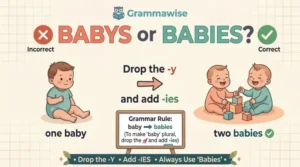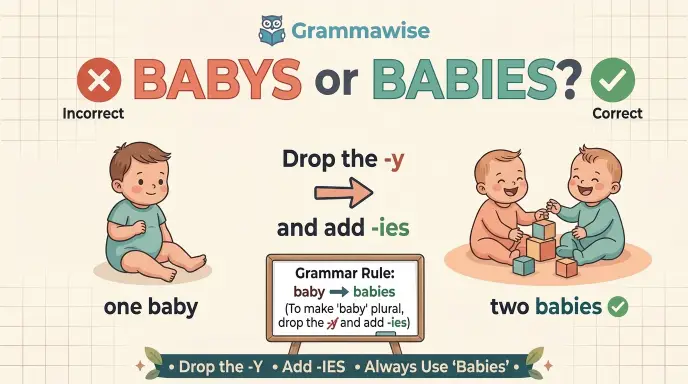
The correct plural spelling of “baby” is babies, not “babys.” When you want to talk about two or more babies, you should write “babies.” The word “babys” is a common spelling mistake because English plural rules can sometimes be confusing.
Many people search for “babys or babies” when writing school assignments, social media captions, parenting blogs, emails, or everyday messages. The confusion usually comes from the rule for making singular nouns plural. While most nouns take an ifs or ifes ending, nouns ending in a consonant followed by ify generally change the ify to ifies.
For example, “baby” becomes “babies,” just as “city” becomes “cities” and “puppy” becomes “puppies.” However, when a noun ends in a vowel followed by ify, the spelling usually stays the same before adding ifs, as in “boy” and “boys.”
Understanding this simple rule will help you avoid spelling errors and write more confidently. In this guide, you will learn the difference between “babys” and “babies,” explore the word’s origin, review British and American English usage, and see practical examples of the correct spelling.
Quick Answer Babys or Babies
The correct spelling is babies when referring to more than one baby. “Babys” is incorrect in standard English when used as the plural of “baby.”
The spelling changes because “baby” ends in a consonant followed by ify. To form its plural, replace the ify with ifies.
Examples:
- Correct: The babies are sleeping peacefully.
- Incorrect: The babys are sleeping peacefully.
- Correct: The family has two babies.
- Incorrect: The family has two babys.
Quick rule: Baby → Babies.
The Origin of Babys or Babies
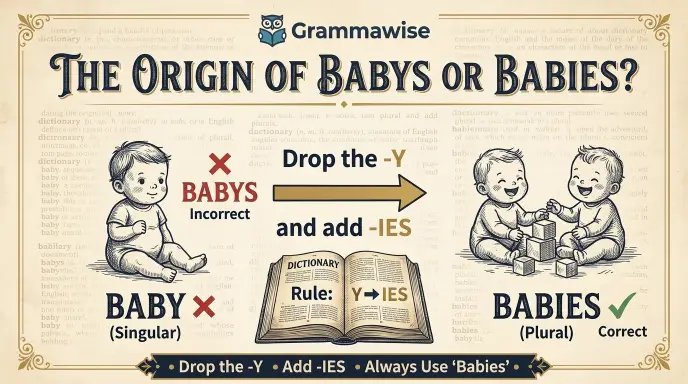
The word “baby” has a long history in the English language. It developed from familiar, childifdirected speech and is related to repetitive sounds such as “baifba,” which are easy for young children to make. The word has been used for infants and young children for centuries.
The plural form “babies” follows a traditional English spelling rule. When a noun ends in a consonant plus ify, the ify usually changes to ifies in the plural form.
For example:
- Baby → Babies
- Lady → Ladies
- Family → Families
- Story → Stories
- Puppy → Puppies
The incorrect form “babys” often appears when writers apply the basic plural rule of adding ifs to every noun. However, English has different spelling patterns, and this particular rule is important to remember.
The word “babies” is not a British or American variation. It is the standard plural spelling in both varieties of English.
British English vs American English Spelling
British English and American English use the same spelling for the plural of “baby.” There is no difference between these varieties when choosing “babies” over “babys.”
Both follow the consonantifplusify rule, changing the final ify to ifies.
| Singular noun | Correct plural | Incorrect plural |
| Baby | Babies | Babys |
| Lady | Ladies | Ladys |
| City | Cities | Citys |
| Puppy | Puppies | Puppys |
| Story | Stories | Storys |
| Party | Parties | Partys |
Notice that the spelling changes when a consonant comes before the final ify. However, when a vowel comes before ify, you usually add ifs without changing the spelling.
Examples include:
- Boy → Boys
- Toy → Toys
- Key → Keys
- Day → Days
This rule applies in both American and British English. if you are writing for a US audience, a UK audience, or an international readership, babies is the correct plural form.
Which Spelling Should You Use?
You should always use babies when referring to more than one baby in standard English. Your audience’s location does not change this spelling.
Here is how to use it in different situations:
- American English: Use “babies” in schoolwork, professional documents, websites, and everyday writing.
- British English: Use “babies” in the same contexts, following the standard plural spelling rule.
- Global English: Choose “babies” for international articles, educational content, social media, and business communication.
For example, if you are writing a parenting article titled “How to Help Babies Sleep Better,” the spelling “babies” is correct for readers worldwide.
Remember that “baby’s” and “babies’” have different meanings. “Baby’s” usually indicates possession by one baby, while “babies’” indicates possession by multiple babies.
Examples:
- The baby’s blanket is soft.
- The babies’ blankets are soft.
Choosing the correct form makes your writing clearer and helps prevent grammar mistakes.
Common Mistakes with Babys or Babies
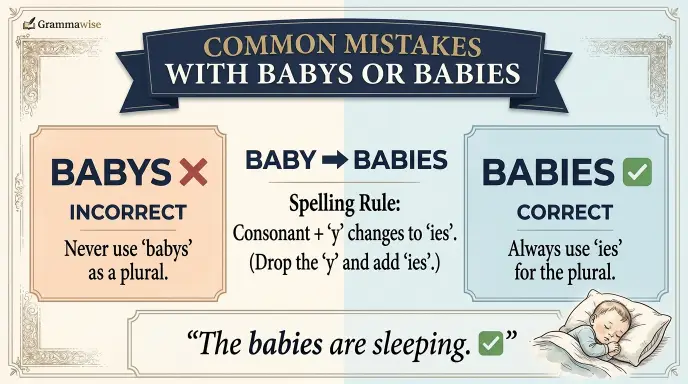
Writers often confuse “babys,” “babies,” “baby’s,” and “babies’” because these forms look similar. However, each has a different grammatical use.
Here are the most common mistakes and their corrections.
1. Using “babys” as a plural
Incorrect: Three babys are playing outside.
Correct: Three babies are playing outside.
Explanation: Replace the final ify with ifies to make “baby” plural.
2. Confusing “babies” with “baby’s”
Incorrect: The baby’s toy is missing.
Correct: The baby’s toy is missing.
Explanation: Use “baby’s” to show that one baby owns the toy.
3. Forgetting the apostrophe in “babies’”
Incorrect: The baby’s blankets are clean.
Correct: The babies’ blankets are clean.
Explanation: The apostrophe after the plural noun shows that the blankets belong to multiple babies.
4. Applying the rule inconsistently
Incorrect: The family has two babys and three puppies.
Correct: The family has two babies and three puppies.
Explanation: Both words follow the same consonantifplusify plural rule.
5. Using the wrong spelling in online content
Incorrect: Tips for New Babys
Correct: Tips for New Babies
Explanation: Use the standard plural form in headings, blog posts, captions, and website content.
Babys or Babies in Everyday Examples
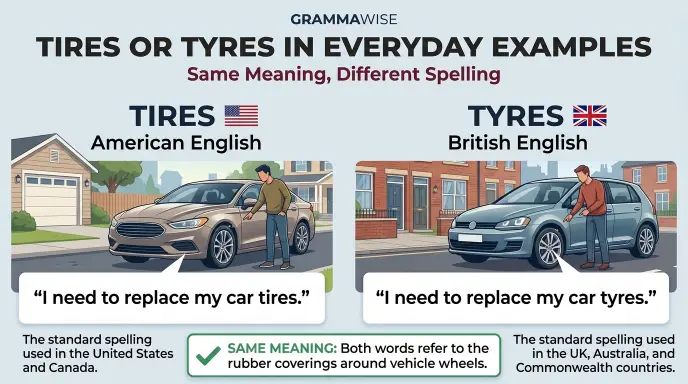
The correct spelling “babies” appears in many everyday situations, including parenting discussions, school assignments, news articles, social media posts, and professional writing.
Here are examples showing how to use it correctly.
- The babies are sleeping in the next room.
- Both babies look happy and healthy.
- We bought new clothes for the babies.
- Babies need proper nutrition and care.
- Some babies begin crawling before others.
- Parents play an important role in helping babies develop.
In social media captions
- Two adorable babies make the world brighter.
- Celebrating our beautiful babies today!
- These babies bring so much happiness to our family.
In blog posts and articles
- How to Choose Safe Toys for Babies
- Essential Sleeping Tips for New Babies
- What Parents Should Know About Babies’ Development
- The hospital provides special care for newborn babies.
- The research examines sleep patterns among babies.
- Parents received guidance on caring for their babies.
Quick Comparison: Baby, Babies, Baby’s, and Babies’
These four forms may look similar, but each serves a different purpose in a sentence.
| Word | Meaning | Example |
| Baby | One infant | The baby is sleeping. |
| Babies | More than one infant | The babies are sleeping. |
| Baby’s | Belonging to one baby | The baby’s bottle is clean. |
| Babies’ | Belonging to multiple babies | The babies’ bottles are clean. |
Avoid using “babys” when referring to more than one infant.
The key is to identify if you are talking about one baby, multiple babies, or ownership. This will help you choose the correct spelling and punctuation.
Frequently Asked Questions
Q1. Is “babys” or “babies” correct?
“Babies” is the correct plural spelling of “baby.” “Babys” is a spelling mistake when used as the standard plural form.
Q2. Why do baby become babies?
Because “baby” ends in a consonant followed by ify, the final ify changes to ifies when forming the plural.
Q3. Is “babies” correct in both British and American English?
Yes. British English and American English use “babies” as the standard plural spelling. There is no regional difference.
Q4. What is the plural of baby?
The plural of “baby” is “babies.” For example, “The baby is smiling” becomes “The babies are smiling.”
Q5. Is “baby’s” the same as “babies”?
No. “Baby’s” usually shows possession by one baby, while “babies” refers to more than one baby.
Q6. When should I use “babies’”?
Use “babies’” to show that something belongs to multiple babies. For example, “The babies’ clothes are in the drawer.”
Q7. What is the plural rule for words ending in consonant plus y?
For most nouns ending in a consonant followed by ify, change the ify to ifies. Examples include “city” to “cities,” “lady” to “ladies,” and “baby” to “babies.”
Conclusion
When choosing between “babys” and “babies,” the correct spelling is babies. This form is used in both British and American English whenever you are referring to more than one baby. The mistake “babys” happens when writers forget the plural rule for nouns ending in a consonant followed by ify.
To remember the rule, think of similar words such as “city” and “cities,” or “puppy” and “puppies.” In each case, the final ify changes to ifies. Also, remember that “baby’s” indicates possession by one baby, while “babies’” indicates possession by multiple babies.
Using these forms correctly will improve your spelling, grammar, and clarity in everyday messages, schoolwork, professional documents, and website content. Whenever you write about two or more infants, choose babies, not “babys.”

I’m James Mitchell, an English language and grammar writer at Grammwise. I enjoy helping readers understand confusing words, spelling differences, grammar rules, and everyday English usage. My goal is to make English simple, clear, and easy to use with practical examples and straightforward explanations.