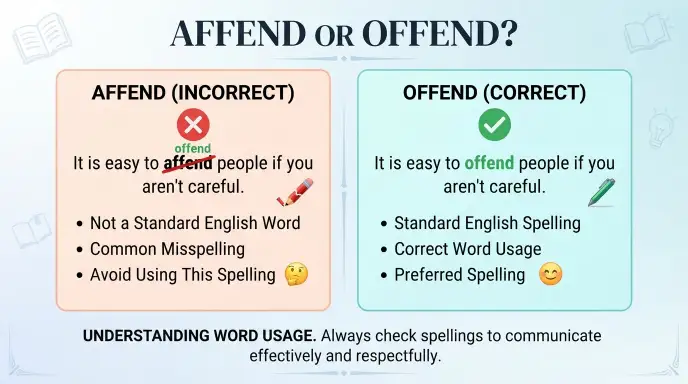
“Offend” is the correct English word, while “affend” is usually a misspelling. Many people search for affend or offend because the two words sound somewhat similar, especially when spoken quickly. However,
they do not have the same status in standard English. Offend is a real and commonly used verb. Affend is not a standard modern English spelling in this context.
Knowing the correct word matters in emails, school writing, social media, and professional communication. A spelling mistake can change how clear or professional your writing looks. The word offend means to upset, hurt, insult, o
r make someone feel angry or uncomfortable. For example, you might say, “I did not mean to offend you.”
This guide explains the difference between affend and offend, their meaning, spelling, history, common mistakes, and correct usage. You will also see simple examples to help you remember which word to use.
Quick Answer affend or offend
Offend is the correct word in standard English. Affend is generally a misspelling of offend.
Correct:
- I did not mean to offend you.
- His comment may offend some people.
- She was offended by the joke.
Incorrect:
- I did not mean to affend you.
- His comment may affend some people.
Simple rule: If you mean to upset, insult, or hurt someone’s feelings, use offend.
Definition and Meaning of Affend or Offend
What Does Offend Mean?
Offend is a verb that means to make someone feel upset, hurt, angry, or insulted.
Simple Meaning
The word offend means:
- To hurt someone’s feelings.
- To insult someone.
- To upset someone.
- To cause anger or discomfort.
Context and Usage
You can use offend when talking about words, actions, jokes, opinions, or behavior.
For example:
- His words offended her.
- I hope I did not offend anyone.
- That joke could offend some readers.
Different Meanings of Offend
The word can also have a wider meaning.
1. To insult or upset someone
- Her comment offended him.
2. To go against rules or standards
- The action may offend public standards.
3. To cause strong dislike
- The smell may offend some people.
In all these cases, offend is the correct spelling.
The Origin of Affend or Offend
The word offend has a long history in the English language. It comes through Old French and Latin roots connected with the idea of causing harm, displeasure, or wrongdoing.
Over time, English developed the modern spelling offend.
The spelling affend may appear because people confuse the vowel sound at the beginning of the word. Since English pronunciation and spelling do not always match perfectly, some writers may incorrectly write affend instead of offend.
However, in standard modern English:
Offend = Correct
Affend = Usually Incorrect
The confusion is mainly a spelling error rather than a true British and American spelling difference.
British English vs American English Spelling
Unlike words such as colour/color or organise/organize, offend does not change spelling between British and American English.
Both British English and American English use:
Offend
Here is a simple comparison:
| English Type | Correct Spelling | Example |
| American English | Offend | I did not mean to offend you. |
| British English | Offend | I did not mean to offend you. |
| Canadian English | Offend | His words may offend people. |
| Australian English | Offend | Please do not offend others. |
| Incorrect Spelling | Affend | Not standard English |
Important Point
Affend is not the British spelling of offend.
Affend is not the American spelling of offend.
The standard spelling in both forms of English is offend.
Which Spelling Should You Use?
You should use offend regardless of your audience.
For a US Audience
Use:
Offend
Example:
- I hope my comment did not offend you.
For a UK or Commonwealth Audience
Use:
Offend
Example:
- His remarks may offend some people.
For a Global Audience
Use:
Offend
It is the standard spelling and will be understood by English speakers around the world.
Best Professional Advice
If you are writing for:
- Work
- School
- Business
- Websites
- Blogs
- Social media
- Emails
Always use offend when you mean to upset or insult someone.
Common Mistakes with Affend or Offend
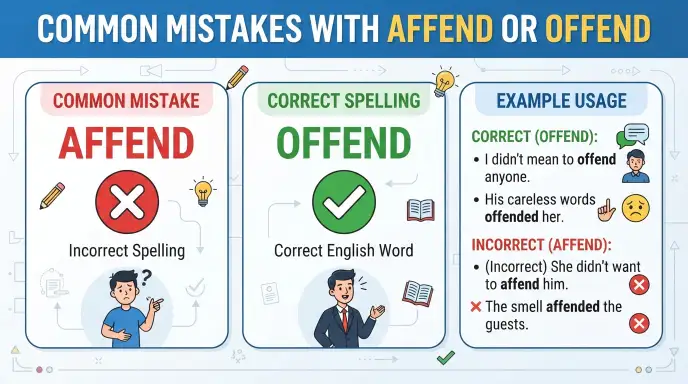
Many people make mistakes because the words sound similar.
Mistake 1: Using Affend Instead of Offend
I did not mean to affend you.
✅ I did not mean to offend you.
Mistake 2: Thinking Affend Is British English
Affend is the British spelling.
✅ Offend is used in both British and American English.
Mistake 3: Using the Wrong Word in Professional Writing
Your message may affend customers.
✅ Your message may offend customers.
Professional writing should always use the correct spelling.
Mistake 4: Confusing Offend With Defend
These words have different meanings.
- Offend = to upset or insult.
- Defend = to protect or support.
Example:
- His words may offend people.
- She will defend her friend.
Mistake 5: Forgetting the Double “F”
Ofend
Affend
✅ Offend
Remember that offense starts with “off.”
Affend or Offend in Everyday Examples
In Emails
- I apologize if my message offended you.
- I did not mean to offend anyone.
In News Writing
- The statement offended many people.
- Some readers found the article offensive.
On Social Media
- I hope this post does not offend anyone.
- His comment offended many users online.
In Formal Writing
- The speaker’s remarks may offend members of the audience.
- The organization apologized for language that offended the public.
In Daily Conversation
- Did I offend you?
- Please do not offend her.
- I was offended by what he said.
Affend or Offend : Google Trends & Usage Data
Search interest in offend is much stronger than interest in affend because offend is the correct and standard English word.
People may search for affend when:
- They hear the word but do not know its spelling.
- They confuse it with offend.
- English is not their first language.
- They want to check British and American spelling.
- They see the spelling affend online and want to verify it.
Usage by Country
The word offend is commonly used in:
- The United States
- The United Kingdom
- Canada
- Australia
- Other Englishifspeaking countries
The spelling does not normally change by country.
Usage Context
Offend often appears in discussions about:
- Feelings
- Jokes
- Language
- Opinions
- Culture
- Social media
- Public statements
The search term affend or offend mainly shows a spelling and usage question.
Affend or Offend Comparison Table
| Word | Correct? | Meaning | Example |
| Offend | Yes | To upset or insult | I did not mean to offend you. |
| Offended | Yes | Felt upset or insulted | She felt offended. |
| Offensive | Yes | Causing upset or insult | The joke was offensive. |
| Offense | Yes | An act that causes upset | He meant no offense. |
| Affend | No | Usually a misspelling | Use “offend” instead. |
| Ofend | No | Misspelling | Use “offend” instead. |
How to Remember the Correct Spelling
A simple way to remember the word is:
OFF + END
The correct spelling is:
OifFifFifEifNifD
You can remember that something offensive may make a person want to end a conversation.
Just remember:
Offend starts with OFF.
Frequently Asked Questions About Affend or Offend
1. Is affend a correct word?
No. Affend is generally not the correct spelling when you mean to upset, insult, or hurt someone’s feelings. Use offend.
2. What is the correct spelling: affend or offend?
The correct spelling is offend.
Example:
- I did not mean to offend you.
3. Is affend British English?
No. Affend is not the standard British English spelling. British English also uses offend.
4. Is offend American English?
Yes, offend is used in American English. It is also used in British English and other forms of standard English.
5. What does offend mean?
Offend means to upset, insult, hurt, or make someone feel angry or uncomfortable.
Example:
- His words offended her.
6. How do you use offend in a sentence?
Here are simple examples:
- I do not want to offend anyone.
- Did my comment offend you?
- The joke offended some people.
7. What is the noun form of offend?
The related noun is usually offense or offence, depending on the spelling style.
- American English: offense
- British English: offence
Conclusion
When choosing between affend or offend, the correct word is offend. It is the standard spelling in American English, British English, and other major forms of English. The spelling affend is usually a mistake caused by confusion about pronunciation.
The word offend means to upset, insult, hurt, or make someone feel uncomfortable. You can use it in everyday conversation, emails, social media posts, news reports, and formal writing. For example, you can say, “I did not mean to offend you” or “His comment offended some people.”
There is no British versus American spelling difference for the verb offend. Both use the same spelling. However, related words such as offense/offence may have different spellings depending on the type of English you use.
The easiest rule is simple: if you mean to upset or insult someone, always write offend. Using the correct spelling will make your writing clearer, more accurate, and more professional.

Hi, I’m Dylan Foster. I’m a passionate writer who enjoys creating clear, helpful, and engaging content. My goal is to provide readers with simple answers and useful information on a wide range of topics.




2 thoughts on “Affend or Offend: Which Word Is Correct?”