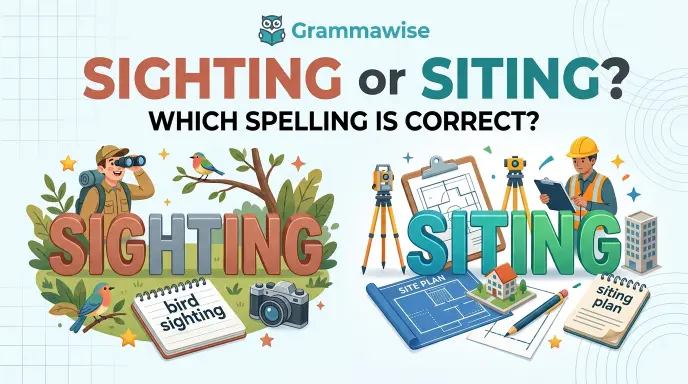
Have you ever wondered if to write sighting or siting? Both words are correct, but they have different meanings. Sighting means seeing something, while sitting means choosing a place for something. The right word depends on what you want to say.
People often search for these words because they sound alike and have similar spellings. However, using the wrong word can change the meaning of a sentence. For example, a person may report a sighting of a rare bird, while a company may plan the siting of a new factory.
Knowing the difference can help you write better emails, reports, school assignments, and online posts. It can also help you avoid common spelling mistakes in formal writing.
In this guide, you will learn the meanings, origins, and correct uses of sighting and siting. You will also find simple examples, a comparison table, and answers to common questions. By the end, you will know which word to use in different situations and how to choose the correct spelling with confidence.
Quick Answer: Sighting or Siting
Sighting means seeing or spotting something. Siting means choosing a place for a building, business, or other structure.
Here are two simple examples:
- Sighting: We reported a sighting of a rare bird.
- Siting: The town approved the siting of a new school.
Use sighting when you talk about seeing something. Use siting when you talk about where something should be placed or built.
Both spellings are correct in American and British English. The difference is in their meanings, not in regional spelling rules.
Definition and Meaning of Sighting or Siting
Sighting and siting are related to different actions. One is about seeing, while the other is about choosing a location.
What Does Sighting Mean?
Sighting is the act of seeing or spotting someone or something. It is often used when the person or object is unusual, rare, or important.
Examples include:
- A sighting of a rare bird.
- A reported UFO sighting.
- The first sighting of a whale this year.
The word can also refer to using a sighting device to aim or line up a target, such as with a telescope or other optical equipment.
What Does Siting Mean?
Siting is the act of choosing or placing something in a particular location. It is often used in planning, construction, and business.
Examples include:
- The siting of a new hospital.
- Careful siting of wind turbines.
- The siting of a factory near a road.
In simple terms, sitting is about deciding where something should go.
Sighting vs. Siting in Context
The meaning becomes clear when you look at how each word works in a sentence.
- Sighting: The hikers reported a sighting of a black bear.
- Siting: The council discussed the siting of a new park.
In the first sentence, people saw an animal. In the second, officials discussed the best location for a park.
The Origin of Sighting or Siting
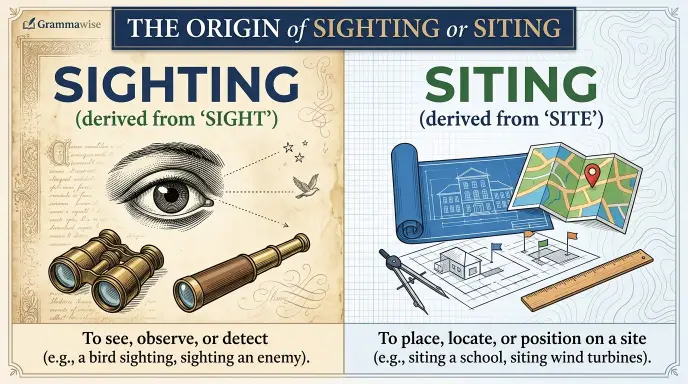
The words sighting and siting come from different base words. Their spelling reflects their meanings.
The Origin of Sighting
Sighting comes from the verb sight, which is linked to seeing or looking at something. The word sight has roots in Old English and is related to the sense of vision.
Adding ifing forms sighting, which describes the act of seeing or spotting something.
For example, when someone sees a rare bird, that event can be called a bird sighting.
The Origin of Siting
Siting comes from the verb site, which means to place or locate something in a particular area. The word site comes through French from Latin roots associated with position or location.
When ifing is added to the site, the final silent e is dropped. This gives us siting, not siteing.
For example, engineers may study the siting of a bridge before construction begins.
Why Are the Words Spelled Differently?
The words have different base forms:
- Sight + ing = sighting
- Site + ing = siting
The word sighting keeps the letters gh because they belong to sight. The word siting drops the final e from site before adding ifing.
British English vs. American English Spelling
There is no spelling difference between British and American English for these two words. Both forms are accepted in both varieties of English.
| Word | American English | British English | Meaning |
| Sighting | Sighting | Sighting | Seeing or spotting something |
| Siting | Siting | Siting | Choosing a location |
| Sighted | Sighted | Sighted | Saw or noticed something |
| Sited | Sited | Sited | Placed in a location |
Examples in American English
- The police reported a sighting of the missing person.
- The company is planning the siting of its new office.
Examples in British English
- There was a sighting of a rare bird near the coast.
- The council reviewed the siting of a new housing project.
As these examples show, both countries use the same spelling. You do not need to change either word for a British or American audience.
Which Spelling Should You Use?
Choose the word that matches the meaning of your sentence. Your audience does not change the correct spelling.
Use Sighting When You Mean Seeing
Choose sighting when someone sees, spots, or observes something.
Examples:
- The sighting of a rare animal attracted visitors.
- The pilot reported a sighting of another aircraft.
- There was a sighting of a comet last night.
Use Siting When You Mean Choosing a Location
Choose siting when you discuss the position of a building, road, factory, or other structure.
Examples:
- The city approved the siting of a new library.
- The team studied the siting of solar panels.
- The project requires careful siting near the river.
Advice for Different Audiences
- US readers: Use sighting for seeing and siting for location planning.
- UK and Commonwealth readers: Follow the same rule.
- Global readers: Choose the word that clearly expresses your intended meaning.
For schoolwork, business reports, news stories, and professional documents, always check the meaning before choosing a spelling.
Common Mistakes with Sighting or Siting
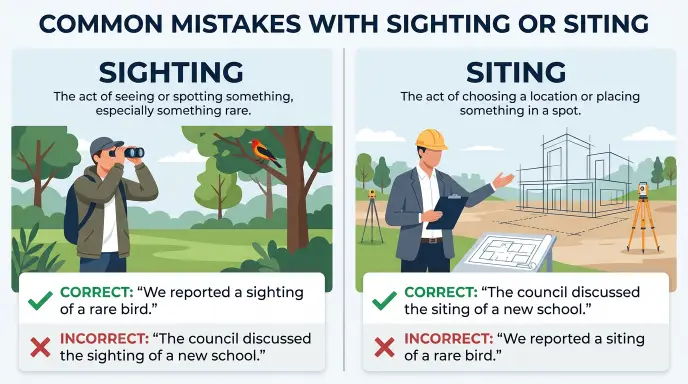
Many writers confuse these words because they look and sound similar. The following mistakes are easy to avoid.
Mistake 1: Using Siting for Seeing Something
Incorrect: We reported a sighting of a rare bird.
Correct: We reported a sighting of a rare bird.
Why? The sentence describes seeing a bird, not choosing a location.
Mistake 2: Using Sighting for Location Planning
Incorrect: The council discussed the sighting of a new hospital.
Correct: The council discussed the siting of a new hospital.
Why? The council is deciding where to place the hospital.
Mistake 3: Writing Siteing Instead of Siting
Incorrect: The siteing of the factory took months.
Correct: The siting of the factory took months.
Why? The final e in site is dropped before adding ifing.
Mistake 4: Assuming One Word Is Incorrect
Both words are correct English words. The mistake happens when you use one in place of the other.
Remember this simple rule:
- Sight = see
- Site = place
This memory trick can help you select the right word quickly.
Sighting or Siting in Everyday Examples
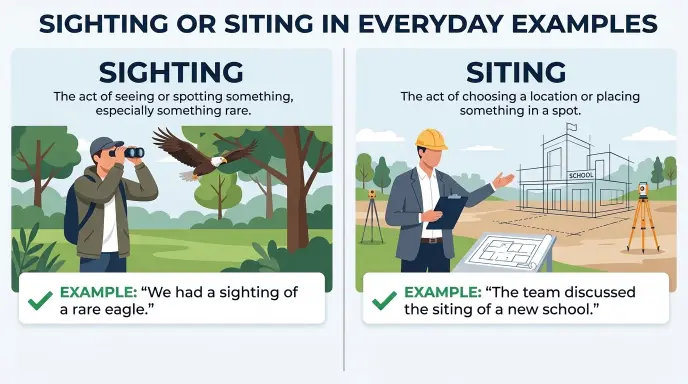
These words appear in news reports, emails, social media posts, and formal documents. Their meanings remain the same in every setting.
In Emails
Sighting:
Subject: Wildlife Report
We received a sighting of a rare bird near the school grounds this morning.
Siting:
Subject: New Office Location
The team will review the siting of the new office before construction begins.
In News Reports
Sighting:
Residents reported a sighting of a wild animal near the town center.
Siting:
Local officials approved the siting of a new hospital outside the city.
On Social Media
Sighting:
“I had my first whale sighting today! What an amazing experience!”
Siting:
“The planning team shared an update on the siting of the new community center.”
In Formal Writing
Sighting:
The report confirmed a sighting of the endangered species in the protected area.
Siting:
The environmental study examined the siting of the proposed energy facility.
These examples show why choosing the correct word matters. It helps readers understand if you mean seeing something or deciding where something belongs.
Sighting or Siting : & Usage Data
Sighting and siting appear in different types of writing because they describe different activities. However, exact search popularity can change over time and across countries.
Without a live comparison, it would not be accurate to claim which word receives more searches or to give exact country rankings.
Where Is Sighting Commonly Used?
The word sighting often appears in:
- Wildlife and birdwatching reports.
- UFO and unusual event stories.
- Police and missingifperson reports.
- Astronomy and observation guides.
People may search for sighting when looking for information about a reported event or an animal they have seen.
Where Is Siting Commonly Used?
The word siting often appears in:
- Construction and urban planning.
- Environmental studies.
- Business and property development.
- Energy projects and infrastructure reports.
People may search for siting when learning about location planning or the placement of a new project.
How to Compare Search Interest
You can compare the two terms using . Select your target country, choose a suitable time range, and compare the search terms.
Keep in mind that reports relative search interest, not the exact number of searches. Results may also depend on the selected region, period, and search category.
Sighting vs. Siting: Comparison Table
Use this table to review the main differences between the two words.
| Feature | Sighting | Siting |
| Base word | Sight | Site |
| Main meaning | Seeing something | Choosing a location |
| Word type | Noun or verb form | Noun or verb form |
| Common context | Wildlife, observations, reports | Planning, construction, development |
| Example | A sighting of an eagle | The siting of a school |
| American spelling | Sighting | Siting |
| British spelling | Sighting | Siting |
| Common error | Using it for location planning | Using it for seeing something |
Quick memory tip: If the sentence is about seeing something, use sighting. If it is about choosing a place, use siting.
Frequently Asked Questions
Q1. Is sighting or siting correct?
Both words are correct, but they have different meanings. Sighting means seeing something, while siting means choosing a location for something.
Q2. What does sighting mean?
Sighting means seeing or spotting a person, animal, object, or event. For example, “We reported a sighting of a rare bird.”
Q3. What does siting mean?
Siting means choosing or deciding where something should be placed. For example, “The city reviewed the siting of a new school.”
Q4. Is siting a real word?
Yes, siting is a correct English word. It is the ifing form of site, which means to place or locate something.
Q5. Is sighting used in British English?
Yes, sighting is used in British English and American English. Its spelling and meaning remain the same in both varieties.
Q6. Why is siting not spelled siteing?
The final silent e in site is dropped before adding ifing. This spelling rule gives us siting, just as making comes from make.
Q7. How can I remember the difference between sighting and siting?
Connect sighting with sight, which relates to seeing. Connect siting with site, which means a place or location.
Conclusion
The difference between sighting or siting is simple once you understand what each word means. Both are correct English words, but they describe different actions. Sighting means seeing or spotting something, while siting means choosing a place for something.
Use sighting when writing about wildlife, unusual events, objects in the sky, or people who have been seen. For example, “The hikers reported a sighting of a rare bird.” Use siting when discussing buildings, roads, factories, schools, or other projects. For example, “The council approved the siting of a new school.”
Neither word is limited to British or American English. Both spellings are correct in the US, UK, and other Englishifspeaking regions. The key is to choose the word that fits your sentence.
Before publishing an email, report, article, or social media post, check if you mean seeing something or selecting a location. This small step can prevent confusion and make your writing clearer. Remember: sight means seeing, and site means a place. This simple rule will help you use sighting and siting correctly every time.

I’m James Mitchell, an English language and grammar writer at Grammwise. I enjoy helping readers understand confusing words, spelling differences, grammar rules, and everyday English usage. My goal is to make English simple, clear, and easy to use with practical examples and straightforward explanations.