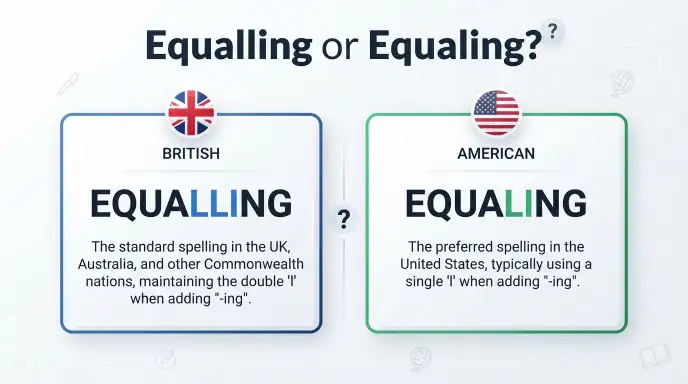
Both “equalling” and “equaling” are correct spellings, but “equalling” is preferred in British English while “equaling” is standard in American English. The two words have the same meaning and are both forms of the verb equal.
People often search for “equalling or equaling” because the spelling looks different in British and American English. The extra l can make writers wonder if one version is a spelling mistake. This difference is especially common in schoolwork, emails, business writing, websites, and professional documents.
The good news is simple: you do not need to learn two different meanings. The difference is mainly regional spelling. British English normally doubles the final l before ifing, giving equalling. American English usually keeps one l, giving equaling.
Understanding this small spelling difference helps you choose the correct form for your audience and keep your writing consistent.
Quick Answer equalling or equaling
Equalling and equaling are both correct.
- Equalling → British English
- Equaling → American English
Both mean becoming, being, or reaching the same amount, value, level, or result as something else.
British English:
The athlete is equalling the world record.
American English:
The athlete is equaling the world record.
The meaning does not change. Only the spelling changes.
Definition and Meaning of Equalling or Equaling
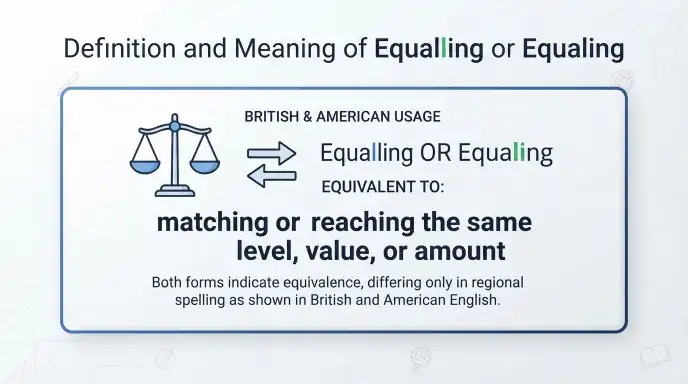
Equalling and equaling are the present participle and gerund forms of the verb equal.
The verb equal means to be the same as something in amount, value, size, quality, or level. Cambridge lists equalling as the present participle of equal.
Simple Meaning
In simple English, equalling/equaling means matching something or reaching the same level.
For example:
- Her score is equalling the previous record.
- His performance is equaling last year’s result.
- The new sales figure is equalling the company record.
- The American team is equaling its best result.
Context and Usage
These forms can appear in many contexts:
Sports:
The player is equalling the tournament record.
Business:
The company is equaling its highest sales figure.
Education:
The student is equalling the previous test score.
News:
The result equaled the record set last year.
Formal writing:
The current output is equalling the estimated demand.
The spelling depends on the variety of English being used, not on the meaning.
The Origin of Equalling or Equaling
The word equal has a long history. It entered English in the late 14th century and comes from Latin aequalis, meaning “uniform,” “identical,” or “equal.” The Latin word is related to aequus, meaning level or even.
The verb equal developed later. Its verbal use is recorded from the 16th century, with meanings connected to matching, comparing, or being equal to something.
The spelling difference between equalling and equaling developed from different English spelling conventions.
British English generally keeps the doubled l in forms such as:
- equal equalling
- travel travelling
- cancel cancelling
- model modelling
American English often uses a single l in these forms:
- equal equaling
- travel traveling
- cancel canceling
- model nmodeling
Therefore, equalling and equaling are not different words. They are regional spelling variants.
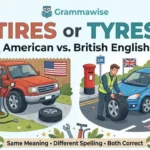
British English vs American English Spelling
The main difference is the number of l’s.
| Variety | Correct Form | Example |
| British English | equalling | She is equalling the record. |
| American English | equaling | She is equaling the record. |
| British English | equalled | He equalled the previous score. |
| American English | equaled | He equaled the previous score. |
Cambridge specifically identifies equalling as the UK form and equaling as the US form.
British English Rule
British English commonly doubles the final l before a suffix beginning with a vowel.
Examples:
- equal → equalling
- equal → equalled
- travel → travelling
- label → labelling
- model → modelling
American English Rule
American English commonly uses one l in these forms.
Examples:
- equal → equaling
- equal → equaled
- travel → traveling
- label → labeling
- model → modeling
This spelling pattern is also seen in other British and American English differences.
Which Spelling Should You Use?
The best choice depends on your audience.
Use “Equalling” for British English
Choose equalling if you are writing for readers in:
- The United Kingdom
- Ireland
- Australia
- New Zealand
- Other audiences that follow Britishifstyle spelling
Example:
The runner is equalling the national record.
Use “Equaling” for American English
Choose equaling when writing for a primarily American audience.
Example:
The runner is equaling the national record.
For Global Writing
If your website has an international audience, either form can be correct. The important point is consistency.
Do not switch between equalling and equaling randomly in the same document. Follow the spelling style used by the rest of your content.
Common Mistakes with Equalling or Equaling
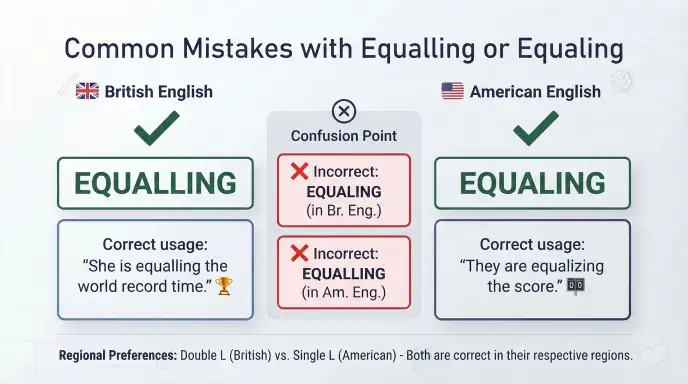
Several mistakes can cause confusion.
Mistake 1: Thinking “Equalling” Is Wrong
Incorrect assumption:
“Equalling” has two l’s, so it must be misspelled.
Correction:
Equalling is the standard British English spelling.
Mistake 2: Thinking “Equaling” Is Always Wrong
Incorrect assumption:
“Equaling” is missing an l.
Correction:
Equaling is the standard American English spelling.
Mistake 3: Mixing Styles
A writer may use equalling in one paragraph and equaling in another.
Better approach:
Choose one regional spelling style and use it consistently.
Mistake 4: Confusing “Equal” with “Equate”
Equal and equate are related but do not always work in the same sentence.
- The two amounts are equal.
- We should not equate the two situations.
Cambridge defines equate as considering one thing to be the same as or equal to another.
Equalling or Equaling in Everyday Examples
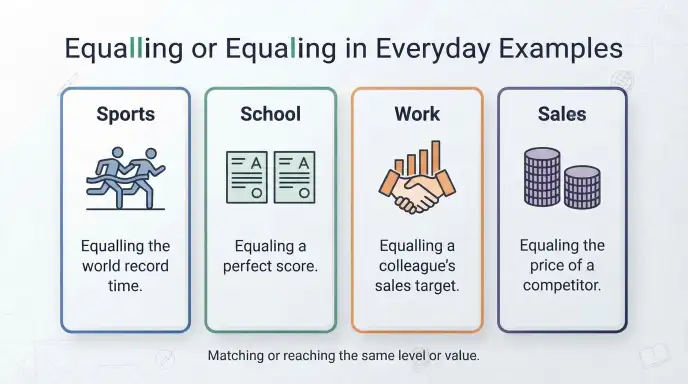
Both spellings can appear in everyday and professional writing.
In Emails
British English:
Our current sales are equalling last year’s results.
American English:
Our current sales are equaling last year’s results.
In News
British English:
The player is equalling a record that has stood for decades.
American English:
The player is equaling a record that has stood for decades.
On Social Media
British English:
We’re equalling our best score today!
American English:
We’re equaling our best score today!
In Formal Writing
British English:
The latest figures show that production is equalling previous levels.
American English:
The latest figures show that production is equaling previous levels.
In Sports
British English:
The team is equalling its bestifever performance.
American English:
The team is equaling its bestifever performance.
Equalling or Equaling Google Trends & Usage Data
Google Trends measures search interest, not the total number of words used in books, websites, or everyday speech. Google also allows users to compare search queries across locations and time periods.
For equalling and equaling, search interest can vary by region because the spellings are linked to different English varieties.
In general:
- Equalling is associated more strongly with Britishifstyle English.
- Equaling is associated more strongly with American English.
- Searches may also come from students, editors, writers, and people checking spelling differences.
- Search interest can change depending on the country, topic, and time period.
Google Trends should therefore be used as a guide to search behavior, not as a dictionary rule. A lower search interest score does not mean that a spelling is incorrect.
Equalling or Equaling Variations Compared
| Word or Form | British English | American English | Meaning |
| Present participle | equalling | equaling | Matching or reaching the same level |
| Past tense | equalled | equaled | Matched or reached the same level |
| Base verb | equal | equal | To be the same as |
| Adverb | equally | equally | In an equal way |
| Related verb | equate | equate | Consider something equal or equivalent |
The key difference is the doubled l in the British forms.
FAQs About Equalling or Equaling
Q1. What does equalling mean?
Equalling means matching something in amount, value, level, or quality.
It is the British English spelling of equaling.
Q2. How do you use equal in a sentence?
You can say, “The new record equals the previous record.”
Here, equals means that both records have the same result or value.
Q3. What is another word for “equaling”?
Common synonyms include matching, paralleling, corresponding to, and reaching.
The best synonym depends on the context and sentence.
Q4. What does “equalizing” mean?
Equalizing means making two things equal, balanced, or more even.
For example, “The team scored a goal, equalizing the match.”
Q5. Is it equaling or equalling?
Both spellings are correct: equaling is American English, while equalling is British English.
They have the same meaning and differ only in regional spelling.
Q6. What is another word for “equalizing”?
Synonyms for equalizing include balancing, leveling, evening out, matching, and equalizing.
The exact choice depends on if you mean balance, fairness, or making values equal.
Q7. What does “equalization” mean?
Equalization means the process of making things equal, balanced, or more even.
It is commonly used in areas such as finance, education, sound, and sports.
Q8. What are 10 good synonyms?
Ten useful synonyms are matching, balancing, leveling, paralleling, corresponding, equating, aligning, evening, rivaling, and attaining.
Choose the synonym that best fits the meaning and context of your sentence.
Q9. What is a synonym for “equalizer”?
A synonym for equalizer can be balancer, leveling device, or equalizing force.
In sports, an equalizer can also mean a goal or score that makes the game level.
Conclusion
Equalling and equaling are both correct English spellings. The difference is based on regional spelling conventions rather than meaning or grammar. Equalling is preferred in British English, while equaling is standard in American English.
Both forms come from the verb equal, which means to match or have the same amount, value, level, or result. The word has a long history, ultimately coming from Latin aequalis, meaning equal or uniform.
The easiest way to remember the difference is simple: British English normally keeps the double l in equalling, while American English normally uses one l in equaling. The same regional pattern appears in words such as travelled/traveled and modelling/modeling.
For professional writing, choose the form that matches your audience. If you are writing for readers in the UK or using British English, choose equalling. If your audience is mainly American, choose equaling. Most importantly, stay consistent throughout your article, email, report, or website.

I’m James Mitchell, an English language and grammar writer at Grammwise. I enjoy helping readers understand confusing words, spelling differences, grammar rules, and everyday English usage. My goal is to make English simple, clear, and easy to use with practical examples and straightforward explanations.

2 thoughts on “Equalling or Equaling: British vs American Spelling”