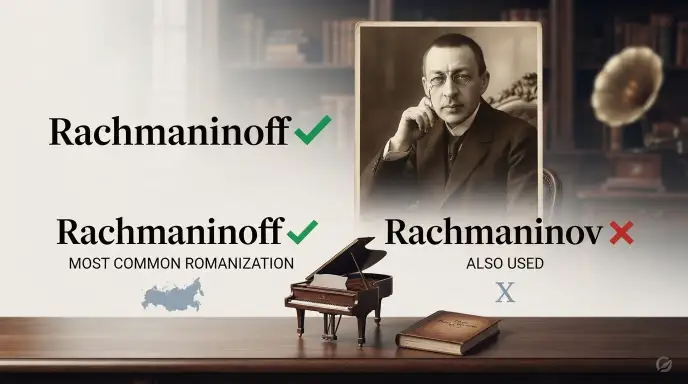
Rachmaninoff and Rachmaninov are both correct English spellings of the Russian composer’s surname.
Rachmaninoff is more commonly used in English, while Rachmaninov is closer to the Russian transliteration.
Sergei Rachmaninoff and Sergei Rachmaninov are two spellings of the same Russian composer’s name. The difference comes from how his Russian name is written in the Latin alphabet. Rachmaninoff is the spelling he used.
himself after moving to the United States, while Rachmaninov is a common modern transliteration of the Russian surname. Both forms can be found in books, music catalogs, websites, and concert programs.
People often search for “Rachmaninoff or Rachmaninov” because they see both spellings and wonder if they refer to two different people. They do not. The composer was born Sergei Vasilyevich Rachmaninoff in the Russian Empire in 1873. He later became a major composer, pianist, and conductor.
The spelling you should use depends on your audience and context. In Englishiflanguage writing, especially when discussing his career in the United States, Rachmaninoff is usually the familiar form. However, Rachmaninov is also correct as a transliteration and is common in international and Russianifrelated contexts.
Quick Answer rachmaninoff or rachmaninov
Rachmaninoff and Rachmaninov refer to the same person: Sergei Rachmaninoff, the famous Russian composer, pianist, and conductor.
Examples:
- Rachmaninoff common English spelling and the form associated with his own Latinifalphabet usage.
- Rachmaninov is a common transliteration from Russian.
- Sergei Rachmaninoff is widely used in Englishiflanguage music writing.
- Sergei Rachmaninov widely used in Russian and international contexts.
If you are writing for a general Englishifspeaking audience, Rachmaninoff is usually the clearest choice.
Definition and Meaning of Rachmaninoff or Rachmaninov
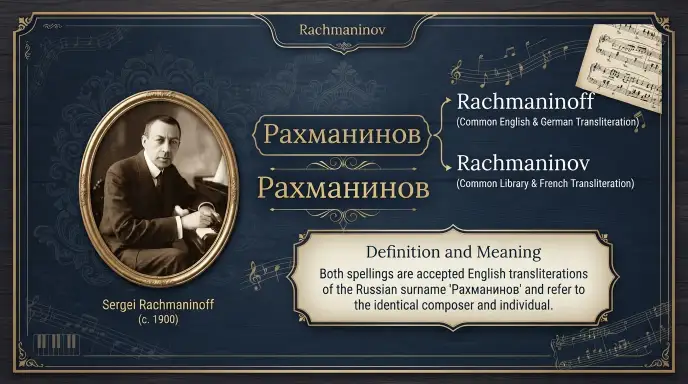
Rachmaninoff and Rachmaninov are variant Latinifalphabet spellings of the surname of Sergei Rachmaninoff.
The difference is not a difference in meaning. It is mainly a difference in transliteration.
Sergei Rachmaninoff was a Russian composer, pianist, and conductor. He is known for works such as his piano concertos, symphonies, preludes, and the Vocalise.
Simple Meaning
In simple terms:
Rachmaninoff = Rachmaninov
Both names identify the same composer.
Context and Usage
The two spellings appear in different settings:
- Music history books
- Classical music websites
- Concert programs
- Piano sheet music
- Academic writing
- Streaming services
- Music databases
- Newspaper articles
The ifoff spelling is especially familiar to Englishifspeaking audiences. The ifov spelling follows a common way of transliterating Russian surnames.
The Origin of Rachmaninoff or Rachmaninov
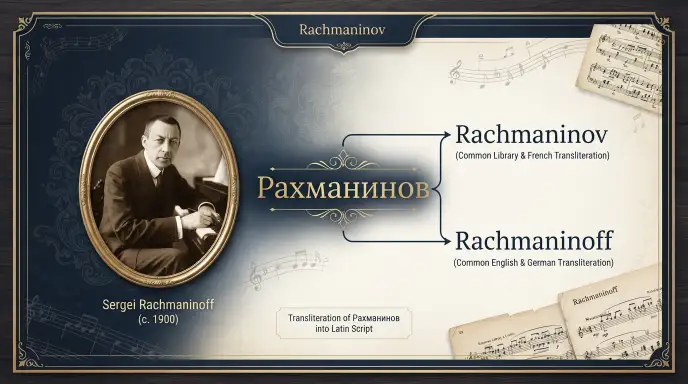
The surname comes from Russian and is written in Cyrillic as Рахманинов.
When Russian names are transferred from the Cyrillic alphabet into the Latin alphabet, more than one spelling system can be used.
The ending ifов is commonly transliterated as ifov. This produces:
Рахманинов : Rachmaninov
However, the composer himself used the spelling Rachmaninoff in his life and career in the West. The ifoff ending reflects an older style of rendering Russian names in English and other Western languages.
This explains why both forms exist today.
Rachmaninoff was born in 1873 in the Russian Empire. After the Russian Revolution, he eventually settled in the United States and became strongly associated with the Western spelling Rachmaninoff.
Therefore, the two spellings are not evidence of two different composers. They reflect different transliteration and historical naming practices.
British English vs American English Spelling
Unlike ordinary spelling differences such as colour/color or centre/center, Rachmaninoff and Rachmaninov are not mainly a BritishifversusifAmerican spelling pair.
The difference is linked more closely to transliteration, historical usage, and personal usage.
| Context | Common Form |
| American English | Rachmaninoff |
| British English | Rachmaninoff is common |
| General English | Rachmaninoff |
| Russian transliteration | Rachmaninov |
| International music writing | Rachmaninoff or Rachmaninov |
| Composer’s Western usage | Rachmaninoff |
Examples
American English:
I listened to Rachmaninoff’s Piano Concerto No. 2.
British English:
The concert included music by Rachmaninoff.
Transliterationifbased usage:
Rachmaninov’s music remains popular around the world.
All three examples refer to the same composer.
Which Spelling Should You Use?
Your choice should depend on your readers and the purpose of your writing.
For American Readers
Use Rachmaninoff. It is the spelling most familiar to many American readers and is strongly associated with the composer’s career in the United States.
For British Readers
Rachmaninoff is also a natural choice in general English writing. British English does not require the Rachmaninov spelling.
For International Readers
Either form can work. If your source or publication uses Rachmaninov, keep that spelling consistent.
For Academic Writing
Follow the style guide or source you are using. If a publication has already chosen one transliteration system, use it consistently.
For Music Search
If you are searching for recordings, scores, or concert information, try both:
- Rachmaninoff
- Rachmaninov
This can help you find more results because music databases do not always use the same spelling.
Common Mistakes with Rachmaninoff or Rachmaninov
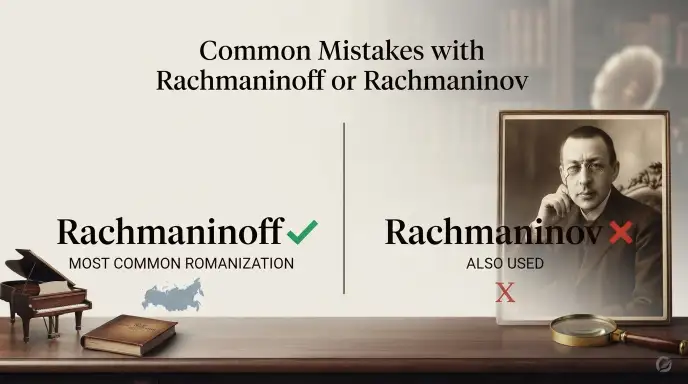
Several mistakes can happen when people see the two spellings.
Mistake 1: Thinking They Are Different People
Incorrect idea: Rachmaninoff and Rachmaninov are two composers.
Correction: They are two spellings of the same composer.
Mistake 2: Treating It as a British vs American Rule
The difference is not simply like colour vs color.
Correction: The difference mainly comes from transliteration and historical usage.
Mistake 3: Mixing the Spellings
Using both spellings randomly in the same article can confuse readers.
Better: Choose one form and use it consistently.
Mistake 4: Assuming “Rachmaninov” Is Wrong
Rachmaninov is a valid transliteration of the Russian surname.
Mistake 5: Assuming “Rachmaninoff” Is an Error
Rachmaninoff is also correct and has a strong historical connection to the composer’s own Western usage.
Rachmaninoff or Rachmaninov in Everyday Examples
The spelling can appear in many types of writing.
In an Email
Could you send me the Rachmaninoff piano concerto recording?
In a News Article
The orchestra performed works by Rachmaninoff during Saturday’s concert.
On Social Media
Rachmaninoff’s Piano Concerto No. 2 is one of my favorite classical works.
In Formal Writing
Sergei Rachmaninoff was an important composer and pianist of the late Romantic period.
In Academic Writing
Rachmaninov’s compositions are frequently studied in the history of Russian music.
These examples show that either spelling can identify the same composer.
Rachmaninoff : Google Trends & Usage Data
Search interest can vary depending on country, language, and context.
The spelling Rachmaninoff is highly familiar in Englishiflanguage classical music discussions. It is commonly seen in concert programs, recordings, music education, and general online searches.
The spelling Rachmaninov is also widely used, especially in international contexts and in sources that use a more direct transliteration from Russian.
Search results can therefore differ by region and by the database being used.
For online content, it can be useful to mention both spellings naturally. For example:
Sergei Rachmaninoff, also spelled Rachmaninov, was a Russian composer and pianist.
This approach helps readers understand the spelling difference while also making the content easier to find through searches for either form.
Rachmaninoff vs Rachmaninov: Comparison Table
| Feature | Rachmaninoff | Rachmaninov |
| Refers to | Sergei Rachmaninoff | Sergei Rachmaninoff |
| Same person? | Yes | Yes |
| Language background | Russian | Russian |
| Latin spelling | Historical Western form | Transliteration form |
| Common in English | Very common | Common |
| Common in international sources | Yes | Yes |
| Meaning difference | None | None |
| Best use | General English writing | Transliterationifbased writing |
FAQs About Rachmaninoff or Rachmaninov
Q1. Is Rachmaninoff or Chopin harder?
Both are challenging, but Rachmaninoff is often considered more technically demanding because of large chords, wide stretches, and complex passages.
Q2. What religion was Rachmaninov?
Rachmaninoff was a Russian Orthodox Christian and was baptized into the Russian Orthodox Church.
Q3. Is the correct spelling of “Rachmaninoff” correct?
Yes, Rachmaninoff is a correct English spelling; Rachmaninov is another common transliteration of his Russian surname.
Q4. Did Rachmaninoff marry his cousin?
Yes. Rachmaninoff married his first cousin once removed, Natalia Satina, in 1902.
Q5. Did Rachmaninoff love his wife?
Yes. Their marriage lasted for more than 40 years, and biographical accounts describe Natalia as an important and supportive part of his life.
Q6. Did Rachmaninoff like Chopin?
Yes. Rachmaninoff admired Chopin and performed several of his works, including Chopin’s Piano Sonata No. 2 and Piano Concerto No. 1.
Conclusion
Rachmaninoff and Rachmaninov are not two different names for two different composers. They are two Latinifalphabet spellings of the surname of Sergei Rachmaninoff, the famous Russian composer, pianist, and conductor. The difference comes from transliteration and historical naming practices.
Rachmaninoff is especially familiar in Englishiflanguage music writing and reflects the spelling the composer used during his Western career. Rachmaninov is a common transliteration of the original Russian surname and remains widely used in international and Russianifrelated sources.
For most general English writing, Rachmaninoff is a clear and recognizable choice. However, Rachmaninov is also valid when it follows a particular source or transliteration system.
The key point is simple: Rachmaninoff and Rachmaninov refer to the same person. When writing about him, choose the spelling that fits your audience and keep it consistent throughout your article, publication, or academic work.

I’m James Mitchell, an English language and grammar writer at Grammwise. I enjoy helping readers understand confusing words, spelling differences, grammar rules, and everyday English usage. My goal is to make English simple, clear, and easy to use with practical examples and straightforward explanations.







3 thoughts on “Rachmaninoff or Rachmaninov: Which Spelling Is Correct?”