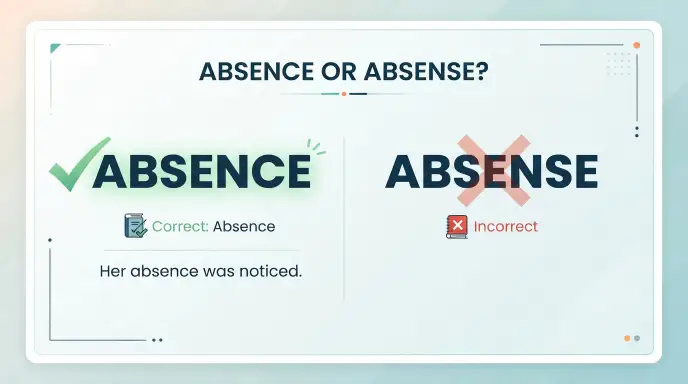
The correct spelling is absence, not absense. “Absence” is the standard English noun for being away, not being present, or lacking something. “Absense” is a common spelling mistake and is not an accepted English word.
People often search for “absence or absence” because both forms sound very similar when spoken. The final sound can make “absense” look natural, especially for English learners, students, and people writing quickly. The key is to remember that the correct spelling uses ifence, not ifense.
This small spelling difference matters in schoolwork, emails, reports, applications, and professional writing. Using the correct form helps your writing look clear and polished“Absence” can describe a person.
who is not present, a period of time away, or a lack of something. For example, you can say, “Her absence was noticed,” or “The absence of evidence made the case difficult.”
There is also no BritishifversusifAmerican spelling difference here. Both varieties use absence.
Quick Answer absence or absense
Absence is the correct spelling. Absense is incorrect.
Examples:
- Correct: His absence from class was recorded.
- Correct: We noticed the absence of clear evidence.
- Incorrect: His absense from class was recorded.
- Incorrect: The absense of evidence was surprising.
The simple rule is:
Absence = correct
Absense = misspelling
Definition and Meaning of Absence or Absense
Absence
Absence is a noun. It means the state of being away or not being present. It can also mean that something is missing or lacking.
For example:
Her absence from work was unexpected.
It can also describe a lack of something:
The absence of noise made the room feel peaceful.
Simple Meaning
In simple words, absence means “not being there.”
It may describe:
- A person who is away
- A student who does not attend class
- An employee who is away from work
- Something that is missing
- A lack of evidence, support, or information
Different Contexts
Physical absence:
His absence from the meeting was noticed.
School absence:
The teacher recorded her absence.
Work absence:
Please explain your absence from work.
Lack of something:
There was an absence of clear instructions.
Mental absence:
His absence of attention caused a mistake.
The opposite of absence is generally presence
The Origin of Absence or Absense
The word absence has a long history. It entered English through Old French and comes from the Latin absentia, which was related to absens, meaning “being away” or “absent.”
The Latin verb abesse meant “to be away.” It was formed from abif, meaning “away” or “from,” and esse, meaning “to be.
The word appeared in English in the late Middle English period.
The spelling absense does not represent a separate historical form of the English word. It is a spelling error. The mistake likely happens because the ending sounds like ifsense when spoken.
A useful connection is:
- absent → absence
- present → presence
Both absence and presence use the ifence ending.
British English vs American English Spelling
There is no spelling difference between British and American English for this word.
| English Variety | Correct Spelling | Example |
| British English | absence | Her absence was noticed. |
| American English | absence | Her absence was noticed. |
| Canadian English | absence | His absence was recorded. |
| Australian English | absence | Her absence was explained. |
| Commonwealth English | absence | The absence was unexpected. |
Dictionaries list absence in both British and American English.
So, unlike words such as colour/color or centre/center, you do not need to change the spelling based on your audience.
Examples in British English
The student’s absence was recorded.
There was an absence of evidence.
Examples in American English
The student’s absence was recorded.
There was an absence of evidence.
Both versions use exactly the same spelling.
Which Spelling Should You Use?
Use absence in all standard English writing.
For US Readers
Use:
absence
Do not use:
absense
For UK and Commonwealth Readers
Use:
absence
The spelling remains the same in British English and Commonwealth varieties.
For a Global Audience
Absence is the safest and correct form for international English.
Use it in:
- Emails
- School assignments
- Business documents
- Websites
- Applications
- Reports
- Social media
- Academic writing
There is no standard English situation where absense should replace absence.
Common Mistakes with Absence or Absense
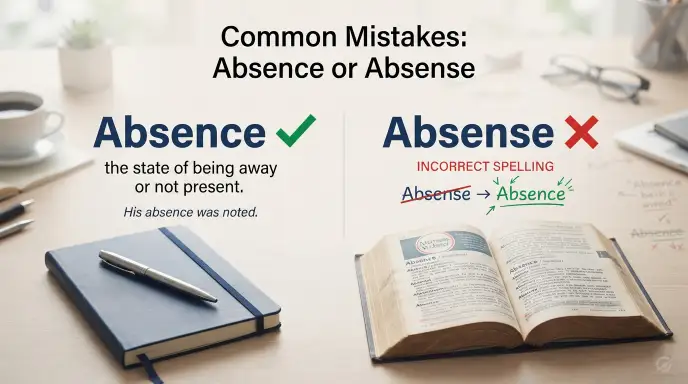
The most common mistake is replacing ifence with ifense.
Mistake 1: Writing “Absense”
Incorrect:
Her absense was noticed.
Correct:
Her absence was noticed.
Mistake 2: Using “Absense” in Formal Writing
Avoid this spelling in:
- Resumes
- Cover letters
- Emails
- Reports
- Essays
- Applications
Always write in my absence.
Mistake 3: Confusing the Sound
The word may sound like it ends in a way that suggests ifsense. This can lead writers toward absense.
Easy Memory Trick
Remember:
Absence has “C” before “E.”
Think:
absen + ce = absence
You can also connect it with presence:
presence
absence
Both words end in ifence.
Absence or Absence in Everyday Examples
In Emails
Correct:
Please let me know the reason for your absence.
Correct:
I apologize for my absence from yesterday’s meeting.
In News Writing
Correct:
The absence of evidence raised questions.
News and formal writing use absence when describing something missing or unavailable.
On Social Media
Correct:
We missed you during your absence!
Correct:
Your absence was definitely noticed today.
In Formal Writing
Correct:
In the absence of additional information, the decision was delayed.
The phrase “in the absence of” is common in formal and professional English.In School Writing
Correct:
The teacher recorded three absences this month.
The plural form is absences.
Absence or Absense : Google Trends & Usage Data
Searches for “absence or absense” usually come from people checking which spelling is correct. The spelling absence is the standard form used in dictionaries and edited English, while absense is treated as a misspelling.
Search interest can vary by country and context. Spelling questions are especially relevant for:
- English learners
- Students
- Workplace writers
- People writing leave applications
- People preparing formal documents
The important point is that search activity for absence should not be confused with accepted usage. A word can appear in search queries because people are asking if it is correct.
For professional writing, dictionaries and standard usage consistently support absence.
Absence or Absence Comparison Table
| Feature | Absence | Absense |
| Correct spelling | Yes | No |
| Standard English word | Yes | No |
| Dictionary entry | Yes | No |
| Meaning | Being away or lacking something | None as a standard English word |
| British English | Correct | Incorrect |
| American English | Correct | Incorrect |
| Formal writing | Correct | Incorrect |
| Academic writing | Correct | Incorrect |
| Plural | Absences | — |
| Related adjective | Absent | — |
FAQs About Absence or Absence
1. Is it absence or absence?
The correct spelling is absence. Absence is a spelling mistake.
2. Is absence a real English word?
No. Absence is not the standard English spelling. Use absence instead.
3. Why do people spell absence as absence?
The mistake happens because the word’s pronunciation can make the ifence ending difficult to identify. Writers may replace it with ifense.
4. Is absence spelled differently in British English?
No. British English uses absence, just like American English.
5. What does absence mean?
Absence means the state of being away or not being present. It can also mean a lack of something.
6. What is the plural of absence?
The plural is absence.
Example:
The school recorded several absences this month.
7. What is the difference between absence and absence?
Absent is usually an adjective describing someone or something that is not present.
Absence is a noun describing the state or period of not being present.
Example:
She was absent from school.
Her absence was recorded.
Conclusion
When choosing between absence or absence, always use absence. It is the standard English spelling in British, American, and other major varieties of English. Absense is a common spelling mistake, not an accepted alternative.
The word absence means being away, not being present, or lacking something. You can use it for people, places, events, objects, evidence, information, and other things that are missing. Its history goes back through Old French to the Latin absentia, which helps explain its traditional ifence spelling.
For everyday writing, remember the simple rule: absence is correct; absence is incorrect. If you are writing an email, school assignment, report, application, or professional document, choose absence. A helpful memory trick is to connect it with presence, because both words end in ifence. Once you remember this pattern, the spelling becomes much easier to use correctly.
Meta Description: Absence or absense: learn the correct spelling, meaning, origin, examples, British and American usage, common mistakes, and easy tips for writing.

Hi, I’m Dylan Foster. I’m a passionate writer who enjoys creating clear, helpful, and engaging content. My goal is to provide readers with simple answers and useful information on a wide range of topics.



3 thoughts on “Absence or Absense: Which Spelling Is Correct?”