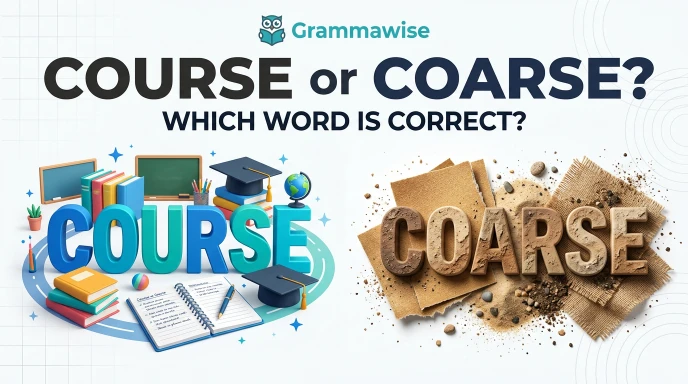
Course and coarse are both correct words, but they have different meanings. Course usually means a class, a path, or a part of a meal. Coarse means rough, harsh, or made of large pieces. Both words sound the same, so people often mix them up when writing.
Have you ever wondered if to write “English course” or “English coarse”? The correct phrase is “English course” because it refers to a class where people learn English. However, you can use “coarse sand” to describe sand with large grains.
This spelling confusion is common in emails, schoolwork, online posts, and professional writing. A small mistake can change the meaning of a sentence. It can also make your writing less clear.
In this guide, you will learn the meaning of course and coarse, their origins, and how to use each word correctly. You will also see simple examples, spelling tips, and answers to common questions. By the end, you will know which word to choose in different situations and avoid common writing mistakes.
Quick Answer: Course or Coarse
The correct word depends on what you want to say. Use course for a class, route, direction, or stage of an activity. Use coarse for something rough, harsh, or made of large particles.
Examples
- Course: I enrolled in a writing course.
- Coarse: This cloth feels coarse.
- Course: The runner followed the race course.
- Coarse: Coarse salt has large grains.
- Course: We had soup as the first course.
- Coarse: His coarse language upset the guests.
Quick tip: If you mean a class or a path, use course. If you mean rough or not fine, use coarse.
Definition and Meaning of Course or Coarse
Course refers to a class, route, sequence, or part of a meal, while coarse describes something rough, harsh, or made of large particles.
What Does Course Mean?
The word course has several meanings. Its meaning depends on the sentence.
1. A class or program of study
A course is a series of lessons that help people learn a subject or skill.
Example: She joined a computer course.
2. A route or path
Course can describe the direction taken by a person, vehicle, river, or other moving thing.
Example: The boat changed its course.
3. A series of events
Course can refer to how something develops over time.
Example: The illness ran its course.
4. A part of a meal
A course is one part of a meal, such as a starter, main dish, or dessert.
Example: Dessert was the final course.
5. A usual or expected action
The phrase “of course” means certainly or naturally.
Example: Of course, I will help you.
What Does Coarse Mean?
The word coarse describes something that is rough, harsh, or not fine in texture or quality.
1. Rough in texture
Example: The towel feels coarse against my skin.
2. Made of large particles
Example: Coarse sand is often used in construction.
3. Harsh or offensive
Example: He used coarse language during the argument.
4. Lacking refinement
Example: The joke was too coarse for a formal event.
When Should You Use Each Word?
Use course when talking about learning, routes, meals, or the development of events. Use coarse when describing texture, particle size, language, or behavior that lacks refinement.
Remember that these words sound alike, but their meanings are different.
The Origin of Course or Coarse
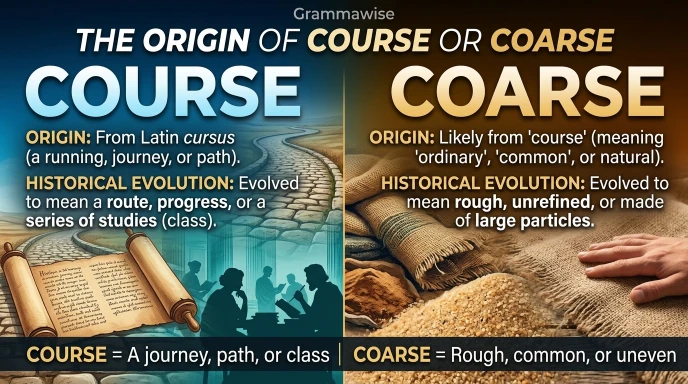
Course and coarse developed from different word histories, even though they now sound alike.
The Origin of Course
The word course came into English through Old French cours, from Latin cursus, meaning a running, movement, or journey. Over time, its meaning expanded to include a route, a sequence of events, and a program of study.
Today, people use courses in education, sports, travel, cooking, and everyday conversation.
Examples include:
- A training course
- A golf course
- The course of history
- A threeifcourse meal
The Origin of Coarse
The word coarse developed from older English forms influenced by Scandinavian language history. It came to describe things that were rough, largeifgrained, or lacking refinement.
Its modern meanings include rough fabric, coarse sand, and coarse language.
Why Are Course and Coarse Confused?
The main reason is pronunciation. In most varieties of English, course and coarse sound the same. This makes them homophones: words that sound alike but have different meanings and spellings.
Their similar sounds can cause mistakes in writing, especially when people rely on pronunciation instead of context.
Remember: The words have different meanings, so the sentence tells you which spelling to use.
British English vs American English Spelling
Both British and American English use course and coarse with the same spellings and meanings.
Unlike words such as colour and color, these words do not have different standard spellings in the UK and the US.
Comparison Table
| Meaning | British English | American English | Example |
| A class | Course | Course | I took a history course. |
| A route | Course | Course | The ship changed course. |
| A meal stage | Course | Course | The main course was delicious. |
| Rough texture | Coarse | Coarse | The fabric feels coarse. |
| Large particles | Coarse | Coarse | Use coarse salt. |
| Harsh language | Coarse | Coarse | Avoid coarse language. |
Examples in British English
- She is studying an English course.
- The path follows the river’s course.
- The fabric is too coarse for this dress.
Examples in American English
- He signed up for a business course.
- The runner stayed on course.
- This sand is too coarse for the project.
The spellings stay the same in both countries. Only pronunciation and some usage preferences may vary by region.
Which Spelling Should You Use?
Choose a course or course based on the meaning you want to express, not the country where your readers live.
For American Readers
Use course for classes, routes, meals, and sequences of events. Use coarse for rough textures, large particles, or harsh language.
Example: I enrolled in a cooking course and learned how to use coarse salt.
For British Readers
Follow the same rule. British English uses both words with the same meanings and spellings as American English.
Example: The college offers a science course, while the path has a coarse gravel surface.
For Global Readers
If you write for an international audience, focus on clear wording and correct context. These spellings do not change between standard British and American English.
Professional Writing Advice
Before publishing an article, email, report, or school assignment, check the sentence’s meaning.
- If you mean education, write course.
- If you mean a route, write course.
- If you mean rough texture, write coarse.
- If you mean large grains, write coarse.
A spelling checker may not catch this error because both words are valid. Always check the context.
Common Mistakes with Course or Coarse
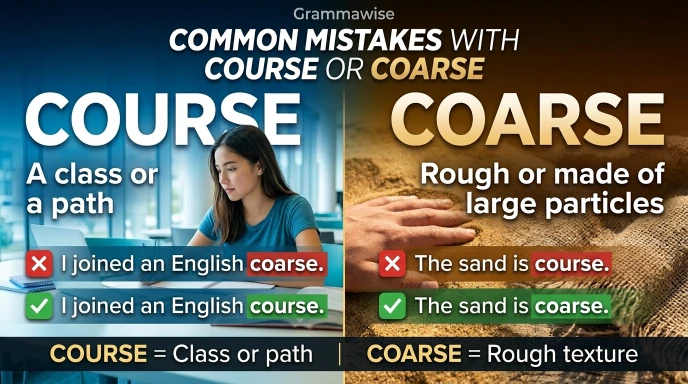
The most common mistake is using one word when the other is needed. Since both words are correct, grammar tools may not identify the intended meaning.
Mistake 1: Writing “Coarse” for a Class
Incorrect: I signed up for a computer coarse.
Correct: I signed up for a computer course.
Why? A course is a program of lessons.
Mistake 2: Writing “Course” for Rough Material
Incorrect: This fabric has a course texture.
Correct: This fabric has a coarse texture.
Why? Coarse describes something rough.
Mistake 3: Confusing Coarse Sand with Course Sand
Incorrect: The builder ordered course sand.
Correct: The builder ordered coarse sand.
Why? Coarse describes sand with larger grains.
Mistake 4: Misspelling “Of Course”
Incorrect: Of coarse, I can help you.
Correct: Of course, I can help you.
Why? The phrase “of course” means certainly.
Mistake 5: Using Course for Harsh Language
Incorrect: The speaker used course words.
Correct: The speaker used coarse words.
Why? Coarse can describe rude or offensive language.
Easy Ways to Remember
- Course = class or path. Think of a school course or a race course.
- Coarse = rough. Think of coarse sand or rough fabric.
Read the whole sentence before choosing the spelling. This simple habit can prevent many mistakes.
Course or Coarse in Everyday Examples

Both words appear in daily conversations, emails, news reports, social media posts, and formal writing.
1. In Emails
Correct examples:
- I would like to enroll in your writing course.
- Of course, I will send the report today.
- Please confirm the course schedule.
These sentences use course to refer to learning or to express agreement.
2. In News Reports
Correct examples:
- The university introduced a new online course.
- The river changed its course after heavy rainfall.
- Experts warned that coarse particles may affect the final product.
News writing uses course for programs and directions, and coarse for physical characteristics.
3. On Social Media
Correct examples:
- I just finished my first photography course!
- Of course, coffee makes my morning better.
- Why does this sweater feel so coarse?
Use the word that matches the intended meaning, even in short posts.
4. In Formal Writing
Correct examples:
- The training course will begin next Monday.
- The study examined the course of economic change.
- The laboratory used coarse material during the first stage of testing.
Formal writing needs clear and precise word choices.
5. In Everyday Conversation
Correct examples:
- Which course are you taking this year?
- This towel feels coarse.
- Of course, you can sit here.
These examples show how easily both words fit into ordinary speech and writing.
Course or Coarse : & Usage Data
Course and coarse are both established English words, but their popularity depends on the subject and context.
How Is Course Used?
Course appears frequently in education, career training, sports, food, and discussions about events. Online searches often include phrases such as:
- English course
- Online course
- Training course
- Golf course
- Main course
The word also appears in the common phrase “of course.”
How Is Coarse Used?
Coarse is more common in descriptions of materials, textures, particles, and language. Common search phrases include:
- Coarse sand
- Coarse salt
- Coarse hair
- Coarse language
- Coarse texture
Which Word Is More Popular?
Course is used across a wider range of everyday topics, so it is generally the more common word in ordinary English. Coarse is more specialized and appears often in specific contexts.
However, exact search interest varies by region and time. Without a live comparison, specific percentages, rankings, or countryifbyifcountry figures should not be claimed.
What About British and American Usage?
Both words are standard in the United States, the United Kingdom, Canada, Australia, and other Englishif speaking regions. Their spellings do not change between these varieties.
For current regional interest, compare the exact terms in and select your target country and time range.
Course or Coarse : Comparison Table
This table summarizes the key differences between the two words.
| Feature | Course | Coarse |
| Main meaning | Class, route, sequence, or meal stage | Rough, largeifgrained, or harsh |
| Part of speech | Noun; also a verb in some uses | Adjective |
| Common phrase | Online course | Coarse sand |
| Education | A course in English | Not used for a class |
| Texture | Not the usual word for roughness | Coarse fabric |
| Meal | Main course | Not used for a meal stage |
| Language | Not the usual word for offensive speech | Coarse language |
| Example | The course starts today. | The surface feels coarse. |
| Spelling variation | Same in US and UK English | Same in US and UK English |
Key point: Course names a thing or process, while coarse usually describes a quality or characteristic.
Frequently Asked Questions (FAQs)
Q1. Is the course or course correct?
Both are correct spellings, but they have different meanings. Use a course for a class or route and course for something rough or largeifgrained.
Q2. What is the difference between course and coarse?
Course can mean a class, path, sequence, or meal stage. Coarse describes rough texture, large particles, or harsh language.
Q3. Is it “of course” or “of coarse”?
The correct phrase is “of course.” It means certainly or naturally, as in “Of course, I can help.”
Q4. Is it an English course or English coarse?
The correct phrase is “English course.” It refers to lessons that teach the English language.
Q5. Is coarse sand or course sand correct?
“Coarse sand” is correct when describing sand with large grains. Coarse refers to particle size and texture.
Q6. Do British and American English spell courses and courses differently?
No. Both varieties use course and coarse with the same spellings and meanings.
Q7. How can I remember course vs coarse?
Remember that course is linked to a class or path, while coarse is linked to roughness. Think of a school course and coarse sand.
Q8. Can course and coarse sound the same?
Yes. In most English accents, they are homophones. They sound alike but have different meanings and spellings.
Conclusion
Course and coarse are easy to confuse because they sound alike, but their meanings are different. Course refers to a class, route, sequence of events, or part of a meal. You can take a course at college, follow a course through a race, or enjoy the main course at dinner.
Coarse describes something rough, largeifgrained, harsh, or lacking refinement. You might describe coarse sand, coarse fabric, or coarse language.
Neither spelling is wrong on its own. The correct choice depends on the sentence and the meaning you want to express. British and American English use both words in the same way, so you do not need to change their spelling for different audiences.
To avoid mistakes, remember this simple rule: course means a class or path, while coarse means rough. Check the context before you publish an email, article, report, or social media post. Since both words are valid English words, a spelling checker may not catch the mistake. Choosing the right word will make your writing clearer, more accurate, and more professional.

I’m James Mitchell, an English language and grammar writer at Grammwise. I enjoy helping readers understand confusing words, spelling differences, grammar rules, and everyday English usage. My goal is to make English simple, clear, and easy to use with practical examples and straightforward explanations.




1 thought on “Course or Coarse: Which Spelling Is Correct?”