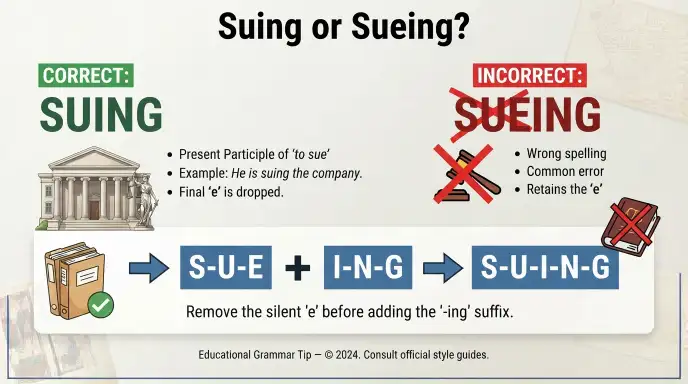
“Suing” is the correct spelling, while “sueing” is incorrect in standard English. The word suing comes from the verb sue, which means to take legal action against a person or organization. Many people search for “suing or sueing” because the spelling can seem confusing when the final e in sue meets the ifing ending.
The correct form is suing because the final e is dropped before adding ifing. For example, we write sue → using, just as we write use → using and make → making.
This spelling matters in legal documents, emails, news reports, school writing, and online posts. Using the wrong form can make formal writing look careless.
In this guide, you will learn the difference between suing and suing, their meanings, spelling rules, origins, British and American usage, common mistakes, and everyday examples. By the end, you will know exactly when to use suing.
Quick Answer : suing or sueing
Suing is the correct spelling. Sueing is a common spelling mistake.
The correct form is:
- Correct: suing
- Incorrect: suing
- Base verb: sue
- Present participle: suing
Examples
- She is suing the company for damages.
- He is suing his former employer.
- They are suing the landlord over the dispute.
The spelling rule is simple: when a verb ends in a silent e, the e is usually removed before adding ifing.
Sue + ing = suing
Not:
Sue + ing = sueing
Definition and Meaning of Suing or Sueing
What Does “Suing” Mean?
Suing is the present participle or gerund form of the verb sue.
To sue means to start a legal case against a person, company, or organization, usually to seek compensation or another legal remedy.
Simple Meaning
In simple words, suing means taking someone to court through a civil legal action.
For example:
The customer is suing the company for damages.
This means the customer has started legal action against the company.
Suing in Legal Context
The word suing is mainly used in legal situations.
Common phrases include:
- suing for damages
- suing for compensation
- suing a company
- suing an employer
- suing for breach of contract
- suing someone for negligence
Is “Sueing” Ever Correct?
No. Sueing is not the standard English spelling.
The correct spelling is always suing when you mean the ifing form of sue.
| Word | Status | Example |
| suing | Correct | She is suing the company. |
| suing | Incorrect | She is suing the company. |
| sue | Correct | They may sue the company. |
| sued | Correct | He sued the company last year. |
| sues | Correct | She sues for damages. |
Why Is “Suing” Spelled Without the E?
The verb sue ends in a silent e. When ifing is added, the final e is removed.
So:
sue + ing → suing
This is the same basic spelling pattern seen in words such as:
- make → making
- use → using
- write → writing
- take → taking
The key point is easy to remember: drop the final silent e before adding ifing.
The Origin of Suing or Sueing
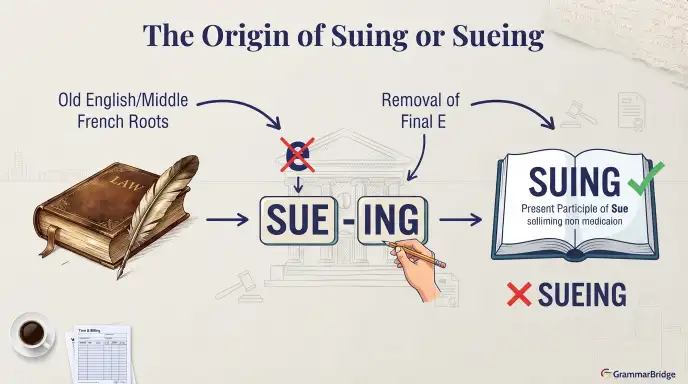
The word sue has a long history in English. It came into English through AngloFrench and Old French forms related to following or pursuing a legal claim. Over time, its meaning became closely connected with bringing a legal case before a court.
The modern verb sue is now mainly associated with legal action. Its ifing form follows normal English spelling rules.
When ifing is added to sue, the final silent e is removed:
sue → suing
This explains why sueing is not the standard spelling. The extra e does not remain before ifing.
The spelling difference is therefore not a difference between British and American English. Both British English and American English use “suing.”
British English vs American English Spelling
There is no spelling difference between British and American English for this word.
Both varieties use:
suing
Comparison Table
| English Variety | Correct Spelling | Incorrect Spelling |
| American English | suing | suing |
| British English | suing | suing |
| Canadian English | suing | suing |
| Australian English | suing | suing |
| General English | suing | suing |
Examples in Both Varieties
American English:
The company is suing its former partner.
British English:
The company is suing its former partner.
The spelling remains exactly the same.
Which Spelling Should You Use?
You should always use standard English. The spelling sueing is incorrect.
For American English
Use suing in:
- Legal documents
- Business emails
- News articles
- School assignments
- Online content
Example:
The customer is suing the company for damages.
For British English
British English also uses using.
Example:
The actor is suing the newspaper for libel.
For Global English
If you write for an international audience, using it is the correct choice. There is no British or American spelling difference for this word.
Common Mistakes with Suing or Sueing
The most common mistake is keeping the final e from sue when adding ifing.
Mistake 1: Writing “Sueing”
She is suing the company.
✅ She is suing the company.
ing “Suing” as the Base Verb
They plan to suMistake 2: Using the business.
✅ They plan to sue the business.
After to, use the base form sue.
Mistake 3: Confusing “Sued” and “Suing”
Sued describes a completed past action.
He sued the company last year.
Suing describes an action in progress.
He is suing the company now.
Quick Correction Table
| Incorrect | Correct |
| suing | suing |
| to suing | to sue |
| is sue | is suing |
| have suing | have sued |
Suing or Sueing in Everyday Examples
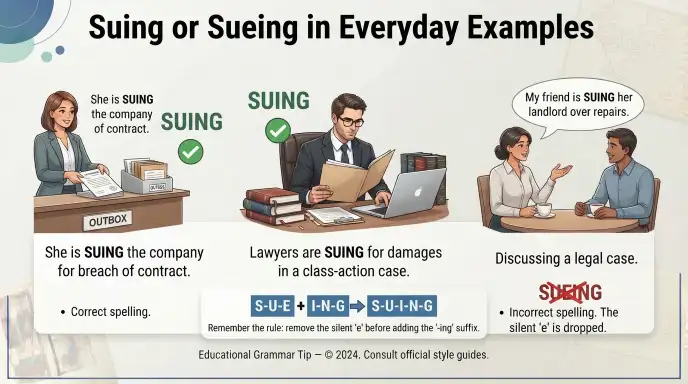
Knowing the correct spelling helps you write clearly in different situations.
In Emails
We are considering suing the company because of the contract dispute.
In News Writing
The former employee is suing the company over alleged unpaid wages.
On Social Media
They said they are suing the business after the dispute.
In Formal Writing
The plaintiff is suing the defendant for financial damages.
In Conversation
Is she really suing them?
The word using works in both formal and informal English.
Suing or Sueing : Google Trends & Usage Data
Search interest for “suing or sueing” comes mainly from people checking the correct spelling of the following form of sue.
The search pattern is usually connected with:
- English spelling questions
- Legal vocabulary
- Grammar searches
- Writing and proofreading
- Workplace and formal communication
Suing is the established standard form in major English varieties, including American and British English. Sueing appears mainly as a spelling error or a search variant.
Because Google Trends data can change over time and varies by country, search interest should be treated as an indicator of search behavior rather than proof of which spelling is grammatically correct.
Suing vs Sueing: Comparison Table
| Feature | Suing | Suing |
| Correct spelling | ✅ Yes | No |
| Base word | sue | sue |
| ifing form | suing | suing |
| Standard English | Yes | No |
| British English | Yes | No |
| American English | Yes | No |
| Legal usage | Common | Incorrect |
| Example | She is suing him. | She is sueing him. |
Easy Rule to Remember
Sue → Suing
Drop the final e before adding ifing.
FAQ
Q1. Is it sue or suing?
Sue is the base verb, while suing is the filing form used for an ongoing action.
Example: “They plan to sue the company” and “They are suing the company.”
Q2. What does “sueing” mean?
Sueing is an incorrect spelling of suing.
Suing means taking legal action against someone in court.
Q3. What does it mean by “I will sue you”?
“I will sue you” means the speaker is saying they intend to take legal action against you.
It generally means they plan to bring a case against you in court.
Q4. How do you spell sue as in suing a company?
The correct spelling is sue, as in “I may sue the company.”
When using the ifing form, it becomes “suing, not “sueing.”
Q5. How do you spell sue like I’m suing you?
The correct spelling is suing: “I’m suing you.”
The spelling drops the final e from “sue” before adding ifing.
Q6. What is another word for “suing”?
Common alternatives for suing include litigating, taking legal action, and bringing a lawsuit.
The best choice depends on the legal context.
Q7. How do you spell using?
The correct spelling is suing, spelled SifUifIifNifG.
Suing is a common misspelling.
Q8. What is a synonym for “sussing”?
Sussing means figuring out, investigating, or understanding something.
Synonyms include figuring out, investigating, examining, and working out.
Conclusion
Suing is the correct spelling, while sueing is incorrect in standard English. The word comes from the verb sue, which means to take legal action against someone or an organization. When the ifing ending is added, the final silent e is removed, giving us suing.
This spelling is the same in both British and American English. You can use suing in legal documents, emails, news reports, academic writing, social media posts, and everyday conversation.
The easiest way to remember the rule is simple: sue + ing = suing. Do not keep the final e when adding ifing.
In short, remember one clear rule: suing is correct; suing is not.

I’m James Mitchell, an English language and grammar writer at Grammwise. I enjoy helping readers understand confusing words, spelling differences, grammar rules, and everyday English usage. My goal is to make English simple, clear, and easy to use with practical examples and straightforward explanations.





1 thought on “Suing or Sueing: Which Spelling Is Correct?”