“Arrive” is the correct spelling, while “arive” is an incorrect spelling. Many people search for “arive or arrive” because the word is pronounced quickly, making it easy to forget that “arrive” has two r’s. This small spelling mistake can appear in emails, schoolwork, messages, social media posts, and formal writing.
The word arrive is a common English verb. It means to reach a place, destination, or point at the end of a journey. For example, you can say, “We will arrive at the airport at 8 p.m.” The spelling arive is not the standard English spelling and should not be used in normal writing.
Knowing the correct form is useful because spelling errors can make otherwise clear writing look careless. The good news is that the difference is simple: always use “arrive” with double r. In this guide, you will learn the meaning, origin, spelling rules, common mistakes, examples, and correct usage of arive or arrive.
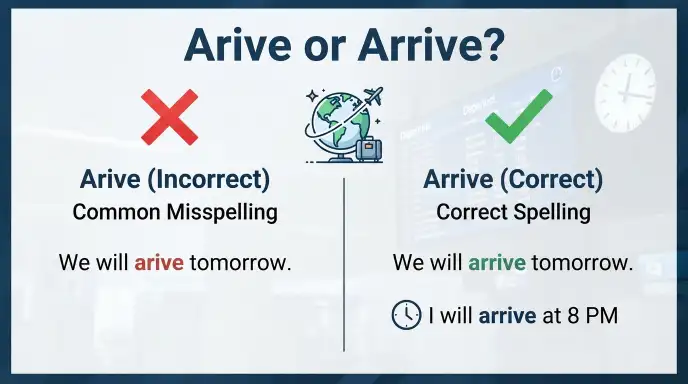
Quick Answer : arive or arrive
Arrive is the correct spelling. Arive is an incorrect spelling.
- ❌ Arive
- ✅ Arrive
Arrive means to reach a place or destination.
Examples:
- We will arrive at the station soon.
- Please arrive before 9 a.m.
- The package should arrive tomorrow.
The easiest way to remember the spelling is to remember the double r in arrive.
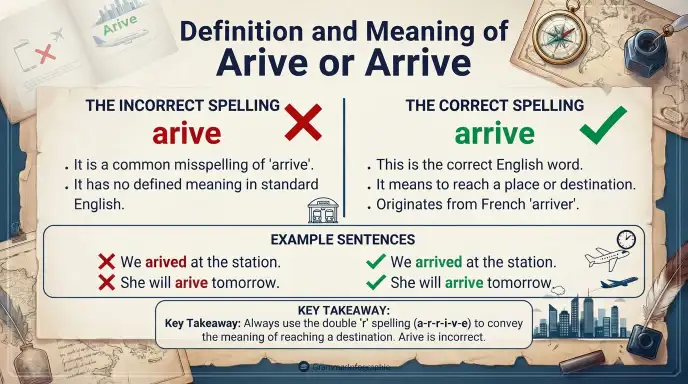
Definition and Meaning of Arive or Arrive
Arrive
Arrive is a verb that means to reach a place or destination.
For example:
We arrived at the hotel late.
It can also refer to something happening or coming at a certain time.
The moment has finally arrived.
The word can also describe reaching a decision or conclusion:
We arrived at an agreement after a long discussion.
In some contexts, arrive can also mean becoming successful or well known.
She had finally arrived as a respected writer.
Oxford lists uses of arrive for reaching a place, for an event or moment to happen, and in the phrase arrive at for reaching a conclusion or decision.
Arive
Arive is not the standard spelling of the English verb.
If you mean “to reach a place,” use arrive, with two r’s.
The Origin of Arive or Arrive
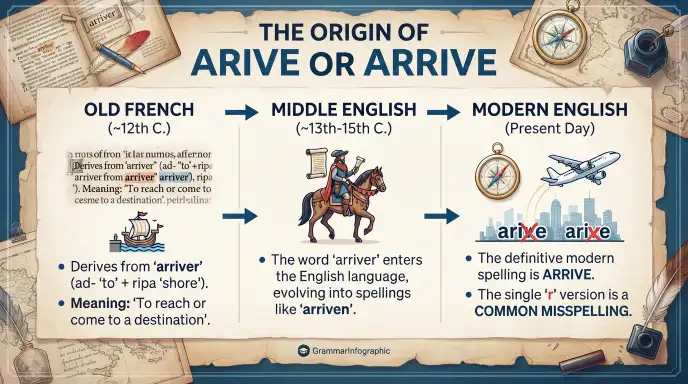
The word arrive has a long history. It entered English through Middle English from Old French ariver. Its older meaning was connected with reaching the shore after a journey by sea.
The word can ultimately be traced to Latin ad ripam, meaning “to the shore.” The Latin word ripa meant “shore” or “river bank.”
Over time, the meaning became broader. Instead of referring only to reaching a shore, arrive came to mean reaching almost any destination. By the late 14th century, English speakers were using it for reaching a destination more generally.
The spelling arive is therefore not a British or American spelling variation. It is simply a misspelling of the standard word arrive.
British English vs American English Spelling
There is no spelling difference between British English and American English for this word.
Both use:
Arrive
| English Variety | Correct Spelling | Example |
| British English | arrive | We will arrive at noon. |
| American English | arrive | We will arrive at noon. |
| Canadian English | arrive | They arrived yesterday. |
| Australian English | arrive | Please arrive early. |
| Global English | arrive | The train will arrive soon. |
| Incorrect | arrive | ❌ Do not use this spelling. |
Unlike words such as colour/color or centre/center, arrive does not change spelling between British and American English.
Which Spelling Should You Use?
Use arrive in all standard English writing.
For American English
Use:
Please arrive at the office by 9 a.m.
For British English
Use:
Please arrive at the office by 9 a.m.
For International English
Use arrives as well. It is widely understood and accepted in standard English.
The key point is simple: there is no situation in standard English where “arrive” should replace “arrive.”
Common Mistakes with Arrive or Arrive
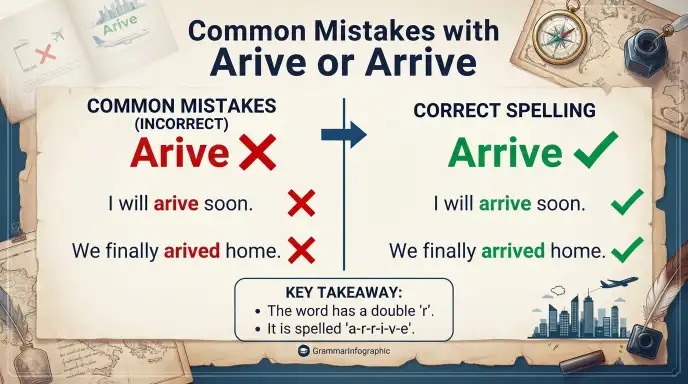
The most common mistake is dropping one of the two r’s.
Incorrect:
Please arrive on time.
Correct:
Please arrive on time.
Another common mistake is writing arrived instead of arrived.
Incorrect:
She arrived at the airport.
Correct:
She arrived at the airport.
The same doubleif r pattern appears in related forms:
- arrive
- arrived
- arriving
- arrival
Spelling Tip
Remember:
arrive → arrived → arriving → arrival
The word family can help you remember that arrive begins with arrif not arif
Arrive or Arrive in Everyday Examples
In Emails
Please arrive at the meeting room by 10 a.m.
I will arrive at the office shortly.
In News Writing
The train is expected to arrive at the station this evening.
Emergency teams arrived at the scene within minutes.
On Social Media
Finally arrived in New York!
We just arrived at the beach.
In Formal Writing
The delegation arrived at the conference center on Monday.
The researchers arrived at an important conclusion.
In Everyday Speech
What time will you arrive?
I should arrive home by seven.
These examples show that arrive works in casual, professional, academic, and formal English.
Arive or Arrive : Google Trends & Usage Data
Searches for “arive or arrive” usually come from people checking the correct spelling of the word. The strong reason for this confusion is simple: arive sounds close to arrive, but standard English requires two r’s.
The correct form, arrive, is used across Englishif speaking countries, including the United States, United Kingdom, Canada, and Australia. It is also common in international English because it is a basic English verb.
The incorrect form arive may appear in searches, messages, or userif generated content, but this does not make it an accepted spelling.
When comparing the two forms, the important usage pattern is:
| Variation | Standard English? | Meaning |
| arrive | ✅ Yes | Reach a place or destination |
| arrived | ✅ Yes | Past form of arrive |
| arriving | ✅ Yes | Present participle |
| arrival | ✅ Yes | Act of arriving |
| arive | ❌ No | Common misspelling |
Google Trends can show search interest for spelling questions, but search volume should not be treated as proof that a spelling is correct. Dictionary and standardif English usage are better guides for spelling.
Arrive vs Arrive: Comparison Table
| Feature | Arive | Arrive |
| Correct spelling | ❌ No | ✅ Yes |
| Part of speech | Verb | |
| Meaning | To reach a place | |
| Double “r” | ❌ No | ✅ Yes |
| British English | ❌ Incorrect | ✅ Correct |
| American English | ❌ Incorrect | ✅ Correct |
| Formal writing | ❌ Avoid | ✅ Use |
| Example | ❌ We will arive soon. | ✅ We will arrive soon. |
FAQs
Q1. Is arrive or arrive correct?
Arrive is correct. Arive is a misspelling and should not be used in standard English.
Q2. How do you spell it correctly?
The correct spelling is arrive, with two r’s: Aif Rif Rif Iif Vif E.
Q3. What does arrive mean?
Arrive means to reach a place, destination, or point after traveling or waiting.
Q4. Is arive a word?
No. Arive is not the standard English spelling of the verb arrive.
Q5. Is arrive the same in British and American English?
Yes. Both British English and American English use the same spelling.
Q6. What is the past tense of arrival?
The past tense has arrived.
Example: “They arrived at the hotel early.”
Q7. What is the noun form of arrive?
The noun form is arrival.
Example: “We waited for her arrival.”
Q8. Why does arrive have two r’s?
The standard spelling developed from historical forms such as Old French ariver and Middle English forms. Modern English uses arrive with two r’s.
Conclusion
Arrive is the correct spelling, while arive is an incorrect spelling. The difference is easy to remember because arrive always uses two r’s. You should use arrive in British English, American English, Australian English, Canadian English, and international English.
The verb arrive means to reach a place or destination. It can also describe a time or event that comes, such as “The day has arrived,” or reaching a decision, as in “We arrived at an agreement.” Its history goes back through Middle English and Old French to a Latin expression meaning “to the shore.”
For everyday writing, emails, schoolwork, professional documents, and social media, always choose arrive. If you see arive, treat it as a spelling error and correct it to arrive. Remembering the double r will help you avoid this common mistake and make your English writing more accurate.

I’m James Mitchell, an English language and grammar writer at Grammwise. I enjoy helping readers understand confusing words, spelling differences, grammar rules, and everyday English usage. My goal is to make English simple, clear, and easy to use with practical examples and straightforward explanations.