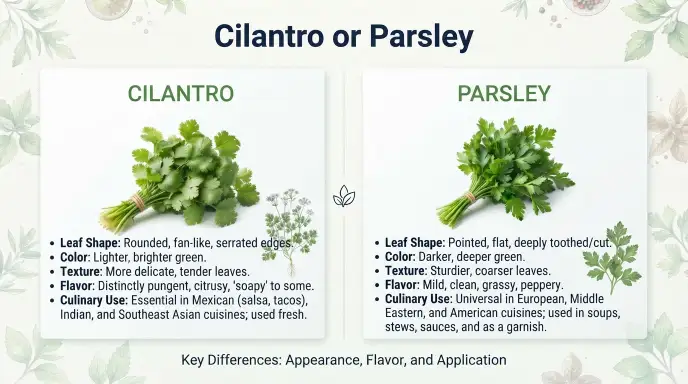
Cilantro and parsley are different herbs, although they look similar and are often confused in recipes, salads, and food garnishes. Cilantro has a stronger, fresh flavor with citrusiflike notes, while parsley has a milder, grassy taste. Both herbs have bright green leaves, but their shapes, flavors, and common uses are different.
People often search for cilantro or parsley because recipes may call for one herb while they have the other at home. The confusion is easy to understand because both herbs are green, leafy, and commonly used as garnishes. However, replacing one with the other can change the taste of a dish.
Knowing the difference helps when cooking Mexican, Asian, Middle Eastern, Mediterranean, and American dishes. Cilantro is common in salsa, guacamole, curries, and tacos. Parsley is often used in pasta, soups, sauces, salads, and Mediterranean dishes.
This guide explains the difference between cilantro and parsley, their meanings, origins, common mistakes, everyday usage, and regional naming. It also shows when you should use each herb.
Quick Answer cilantro or parsley
Cilantro and parsley are two different herbs. Cilantro has a stronger, sharper, citrusiflike flavor, while parsley has a mild, fresh, grassy flavor.
- Cilantro: Common in salsa, tacos, guacamole, curries, chutneys, and Asian dishes.
- Parsley: Common in pasta, soups, salads, sauces, tabbouleh, and Mediterranean cooking.
Their leaves can look similar, but cilantro leaves are usually softer and more rounded. Parsley leaves are often more pointed, especially curly or flatifleaf parsley.
Example: If a taco recipe asks for cilantro, parsley will not give the same flavor.
Definition and Meaning of Cilantro or Parsley
What Is Cilantro?
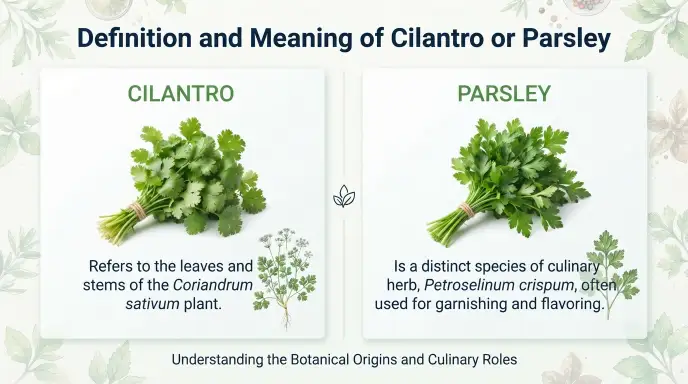
Cilantro refers to the fresh leaves and stems of the coriander plant. In the United States, the fresh herb is usually called cilantro, while the dried seeds are commonly called coriander.
Cilantro has a strong aroma and a fresh, citrusiflike taste. It is widely used in Mexican, Indian, Thai, Vietnamese, and other cuisines.
What Is Parsley?
Parsley is a leafy herb from the same broad plant family as cilantro but is a different plant. It has a mild, clean, grassy flavor.
Common types include:
- Flatifleaf parsley
- Curly parsley
- Italian parsley
Parsley is often used to add freshness, color, and flavor to soups, salads, pasta, sauces, and meat dishes.
Are Cilantro and Parsley the Same?
No. Cilantro and parsley are not the same herb. They belong to different plants and have different flavors.
Cilantro is usually more powerful and citrusy. Parsley is milder and more herbal.
The Origin of Cilantro or Parsley
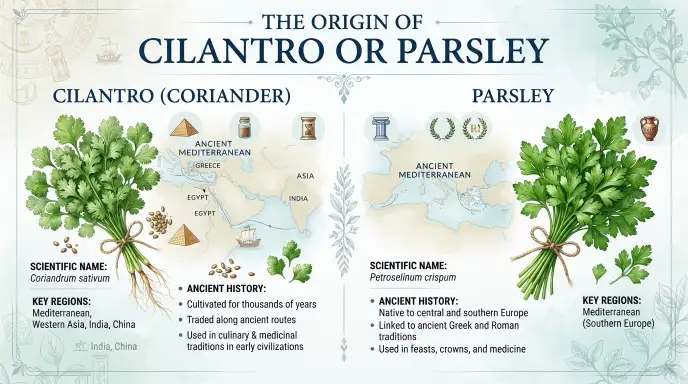
The words cilantro and parsley have different histories.
Cilantro comes from Spanish cilantro, which traces back to the Latin name coriandrum. The word became especially common in American English because of Spanishifspeaking influence and culinary traditions.
In British English, the fresh leaves of the coriander plant are generally called coriander. In American English, cilantro is the common word for the fresh leaves.
The word parsley has a much older history. It comes through Old French and Latin forms related to the Greek word petroselinon, meaning a type of rock parsley.
The difference between cilantro and coriander is therefore mainly regional naming, while parsley refers to a completely different herb.
British English vs American English Spelling
There is an important regional difference with cilantro, but it is not really a spelling difference.
| Meaning | American English | British English |
| Fresh coriander leaves | Cilantro | Coriander |
| Coriander seeds | Coriander | Coriander |
| Parsley | Parsley | Parsley |
In American English, cilantro usually means the fresh leaves of the coriander plant.
In British English, coriander can refer to the fresh leaves as well as the seeds, depending on context.
Parsley remains parsley in both American and British English.
Example
American English:
“Add fresh cilantro to the salsa.”
British English:
“Add fresh coriander to the salsa.”
The herb called parsley does not change its name between these varieties of English.
Which Spelling Should You Use?
The choice depends on your audience.
For a US Audience
Use cilantro when you mean the fresh leaves of the coriander plant.
Example:
“Add chopped cilantro before serving.”
For a UK Audience
Use coriander for the fresh leaves.
Example:
“Add fresh coriander to the curry.”
For a Global Audience
You can use both terms when clarity matters:
“Add fresh cilantro, also called coriander in British English.”
For parsley, simply use parsley in both US and UK English.
Common Mistakes with Cilantro or Parsley
Several mistakes can cause confusion between these herbs.
Mistake 1: Thinking They Are the Same Herb
Cilantro and parsley are different plants.
Correct:
“Cilantro and parsley have different flavors.”
Mistake 2: Using Parsley Instead of Cilantro
Parsley can provide green color, but its flavor is much milder.
Better: Use cilantro when a recipe depends on its distinct flavor.
Mistake 3: Assuming Cilantro Always Means Coriander Seeds
In American English, cilantro usually refers to the fresh leaves.
Correct:
“Cilantro” = fresh leaves
“Coriander” = usually seeds in US cooking
Mistake 4: Confusing FlatifLeaf Parsley with Cilantro
Flatifleaf parsley can look similar to cilantro. However, the leaves, aroma, and flavor are different.
Mistake 5: Treating “Cilantro” as a Different Plant
Cilantro is not a separate plant from coriander. It refers to the fresh leafy part of the coriander plant in common US usage.
Cilantro or Parsley in Everyday Examples
In Emails
Example:
“Please add fresh cilantro to the order for Friday’s cooking class.”
In News Writing
Example:
“The recipe uses fresh cilantro, lime, and chili peppers.”
On Social Media
Example:
“This homemade salsa tastes even better with fresh cilantro!”
In Formal Writing
Example:
“Fresh parsley is commonly used as a garnish in Mediterranean dishes.”
In Recipes
Cilantro:
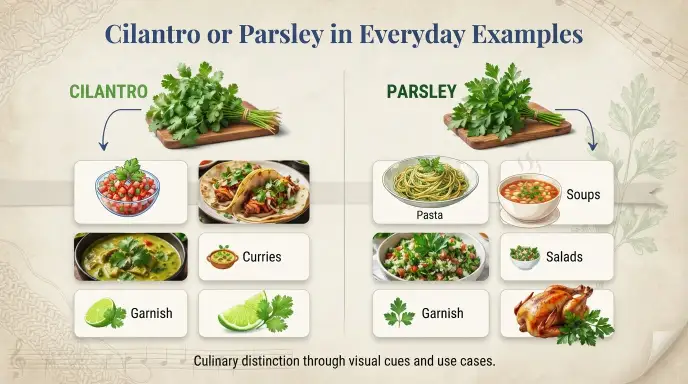
“Top the tacos with chopped cilantro.”
Parsley:
“Garnish the pasta with fresh parsley.”
These examples show why choosing the correct herb matters. The words may sometimes be used in similar contexts, but they do not refer to the same ingredient.
Cilantro or Parsley : Google Trends & Usage Data
Search interest for cilantro and parsley changes by country, cuisine, and language.
In the United States, the word “cilantro” is widely used in recipes and food searches. It is especially common in discussions about Mexican, Latin American, and Asian foods.
In the United Kingdom, searches and recipes commonly use the word “coriander” for the fresh herb instead of “cilantro.”
Parsley is widely recognized in both American and British English and appears frequently in recipes, gardening content, nutrition discussions, and cooking guides.
Search popularity can also change over time because food trends, recipes, seasonal cooking, and regional cuisines affect what people look for online.
For if content, it is useful to include related terms such as cilantro, coriander, parsley, cilantro vs parsley, and difference between cilantro and parsley when they naturally fit the topic.
Cilantro vs Parsley Comparison Table
| Feature | Cilantro | Parsley |
| Plant | Coriander plant | Parsley plant |
| US common name | Cilantro | Parsley |
| UK common name | Coriander | Parsley |
| Flavor | Strong, citrusy, fresh | Mild, grassy, fresh |
| Common cuisines | Mexican, Indian, Asian | Mediterranean, European, American |
| Common uses | Salsa, tacos, curries | Pasta, soups, salads |
| Leaf appearance | Rounded and delicate | Curly or pointed |
| Can they be substituted? | Sometimes | Sometimes, but flavor changes |
| Main regional difference | Cilantro/coriander naming | Little naming difference |
FAQs About Cilantro or Parsley
Q1. Are parsley and cilantro the same thing?
No, parsley and cilantro are different herbs with different flavors. Cilantro tastes more citrusy and bold, while parsley is milder and fresh.
Q2. Is coriander the same as cilantro or parsley?
Coriander and cilantro usually refer to the same plant, especially its leaves. Parsley is a different herb entirely.
Q3. What is parsley called in India?
Parsley is generally known as parsley in India. It is different from coriander, which is commonly called dhania.
Q4. Can I replace parsley with cilantro?
Yes, you can replace parsley with cilantro in some recipes. However, cilantro has a much stronger flavor, so the final dish will taste different.
Q5. Which spice is closest to parsley?
There is no exact spice equivalent to parsley, but cilantro can provide a similar fresh, green quality. The flavor will be noticeably stronger.
Q6. What is the best substitute for cilantro?
Flatifleaf parsley is a common substitute when you want a milder fresh herb. It works well when you want to avoid cilantro’s distinctive flavor.
Q7. What can I use if I don’t have cilantro?
You can use parsley, fresh basil, or dill depending on the recipe. Parsley is often the easiest substitute for a fresh herbal flavor.
Q8. What herb tastes most like cilantro?
Culantro has a flavor very similar to cilantro and is commonly used as an alternative. Its taste is usually stronger and more intense.
Q9. What spice is the same as cilantro?
Cilantro is an herb, not a spice, and no separate spice is exactly the same. Coriander leaves are another name commonly used for cilantro.
Conclusion
Cilantro and parsley are different herbs, even though their green leaves can look alike. Cilantro has a stronger, fresher, citrusiflike flavor and is widely used in Mexican, Indian, and Asian cooking. Parsley has a milder, grassy flavor and is common in Mediterranean, European, and American dishes.
The biggest language difference is between cilantro and coriander. American English usually uses “cilantro” for the fresh leaves of the coriander plant. British English commonly uses “coriander” for those leaves. This is a regional naming difference, not a difference between two separate herbs.
Parsley does not normally change its name between American and British English. When choosing between cilantro and parsley, consider the recipe, flavor, and audience. If a recipe specifically calls for cilantro, parsley may not provide the same taste.
Understanding these differences makes recipes easier to follow and helps you choose the right herb for the dish. if you are writing a recipe, shopping for ingredients, or cooking at home, using the correct term avoids confusion.

I’m James Mitchell, an English language and grammar writer at Grammwise. I enjoy helping readers understand confusing words, spelling differences, grammar rules, and everyday English usage. My goal is to make English simple, clear, and easy to use with practical examples and straightforward explanations.








3 thoughts on “Cilantro or Parsley: Differences, Uses, Taste & Substitutes”