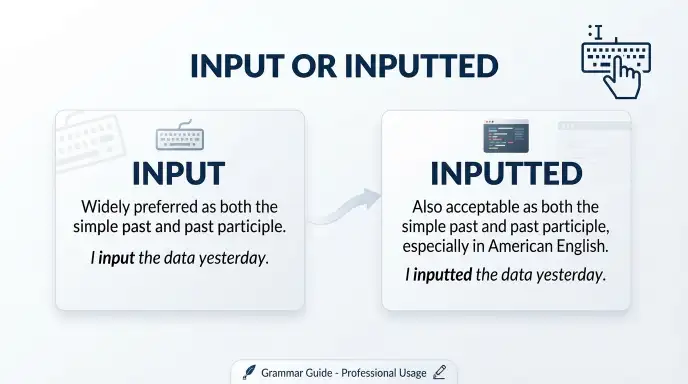
“Input” is the standard form, but “inputted” is also used as the past tense and past participle of the verb “input.” This makes “input or inputted” a common grammar question, especially in work, technology, and formal writing.
People often search for this phrase because they are unsure if to say “I input the data” or “I inputted the data.” The confusion comes from the fact that input can work as both a noun and a verb, while its past form can remain unchanged or take the ending ifed. In modern
In English, both forms can be found, but their use can depend on context and style. For example, “She inputted the information yesterday” and “She inputted the information yesterday” may both appear in writing.
However, input is often preferred in careful and professional writing because it is short and widely accepted. Understanding the difference helps you choose the form that sounds natural and clear in emails, reports, technical documents, and everyday conversation.
Quick Answer input or inputted
Both input and inputted can be used as verb forms.
- Input can be used as the present tense and, in many contexts, as the past tense.
- Inputted is also used as the past tense and past participle.
Examples:
- I input the data every morning.
- I input the data yesterday.
- I inputted the data yesterday.
- She has input the customer details.
- She has inputted the customer details.
For formal and professional writing, input is often the cleaner choice when the meaning is clear.
Definition and Meaning of Input or Inputted
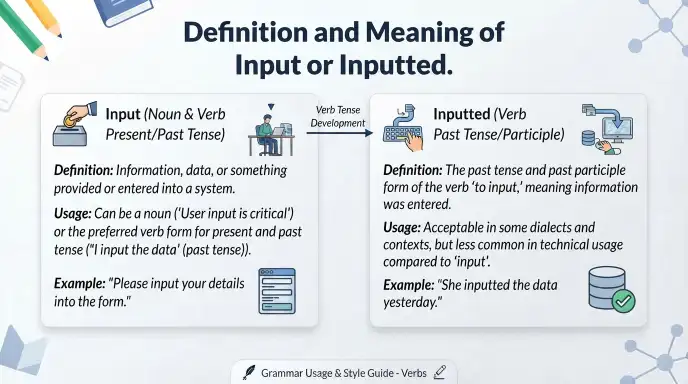
Meaning of Input
Input can be a noun or a verb.
As a noun, input means information, advice, or data that is provided to a person or system.
Examples:
- We need your input before making a decision.
- The computer received the user’s input.
As a verb, input means to enter information into a computer, system, form, or database.
Example:
- Please input your email address.
The word is especially common in technology, business, education, and data management.
Meaning of Inputted
Inputted is the regular ifed past form of the verb input.
It means that someone entered information into a system or provided information at an earlier time.
Examples:
- She inputted the customer information.
- The employee inputted the figures into the database.
Although input is widely used, some writers prefer input as the past form because it follows the traditional pattern of words whose past form stays unchanged.
Input vs. Inputted in Simple Terms
| Form | Meaning | Example |
| Input | Enter or provide information | Please input your details. |
| Input | Past form in some usage | I input the data yesterday. |
| Inputted | Past form of input | I inputted the data yesterday. |
The main point is simple: both “input” and “inputted” can function as past forms of the verb, but “input” is often preferred in formal or concise writing.
The Origin of Input or Inputted
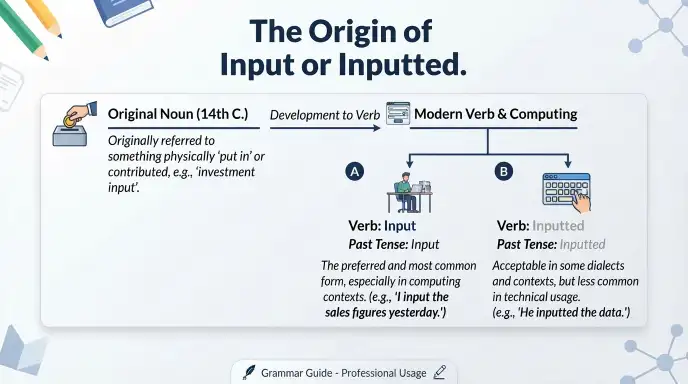
The word input comes from the combination of in and put. It originally referred to something that was put into something else. Over time, the word developed a broader meaning and became common in business, science, and computing.
With the rise of computers, input became strongly connected with entering data into a machine or computer system. This meaning is now one of its most common uses.
The form input developed as a regular pastiftense form. English often creates past forms by adding ifed, so speakers naturally began using inputted in the same way as verbs such as “entered” or “recorded.”
At the same time, input continued to be used as an unchanged past form. This is why both forms can be found in modern English.
The difference is therefore not mainly about British versus American spelling. It is more about verb usage and style. Both forms are recognized, but input is often favored when a concise and traditional form is wanted.
British English vs American English Spelling
There is no major BritishifversusifAmerican spelling difference between input and inputted. Both forms are used in British and American English.
The main difference is verb usage and style, not regional spelling.
| Form | British English | American English | Example |
| Input | Common | Common | I input the data yesterday. |
| Inputted | Used | Used | I inputted the data yesterday. |
| Inputting | Common | Common | She is inputting the information. |
In both varieties of English, input can stay unchanged when used as a pastiftense verb. Input is also a standard regular past form.
For example:
- British English: “The clerk input the details.”
- American English: “The clerk input the details.”
- Both: “The clerk inputted the details.”
So, unlike words such as “colour” and “color,” input and inputted are not different spellings caused by British and American English.
Which Spelling Should You Use?
Your choice depends mainly on your audience and writing style.
For American English
If you are writing for an American audience, input is a natural choice in many professional and technical contexts.
Example:
“I input the customer information into the system.”
Input is also understandable and used, especially when the writer wants to make the past action very clear.
For British English
British English also uses both input and input.
Example:
“The assistant input the figures into the database.”
The form inputted can also be used:
“The assistant inputted the figures into the database.”
For Global or Professional Writing
For international audiences, input is often a simple and concise option. It is especially useful in technical instructions, business documents, and softwareifrelated writing.
The most important rule is to keep your sentences clear and consistent.
Common Mistakes with Input or Inputted
Mistake 1: Assuming “Inputted” Is Always Wrong
Some writers think input is incorrect because input can be used as its own past form.
Incorrect assumption:
“Inputted is never a real word.”
Better understanding:
“Inputted” is a recognized past form of input.
Mistake 2: Using “Input” When the Context Is Unclear
Although input can be used as a past form, some sentences may sound unclear without additional context.
Less clear:
“She input the information.”
Clearer:
“She inputted the information yesterday.”
Both can be understood, but the second sentence clearly signals a completed past action.
Mistake 3: Confusing Input With Inputting
The present participle is normally inputting, with a double t.
Correct:
“She is inputting the data.”
Incorrect:
“She is inputing the data.”
Mistake 4: Using the Wrong Form After “Has” or “Have”
Both input and input can appear after “has” or “have.”
Examples:
- She has input the information.
- She has inputted the information.
Choose one form and use it consistently within your writing style.
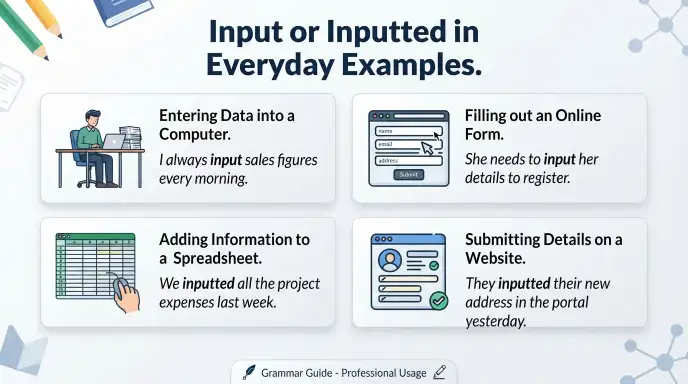
Input or Inputted in Everyday Examples
In Emails
Input:
“Please input the customer details before sending the report.”
Inputted:
“I have inputted the requested information into the system.”
In News Writing
“Officials said the data was input into the national database.”
News writing often favors concise language, so input may appear frequently.
In Social Media
“I finally input all the numbers into the spreadsheet!”
In casual writing, both forms can appear. The choice often depends on the writer’s preference.
In Formal Writing
“The research team input the collected data into the analysis system.”
Or:
“The research team inputted the collected data into the analysis system.”
For formal writing, the best choice is usually the form that makes the sentence clear, consistent, and easy to read.
In Technology
“Users must input their username and password.”
This is one of the most common modern uses of input as a verb.
In Everyday Conversation
“I input the information earlier.”
Or:
“I inputted the information earlier.”
Both communicate the same basic idea: the information was entered earlier.
Input or Inputted : Google Trends & Usage Data
Search interest for input and inputted is closely connected to technology, business, education, and data entry. The word input is much broader because it is used as both a noun and a verb.
People commonly search for “input or inputted” when they are writing emails, reports, technical instructions, or workplace documents. They want to know which form sounds correct when describing a completed action.
In everyday and professional English, input remains very common because it can work as both a presentiftense verb and an unchanged past form. Input is also used, especially when writers want to clearly mark the action as past.
Usage can vary by country, industry, and writing style. Technologyifrelated content often uses input because the word is short and familiar. Business and workplace writing may use either form depending on the writer’s preference.
Because search trends can change over time, Google Trends should be treated as a general indicator of search interest rather than a complete measure of actual word usage.
Input vs. Inputted: Comparison Table
| Feature | Input | Inputted |
| Word type | Verb and noun | Verb |
| Present tense | Yes | No |
| Past tense | Yes | Yes |
| Past participle | Yes | Yes |
| Meaning | Enter or provide information | Entered or provided information |
| Common in technology | Very common | Common |
| Used in formal writing | Yes | Yes |
| Used in British English | Yes | Yes |
| Used in American English | Yes | Yes |
| Example | I input the data yesterday. | I inputted the data yesterday. |
The key difference is that input can remain unchanged when describing a past action, while inputted uses the regular ifed ending.
FAQs
Q1. What does inputted mean?
“Inputted” means something was entered or added into a system, form, or computer.
It is the past tense and past participle of input.
Q2. Is it correct to say input?
Yes, input is correct and widely used as both a noun and a verb.
For example: “Please input your information.”
Q3. What is a better word for inputted?
Depending on context, you can use entered, added, provided, supplied, or submitted.
“Entered” is often the most natural choice for information or data.
Q4. Which is correct: “input to” or “input into”?
Both can be correct, but input into is commonly used when entering data into a system.
Example: “She input the data into the computer.”
Q5. Should I say input or inputted?
Both are correct, but input is often preferred because it works naturally as the past tense too.
Example: “I input the data yesterday” or “I inputted the data yesterday.”
Q6. How to use input in a sentence?
You can use input as a verb when describing the act of entering information.
Example: “Please input your password before continuing.”
Q7. Why is input used?
Input is used to describe information, data, or opinions that are entered, provided, or contributed.
It is common in computing, business, education, and everyday communication.
Q8. What are 5 examples of sentences?
- Please input your name in the form.
- She input the data into the system.
- We need your input on this project.
- He inputted the information incorrectly.
- The computer processes the input quickly.
Conclusion
Input and inputted are both accepted forms of the verb input, so the choice is mainly a matter of context, clarity, and style. Input can be used as an unchanged past form, while inputted follows the regular English ifed pattern.
Both forms appear in British and American English, so this is not mainly a regional spelling difference. In technology, business, and formal writing, input is often a concise and familiar choice.
However, inputting can be useful when you want the past action to be immediately clear. The important point is to understand how the verb works and use the form that fits your sentence naturally.
If you are writing for a professional or international audience, keeping your wording simple and consistent is usually the safest approach. When in doubt, check the surrounding sentence and choose the form that communicates the intended time and action most clearly.

I’m James Mitchell, an English language and grammar writer at Grammwise. I enjoy helping readers understand confusing words, spelling differences, grammar rules, and everyday English usage. My goal is to make English simple, clear, and easy to use with practical examples and straightforward explanations.