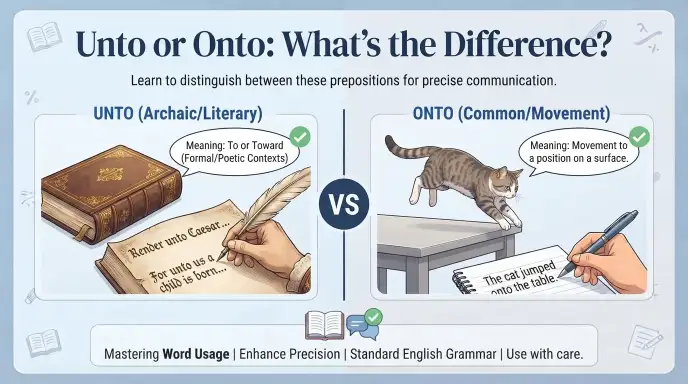
“Unto” and “onto” are not interchangeable because they have different meanings and uses in modern English. Many people search for “unto or onto” because the two words look and sound similar, yet choosing the wrong one can.
change the meaning or make a sentence sound unnatural. The confusion is especially common among English learners, writers, students, and people who encounter the older word unto in religious texts, literature, or formal writing.
In simple terms, onto usually describes movement toward or to a position on top of something, while unto is an older and more formal word that often means to, until, or toward, depending on the context.
For example, you might say, “The cat jumped onto the table,” but you would not normally use unto in that sentence.
Understanding the difference between unto and onto helps you write more accurately and recognize when older or traditional English is being used. This guide explains their meanings, origins, usage, spelling, common mistakes, everyday examples, and more.
Quick Answer Unto or Onto
The main difference between unto and onto is their meaning and usage.
- Onto means moving to a position on or upon something.
- Unto is an oldiffashioned or formal word that can mean to, toward, or until, depending on the sentence.
Examples
Onto:
- The child climbed onto the chair.
- She placed the book onto the table.
- The dog jumped onto the bed.
Unto:
- Give unto others as you would like them to give unto you.
- The message was delivered unto the king.
- Peace be unto you.
In modern everyday English, onto is much more common. Unto is usually found in older literature, religious writing, traditional expressions, or intentionally formal language.
Quick rule: Use onto when something moves or is placed on top of another thing. Use unto mainly when writing in an oldiffashioned, literary, or religious style.
The Origin of Unto or Onto
Understanding the history of unto and onto makes their modern usage easier to understand. Although these words look similar, they developed differently and are used in different ways today.
The Origin of Unto
is an old English word with a long history. It developed from earlier forms of English and was commonly used to mean to, toward, or until. Over time, everyday English began using simpler words such as to, but remained common in religious texts, traditional literature, and formal writing.
For example:
- And he said unto them…
- Peace be unto you.
- Give unto others.
Today, unto sounds oldiffashioned in most everyday conversations. However, it is still used when writers want to create a traditional, poetic, biblical, or formal tone.
The Origin of Onto
Onto developed as a combination of on + to. It became useful for clearly describing movement toward a surface or position.
For example:
- The cat jumped onto the roof.
- She stepped onto the stage.
- He placed the box onto the shelf.
In modern English, onto is a common and natural word, especially when describing physical movement or direction.
Why the Difference Exists
The confusion between unto and onto happens because both words end in “to” and can sometimes appear in sentences involving direction or movement. However, their meanings are different.
- Unto → usually means to, toward, or has an oldiffashioned meaning.
- Onto → means movement to a position on something.
For example:
The child climbed onto the table.
✅ The child climbed onto the table.
The first sentence sounds unnatural in modern English because the child is moving to the surface of the table. Therefore, onto is the correct choice.
British English vs American English Spelling
Unlike some English words that have different spellings in British and American English, unto and onto generally keep the same spelling in both varieties.
The difference between them is mainly about meaning and usage, not British versus American spelling.
| Word | American English | British English | Main Meaning |
| Onto | Onto | Onto | Movement to a position on something |
| Unto | Unto | Unto | An oldiffashioned or formal form of “to” or “toward” |
Examples in American and British English
Both American and British English would normally use:
- The boy climbed onto the wall.
- She walked onto the stage.
- The book fell onto the floor.
Similarly, unto can appear in older or formal writing in both varieties:
- The king spoke unto his people.
- Peace be unto you.
Onto vs On To
One area where writers may experience confusion is onto versus on to.
Use onto when describing movement to a surface:
- She jumped onto the bed.
- The bird flew onto the branch.
Use on to when on belongs to the verb or when the words have separate functions:
- Let’s move on to the next topic.
- He carried on to complete the project.
The meaning of the sentence determines if you should use onto or on to.
Which Spelling Should You Use?
Choosing between unto and onto depends mainly on the meaning of your sentence, your audience, and the style of writing you want to use.
For American English
In American English, onto is commonly used when describing movement toward or to a surface.
Examples:
- The cat jumped onto the couch.
- She stepped onto the platform.
- He placed the phone onto the desk.
Unto is rarely used in everyday American English. You are more likely to see it in:
- Religious texts
- Historical writing
- Poetry
- Traditional expressions
- Literary works
For British English
British English follows the same basic distinction.
Use onto when something moves to a position on a surface:
- The children climbed onto the bus.
- She placed the bag onto the table.
Use unto mainly in oldiffashioned, religious, or literary contexts:
- Peace be unto you.
- The king spoke unto his people.
For a Global Audience
If you are writing for an international or global audience, the safest approach is to focus on the meaning.
Use onto when describing movement or direction toward a surface.
Example:
- The bird flew onto the fence.
Use unto only when you intentionally want an oldiffashioned, traditional, poetic, or religious tone.
Example:
- And the message was delivered unto the people.
Simple Rule to Remember
Ask yourself:
Is someone or something moving to a position on top of something?
If the answer is yes, use onto.
- She climbed onto the roof.
- The book fell onto the floor.
If you mean to, toward, or are using traditional language, unto may be appropriate.
- The gift was given unto the king.
Common Mistakes with Unto or Onto
Because unto and onto look similar, writers often confuse their meanings. Here are some of the most common mistakes and how to correct them.
1. Using “Unto” for Physical Movement
One of the most common errors is using unto when onto is needed.
Incorrect: The child jumped unto the bed.
✅ Correct: The child jumped onto the bed.
Why? The child is moving to a position on the bed, so onto is the correct word.
2. Using “Onto” Instead of “Unto” in Traditional Writing
Another mistake is replacing unto with onto when the sentence has a traditional or literary meaning.
Incorrect: Peace be onto you.
✅ Correct: Peace be unto you.
Why? In this context, unto has the traditional meaning of to.
3. Assuming “” Is Simply Another Spelling of “Onto”
These words are not alternative spellings of the same word.
✅ Correct: They have different meanings and uses.
- Onto relates to movement toward a surface.
- is usually an oldiffashioned or formal form of to or toward.
4. Using “Unto” in Modern Everyday Sentences
Although unto is grammatically correct in certain contexts, it can sound unnatural in everyday modern English.
✅ Natural: I gave the book to my friend.
For normal modern communication, to is usually better than unto.
5. Confusing “Onto” with “On To”
Writers also often confuse onto with on to.
Use onto when showing movement toward a surface:
- She climbed onto the chair.
- The dog jumped onto the sofa.
Use on to when the two words perform separate grammatical functions:
- Let’s move on to the next question.
- We can go on to discuss the next topic.
6. Overusing “Unto” to Sound Formal
Some writers use because they believe it always sounds more sophisticated or formal.
However, using it in modern writing can make a sentence sound unnatural or overly oldiffashioned.
Overly formal: Please send the document me.
✅ Natural: Please send the document to me.
Use only when the traditional or literary style is intentional.
Quick Mistake Checklist
Before choosing between unto and onto, remember:
- Use onto for movement to a surface.
- Use mainly in oldiffashioned, religious, or literary contexts.
- Do not treat them as different spellings of the same word.
- Use to instead of in most modern everyday sentences.
- Check if on to should be written as two separate words.
Understanding these common mistakes will help you choose the correct word and make your writing clearer and more natural.
Unto or Onto in Everyday Examples
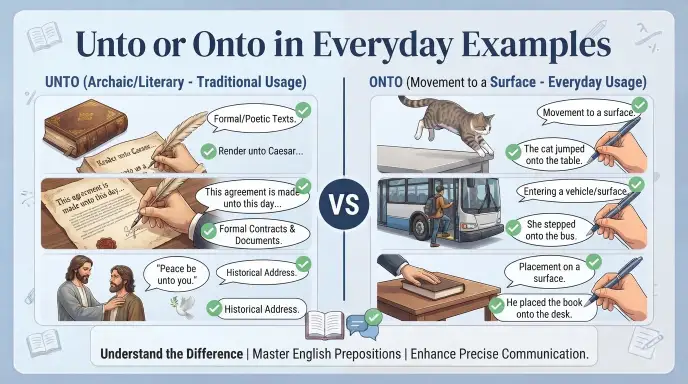
The easiest way to understand the difference between and onto is to see how they are used in real sentences.
Examples of “Onto”
Use onto when someone or something moves to a position on top of another surface or object.
- The baby climbed onto the sofa.
- She placed her phone onto the table.
- The cat jumped onto the bed.
- He stepped onto the train.
- The bird flew onto the fence.
- The children ran onto the playground.
- She poured the sauce onto the pasta.
- The ball rolled onto the road.
In each example, there is movement toward or to a surface, place, or position.
Examples of “Unto”
Unto is mainly used in traditional, religious, poetic, or oldiffashioned writing.
- Peace be you.
- The king spoke his people.
- The gift was given the child.
- A message was deliveredthem.
- Do others as you would have them do you.
In modern everyday English, many of these sentences would normally use to instead of unto.
For example:
- Modern: The king spoke to his people.
- Traditional: The king spoke unto his people.
Unto vs Onto: Quick Comparison
| Feature | Unto | Onto |
| Main meaning | To, toward, or traditional expression | Movement to a surface or position |
| Modern usage | Rare | Common |
| Writing style | Formal, religious, literary, oldiffashioned | Everyday and standard English |
| Example | Peace be unto you | She jumped onto the bed |
| Common replacement | To | On to, depending on context |
Frequently Asked Questions About Unto or Onto
1. What is the difference between unto and onto?
and onto have different meanings. Onto describes movement toward or to a position on something, while is an oldiffashioned or formal word that can mean to or toward.
2. Is “unto” still used in modern English?
Yes, but uncommon in everyday modern English. It is mainly found in religious texts, poetry, historical writing, and traditional expressions.
3. When should I use “onto”?
Use onto when something moves to a position on a surface or object.
Example: The cat jumped onto the table.
4. Can I use “unto” instead of “onto”?
No. Unto and onto are not interchangeable because they have different meanings.
✅ The cat jumped onto the table.
5. Is “onto” one word or two words?
Onto is usually written as one word when it means movement to a position on something.
Example: She climbed onto the roof.
However, on to may be written as two words when on belongs to a verb.
Example: Let’s move on to the next topic.
6. Is “unto” British or American English?
Unto exists in both British and American English. It is not mainly a spelling difference between the two varieties. However, it is considered oldiffashioned or formal in modern English.
7. What is a simple way to remember the difference?
Remember this simple rule:
Onto = movement onto a surface.= oldiffashioned or formal “to.”
For example:
- She climbed onto the wall.
- Peace be you.
8. Is “onto” more common than “unto”?
Yes. Onto is much more common in modern everyday English, while is mostly used in religious, literary, poetic, or historical contexts.
Conclusion
The difference between or onto becomes simple once you understand their meanings. Use onto when describing movement to a position on a surface, such as jumping onto a bed or placing a book onto a table. Use mainly in traditional, religious, poetic, or oldiffashioned language where it often means to or toward.
In most modern everyday writing, onto is the more commonly used word, while should be reserved for specific stylistic or traditional contexts. If you are unsure, ask if the sentence describes movement toward a surface. If it does, onto is usually the correct choice.
By remembering the simple difference between these two words, you can avoid common grammar mistakes and make your writing clearer, more accurate, and more natural.

Hi, I’m Dylan Foster. I’m a passionate writer who enjoys creating clear, helpful, and engaging content. My goal is to provide readers with simple answers and useful information on a wide range of topics.


3 thoughts on “Unto or Onto: What’s the Difference?”