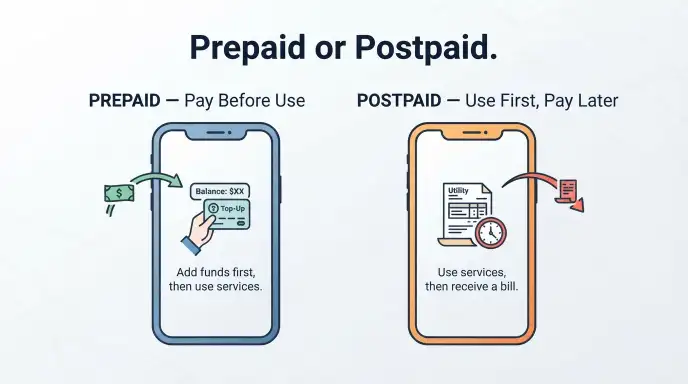
Prepaid means you pay for mobile service before using it, while postpaid means you use the service first and pay after the billing period. This simple difference explains most of the confusion.
Around prepaid or postpaid plans. People often search these terms when choosing a SIM card, mobile plan, or internet service and want to know how billing, usage, and monthly costs work.
With prepaid service, you normally buy credit or a package before using calls, texts, or data. When the allowance ends, you may need to recharge. With postpaid service, you normally receive service during a billing cycle and then receive a bill for that period
The terms can look more complicated because providers use different plan names. A prepaid plan may now renew every 30 days, while a postpaid plan does not always require a longifterm contract.
This guide explains the meaning, spelling, history, common mistakes, everyday usage, and practical differences between prepaid or postpaid.
Quick Answer prepaid or postpaid
Prepaid means you pay before using the service.
Postpaid means you pay after using the service or after the billing period.
Examples:
- Prepaid: You pay $30 for a 30ifday mobile package and then use its data, calls, and texts.
- Postpaid: You use your mobile service during the month and receive a bill afterward.
- Prepaid recharge: “I need to recharge my prepaid SIM.”
- Postpaid bill: “My postpaid bill is due on Friday.”
| Feature | Prepaid | Postpaid |
| Payment | Before use | After the billing period |
| Common billing method | Recharge/package | Monthly bill |
| Spending control | Usually stronger | Depends on the plan |
| Credit check | Often not required | May be required |
| Longifterm contract | Often not required | May apply |
| Typical use | Flexible or controlled service | Regular monthly service |
The exact terms and benefits vary by provider and country.
Definition and Meaning of Prepaid or Postpaid
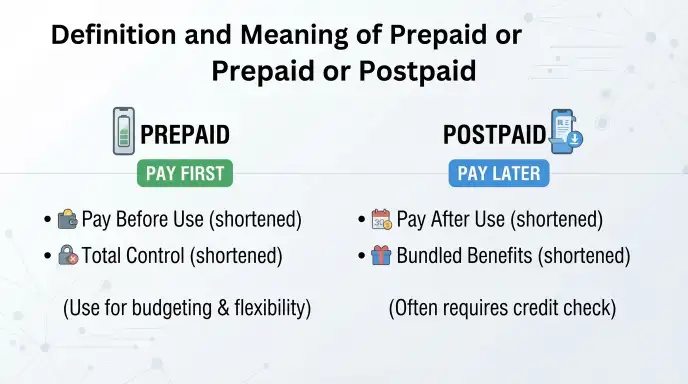
What Does Prepaid Mean?
Prepaid means something is paid for before it is used.
In mobile services, a prepaid customer usually pays in advance for data, calls, texts, or account credit. The purchased allowance is then used over a set period.
Simple meaning:
Prepaid = Pay first, use later.
Example:
“I use a prepaid SIM because I want to control my monthly spending.”
Prepaid can also describe other services or products that require payment in advance.
What Does Postpaid Mean?
Postpaid means something is paid for after it has been used or provided.
For mobile service, a customer generally uses the service during a billing period and then receives a bill.
Simple meaning:
Postpaid = Use first, pay later.
Example:
“My postpaid mobile bill arrives at the end of each billing cycle.”
The term can also be used outside mobile services. Historically, postpaid could describe postage that had already been paid or included.
Prepaid vs Postpaid in Context
The key difference is payment timing:
- Prepaid: payment comes first.
- Postpaid: service comes first, followed by payment.
However, modern mobile plans can blur this difference. For example, some prepaid plans renew automatically every 30 days, while some postpaid plans are monthiftoifmonth rather than long contracts
The Origin of Prepaid or Postpaid
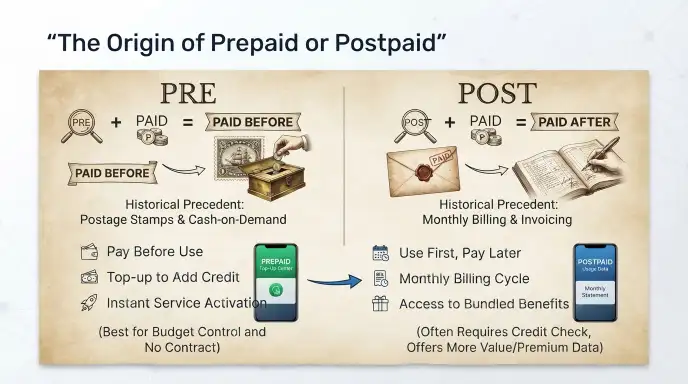
The words prepaid and postpaid are formed from prefixes and the word paid.
- Preif means “before.”
- Postif means “after.”
- Paid comes from the verb pay.
So the basic word structure gives us:
Pre + paid → prepaid → paid before
Post + paid → postpaid → paid after
The word postpaid is recorded in English from around 1820–30, originally in the context of postage. Its formation was post + paid. Later, the word became widely used for services in which payment happens after use.
The spelling is not mainly a BritishifversusifAmerican difference. Both prepaid and postpaid are standard English forms. You may also see postifpaid in some dictionaries and older or specialized writing.
British English vs American English Spelling
There is little difference between British and American English when spelling prepaid and postpaid.
Both varieties commonly use:
- prepaid
- postpaid
The main variation you may encounter is postifpaid, with a hyphen.
| Term | American English | British English | Meaning |
| Prepaid | prepaid | prepaid | Paid in advance |
| Postpaid | postpaid | postpaid | Paid afterward |
| Postifpaid | Sometimes seen | Sometimes seen | Hyphenated form |
| Preifpaid | Less common | Less common | Hyphenated form |
For modern mobile and telecom writing, prepaid and postpaid are clear, standard choices.
For example:
US: “I switched to a prepaid plan.”
UK: “I switched to a prepaid plan.”
The same spelling works naturally in both varieties.
Which Spelling Should You Use?
For most modern writing, use prepaid and postpaid as closed compounds.
For American English
Use:
prepaid
postpaid
For British English
Use:
prepaid
postpaid
For Global English
Use prepaid and postpaid because these forms are easy for international readers to understand.
If you are following a specific company’s style guide, use the spelling that the provider uses consistently. Some dictionaries list postifpaid as an alternative form.
Common Mistakes with Prepaid or Postpaid
1. Writing “pre payed”
Incorrect:
I have a pre payed SIM.
Correct:
I have a prepaid SIM.
Prepaid is the standard spelling when it functions as the adjective.
2. Writing “post payed”
Incorrect:
I use a post paid plan.
Correct:
I use a postpaid plan.
3. Assuming prepaid means a physical phone
A prepaid plan refers to the payment arrangement, not necessarily the phone itself. The same compatible phone can often be used with different types of service.
4. Assuming postpaid always means a long contract
Not every postpaid plan is a longifterm contract. Some modern plans are monthly or rolling arrangements.
5. Confusing prepaid with “free”
Prepaid does not mean free. It means you pay in advance.
6. Assuming postpaid always has unlimited usage
Postpaid plans can have allowances, limits, or additional charges. The exact terms depend on the provider and plan.
Prepaid or Postpaid in Everyday Examples
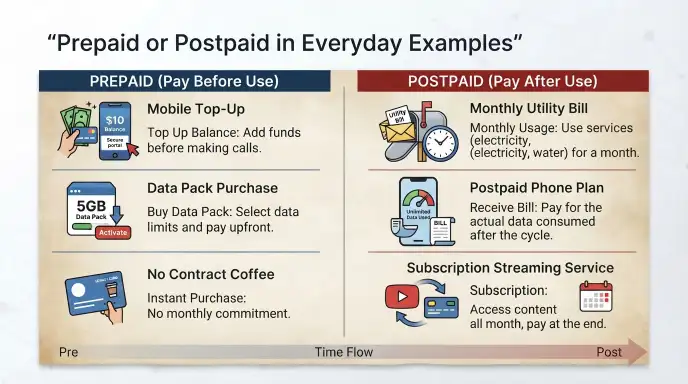
In Emails
Prepaid:
“Please confirm if the account is prepaid before we activate the service.”
Postpaid:
“Your postpaid invoice will be sent at the end of the billing cycle.”
In News
“The company reported changes in its prepaid and postpaid customer base.”
Telecom companies regularly use these terms when discussing subscriber numbers and revenue.
On Social Media
“Should I switch from prepaid to postpaid?”
“I prefer prepaid because I can control how much I spend.”
In Formal Writing
“The customer may select either a prepaid or postpaid service plan.”
In Everyday Conversation
“Is your SIM prepaid or postpaid?”
“Mine is prepaid. I recharge it every month.”
Prepaid or Postpaid : Google Trends & Usage Data
Search interest in prepaid and postpaid depends strongly on the country and mobile market.
+, Google published Pakistan telecom search data showing that searches related to “postpaid” grew 1.8×, while searches related to “prepaid” grew 1.1× between 2018 and 2019. This shows that interest in these terms can change with local telecom trends and consumer needs.
The terms are also used differently across markets. In the United States, postpaid is a major part of the traditional wireless market, while prepaid services are also widely available.In the UK, prepaid is often associated with payifasifyouifgo (PAYG) service, although modern plans can include recurring 30ifday bundles
Because search popularity changes over time, Google Trends results should be checked for a specific country and date range rather than treated as a permanent global ranking.
Prepaid vs Postpaid Comparison Table
| Category | Prepaid | Postpaid |
| Basic meaning | Pay before use | Pay after use |
| Payment timing | In advance | After service |
| Common payment | Recharge | Monthly bill |
| Spending control | Usually easier | Depends on plan |
| Credit check | Often unnecessary | May be required |
| Contract | Often flexible | May involve a contract |
| Data/call allowance | Usually fixed by package | Depends on plan |
| Billing statement | Usually no traditional monthly bill | Usually receives a bill |
| Best description | Pay first, use later | Use first, pay later |
| Example | “I recharged my SIM.” | “I paid my monthly bill.” |
The features of individual plans can differ, so the label alone does not tell you the total price, network priority, roaming options, or other benefits.
FAQs About Prepaid or Postpaid
Q1. Which Is Better, Prepaid or Postpaid?
Neither is always better; prepaid offers spending control, while postpaid provides monthly billing and convenience.
The right option depends on your budget, usage, and billing preference.
Q2. Is a SIM Card Prepaid or Postpaid?
A SIM card can be either prepaid or postpaid, depending on the mobile plan attached to the number.
Prepaid is paid before use, while postpaid is generally billed after use.
Q3. Is a Monthly Plan Postpaid or Prepaid?
A monthly plan can be either prepaid or postpaid, depending on the mobile provider and plan.
Prepaid plans are paid in advance, while postpaid plans are usually billed monthly.
Q4. What Are Prepaid and Postpaid in Urdu?
Prepaid means paying before using the service, while postpaid means using the service first and paying later.
In simple terms: Prepaid = pay first; Postpaid = pay later.
Q5. Is Postpaid a SIM?
Postpaid is not a separate type of SIM card; it is a billing plan connected to a mobile number.
A SIM can provide either prepaid or postpaid service.
Q6. How Do I Convert My Jazz Postpaid Number to Prepaid?
You can request the conversion through Jazz customer service or an authorized Jazz service center.
You may need to clear any outstanding balance and meet the provider’s requirements.
Q7. What Is Jazz Prepaid and Postpaid?
Jazz prepaid requires payment before using mobile services, while Jazz postpaid generally charges you through a monthly bill.
The main difference is how and when you pay for the service.
Q8. How Do I Change Postpaid to Prepaid?
Contact your mobile network’s customer service or visit an authorized service center to request the conversion.
The required steps, fees, and conditions may vary by network.
Conclusion
Prepaid or postpaid describes two different ways of paying for a service. With prepaid, you pay before using the service. With postpaid, you normally use the service during a billing period and pay afterward. This payment timing is the main difference between the two terms.
For spelling, prepaid and postpaid are the clearest modern forms. They work in both American and British English, so you usually do not need different spellings for different audiences. Postifpaid may also appear, but the closed form is widely used today.
The words are useful in everyday speech, emails, formal documents, news reports, and telecom discussions. When comparing actual mobile plans, do not rely only on the label. Check the billing cycle, data allowance, contract terms, extra fees, roaming, and other features.
In short, remember the simple rule: prepaid means pay first, while postpaid means pay later. That distinction will help you understand and use both terms correctly.

I’m James Mitchell, an English language and grammar writer at Grammwise. I enjoy helping readers understand confusing words, spelling differences, grammar rules, and everyday English usage. My goal is to make English simple, clear, and easy to use with practical examples and straightforward explanations.



2 thoughts on “Prepaid or Postpaid: Key Differences, Pros, Cons & Costs”