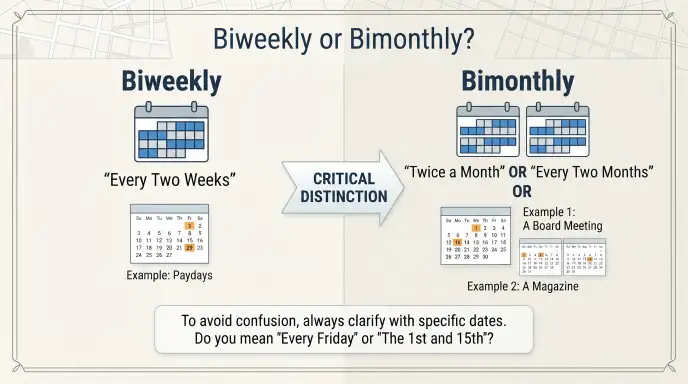
The words biweekly and bimonthly often cause confusion because their prefixes can be interpreted in more than one way. When someone says a meeting is “biweekly,” does it happen every two weeks or twice a week?
Likewise, does “bimonthly” mean twice a month or once every two months? These questions are common because both terms can have more than one dictionaryifrecognized meaning depending on context.
People search for “biweekly or bimonthly” to understand the difference, choose the correct word, and avoid misunderstandings in emails, work schedules, payment plans, newsletters, and other recurring events.
Although the two terms look similar, they refer to different time periods: biweekly is related to weeks, while bimonthly is related to months.
The safest approach is to use these words carefully and provide an exact schedule when there could be confusion.
For example, “every two weeks” and “twice a month” are much clearer than simply saying “biweekly” or “bimonthly.” Understanding their meanings can help you communicate schedules accurately in both formal and everyday writing.
Quick Answer biweekly or bimonthly
Biweekly relates to a period of two weeks, while bimonthly relates to a period of two months or, in some usage, something occurring twice in one month.
- Biweekly: commonly means every two weeks.
- Bimonthly: commonly means every two months or twice a month, depending on context.
Examples
- Biweekly meeting: A meeting held every two weeks.
- Bimonthly magazine: A magazine published every two months or, depending on the publisher, twice a month.
- Biweekly paycheck: A paycheck received every two weeks.
- Bimonthly payment: A payment scheduled every two months or twice a month, depending on the agreement.
Because these meanings can overlap or be interpreted differently, writing the exact frequency is often the clearest choice.
The Origin of Biweekly or Bimonthly
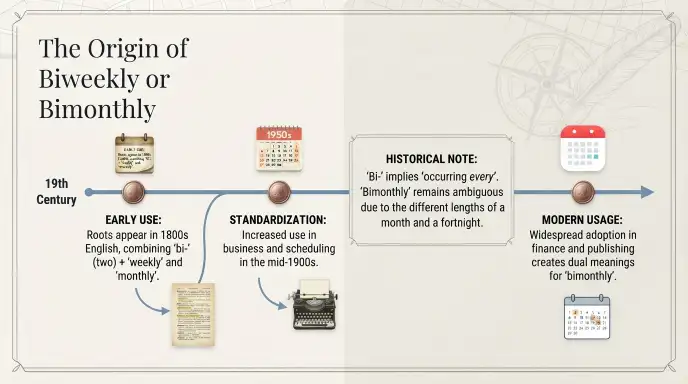
Both biweekly and bimonthly are formed using the prefix biif, which comes from Latin and generally means “two” or “twice.” The second part of each word identifies the time period involved.
Biweekly combines biif with weekly, referring to weeks. Historically, the word developed to describe something occurring once every two weeks or twice within a week. This double interpretation is one reason the term can create confusion.
Bimonthly combines biif with monthly, referring to months. It can describe something occurring once every two months or twice within a month.
The spelling itself is generally consistent in both British and American English. The main difficulty is not spelling but meaning. Since the prefix “biif” can be interpreted as “every two” or “twice,” context is essential.
British English vs American English Spelling
There is generally no major spelling difference between British and American English for biweekly and bimonthly.
| Term | American English | British English | Main Issue |
| Biweekly | biweekly | biweekly | Meaning can be ambiguous |
| Bimonthly | bimonthly | bimonthly | Meaning can be ambiguous |
| Every two weeks | every two weeks | every two weeks | Clear meaning |
| Twice a month | twice a month | twice a month | Clear meaning |
| Every two months | every two months | every two months | Clear meaning |
In both varieties of English, the safest way to communicate a schedule is often to state the frequency directly.
For example:
- Less clear: “The report is biweekly.”
- Clearer: “The report is sent every two weeks.”
Similarly:
- Less clear: “The newsletter is bimonthly.”
- Clearer: “The newsletter is published every two months.”
Which Spelling Should You Use?
There is no different spelling to choose between British and American English. Biweekly and bimonthly are standard spellings in both varieties.
The more important decision is if the intended meaning will be immediately understood by your audience.
For a US audience
Use biweekly or bimonthly when the context clearly establishes the frequency. If there is any possibility of confusion, use an explicit phrase such as “every two weeks” or “twice a month.”
For a UK or Commonwealth audience
The same spellings can be used. However, explicit wording can still make schedules easier to understand.
For a global audience
Avoid ambiguity whenever possible. Instead of:
“The payment is biweekly.”
write:
“The payment is made every two weeks.”
This removes uncertainty and makes the schedule clear to readers regardless of their English variety.
Common Mistakes with Biweekly or Bimonthly
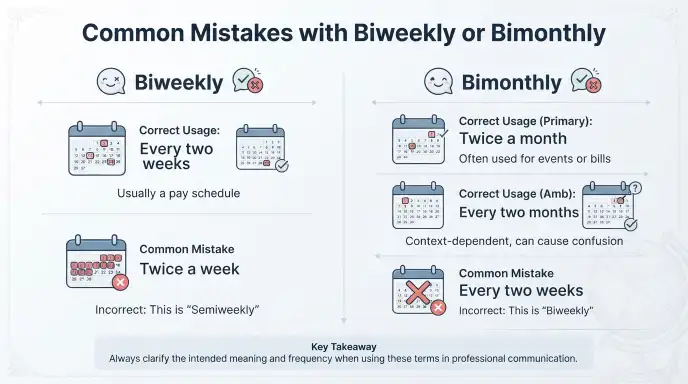
One of the biggest mistakes is assuming that biif always has only one meaning.
Mistake 1: Assuming biweekly always means twice a week
Incorrect assumption:
“Biweekly” always means two times every week.
Better:
Because the word can be interpreted differently, use “twice a week” when that is what you mean.
Mistake 2: Assuming bimonthly always means twice a month
Incorrect assumption:
“Bimonthly” always means two times per month.
Better:
Say “twice a month” if that is the intended schedule.
Mistake 3: Using biweekly when you mean every two weeks
If you want to describe a meeting that happens once every 14 days, “every two weeks” is clearer than simply saying “biweekly.”
Mistake 4: Confusing bimonthly with biweekly
The words refer to different time units:
- Biweekly → weeks
- Bimonthly → months
Mistake 5: Leaving schedules unexplained
In contracts, workplace policies, payment arrangements, or important instructions, relying on an ambiguous frequency word can lead to misunderstandings.
Biweekly or Bimonthly in Everyday Examples
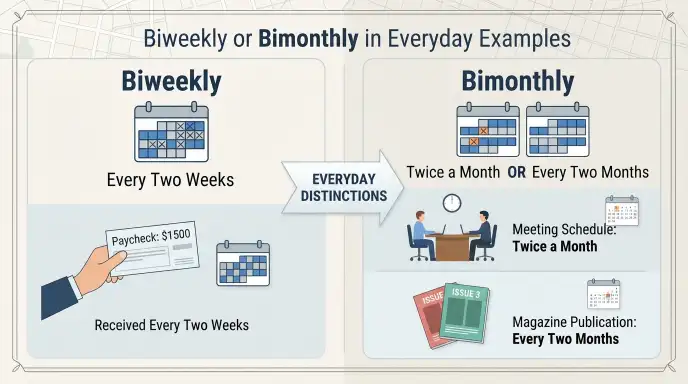
These words commonly appear in workplaces, financial arrangements, publishing, education, and personal schedules.
Workplace
“We have a biweekly team meeting.”
If the meeting occurs every two weeks, a clearer version is:
“We have a team meeting every two weeks.”
Payroll
“Employees are paid biweekly.”
This commonly refers to employees receiving payment every two weeks.
Newsletters
“The newsletter is published bimonthly.”
Because “bimonthly” can be interpreted in more than one way, the publisher can make the schedule clearer by saying:
“The newsletter is published every two months.”
Appointments
“The client has a biweekly appointment.”
A clearer version would be:
“The client has an appointment every two weeks.”
Payments
“The subscription is billed bimonthly.”
If the intended meaning is every two months, writing “billed every two months” eliminates ambiguity.
Academic or Professional Writing
In formal writing, precision is usually more important than brevity. If the timing matters, explicitly state the interval rather than relying on an ambiguous term.
Biweekly vs. Bimonthly: Key Differences
| Feature | Biweekly | Bimonthly |
| Time unit | Week | Month |
| Common interpretation | Every two weeks | Every two months |
| Alternative interpretation | Twice a week | Twice a month |
| Spelling difference | None | None |
| Main problem | Ambiguous frequency | Ambiguous frequency |
| Clearest alternative | Every two weeks | Every two months / twice a month |
FAQs About Biweekly or Bimonthly
Q1. Is biweekly every 2 weeks or twice a month?
Biweekly usually means every two weeks, but some people use it to mean twice a month, so context matters.
Q2. What is “once in 2 months” called?
“Once every two months” is the clearest phrase; bimonthly can also mean this, but it may be ambiguous.
Q3. Is bimonthly twice a month or every 2 months?
Bimonthly can mean either twice a month or every two months, so it is better to state the exact frequency.
Q4. Is 2 times a month biweekly or bimonthly?
Two times a month is best written as “twice a month” to avoid confusion with biweekly or bimonthly.
Q5. Is it bimonthly or biweekly?
Biweekly usually means every two weeks, while bimonthly can mean twice a month or every two months.
Q6. How do you say “2 times per month”?
The clearest expression is “twice a month” or “two times per month.”
Q7. Is biweekly grammatically correct?
Yes, biweekly is grammatically correct and commonly used to describe something happening every two weeks.
Q8. How many times is biweekly in a month?
Biweekly means every two weeks, so it usually occurs about two times per month, with some months having three occurrences.
Q9. What does “bimonthly” mean?
Bimonthly can mean twice a month or every two months, which is why “twice a month” or “every two months” is clearer.
Conclusion
Biweekly and bimonthly are similariflooking words with different time references. Biweekly relates to weeks, while bimonthly relates to months. The main challenge is that both words can be interpreted in more than one way because the prefix biif may suggest either “twice” or “every two.”
For everyday communication, the clearest solution is to state the exact frequency. Use “every two weeks,” “twice a week,” “every two months,” or “twice a month” when precision matters. This is especially useful in professional schedules, payments, contracts, newsletters, and other situations where misunderstanding the timing could cause problems.

I’m James Mitchell, an English language and grammar writer at Grammwise. I enjoy helping readers understand confusing words, spelling differences, grammar rules, and everyday English usage. My goal is to make English simple, clear, and easy to use with practical examples and straightforward explanations.






3 thoughts on “Biweekly or Bimonthly: Meaning, Differences & Examples ”