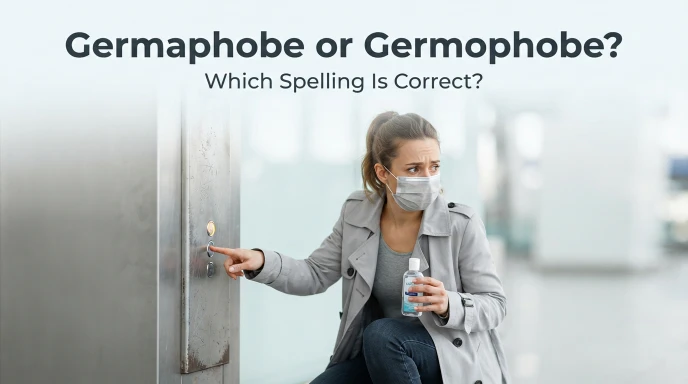
Both “germaphobe” and “germophobe” are correct spellings for a person who has a strong fear or dislike of germs, but “germaphobe” is a widely recognized form in modern English. The two words have almost the same meaning, so the main confusion is about spelling, not meaning.
People often search for “germaphobe or germophobe” because both versions appear in books, articles, news reports, social media, and everyday conversations. It can be hard to know if one is a mistake or if both are accepted.
The answer is simple: germaphobe and germophobe are established variants. Major dictionaries list both forms. Cambridge lists germophobe with germaphobe as another form, while Collins also gives both spellings.
In this guide, you will learn what both words mean, where they come from, how they are used, which spelling may suit different audiences, common mistakes to avoid, and examples for everyday and formal writing.
Quick Answe: Germaphobe or Germophobe
Germaphobe and germophobe are both accepted spellings. They describe someone who has a strong fear, dislike, or concern about germs and contamination.
| Spelling | Status | Meaning |
| germaphobe | Correct | A person strongly concerned about germs |
| germophobe | Correct | A person strongly concerned about germs |
Examples
- She is a germaphobe who always carries hand sanitizer.
- He is a germophobe and avoids touching public surfaces.
The meaning does not normally change when you switch between the two spellings.
So, if you are wondering “germaphobe or germophobe?”, you do not need to treat germophobe as a simple spelling error. It is an established variant.
Definition and Meaning of Germaphobe or Germophobe
What Does Germaphobe Mean?
A germaphobe is a person who has a strong fear or dislike of germs, contamination, or unclean conditions.
The word is often used in everyday English. Someone may call themselves a germaphobe because they wash their hands often, avoid touching dirty surfaces, or feel uncomfortable around germs.
For example:
She calls herself a germaphobe because she always carries disinfectant wipes.
What Does Germophobe Mean?
Germophobe has essentially the same meaning.
It describes someone who has a strong fear or dislike of germs. Cambridge defines germophobe as someone with a strong fear of germs and lists germaphobe as another form.
For example:
My brother is a germophobe, so he avoids crowded places during flu season.
Simple Meaning
In simple English:
Germaphobe = someone who is very afraid of or concerned about germs.
Germophobe = the same basic idea with a different spelling.
Context and Usage
These words are common in casual and general writing.
You may see them in:
- Conversations
- Blogs
- News articles
- Social media
- Emails
- Lifestyle articles
- Entertainment writing
- Descriptions of personal habits
For example:
I’m a bit of a germaphobe, so I wash my hands after using public transport.
The word can also be used humorously or casually. Calling someone a germaphobe does not automatically mean that person has a medical condition.
Germaphobe vs. a Medical Diagnosis
It is important not to confuse the everyday word germaphobe with a medical diagnosis.
People often use the word casually to describe someone who is very careful about germs. Strong contamination fears or repetitive behaviors can occur in some mentalif health conditions, but the word germaphobe by itself does not establish a diagnosis.
Good hygiene is also not the same thing as being a germaphobe.
The Origin of Germaphobe or Germophobe
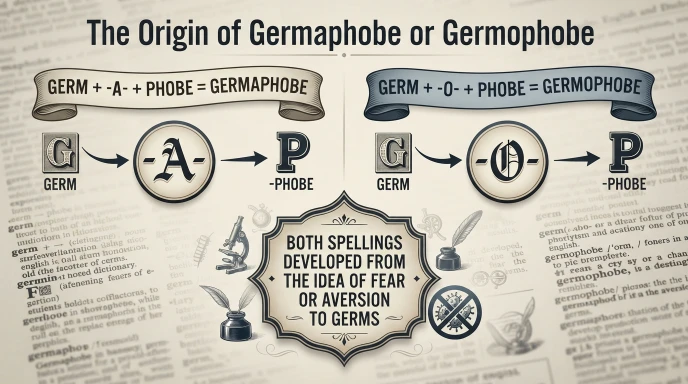
The two spellings developed from the idea of germs + fear or aversion.
The ending if phobe comes from a Greekif derived word element associated with fear or aversion. English uses this element in words such as:
- acrophobe
- arachnophobe
- claustrophobe
- technophobe
Dictionary.com records germaphobe as dating to around 1890–1900 and explains it as germ + if aif + if phobe.
Historical evidence also shows early use of related forms. Dictionary.com notes that germophobia appeared in the 1890s, while germophobe appeared in an 1894 issue of Punch.
Why Are There Two Spellings?
English often develops more than one form when words are combined.
One version uses a connecting if aif :
germ + a + phobe = germaphobe
The other uses an if oif :
germ + o + phobe = germophobe
This difference does not create a major difference in meaning.
Both forms became established in English, which explains why modern dictionaries recognize them.
British English vs American English Spelling
There is an important point here: this is not a simple Britishif versusif American spelling difference like “colour” and “color.”
Both germaphobe and germophobe can be found in English varieties.
Cambridge lists germophobe and gives germaphobe as an alternative form in both its UK and US dictionary entries.
Collins also lists germaphobe or germophobe in British English.
Spelling Comparison
| Feature | Germaphobe | Germophobe |
| Main meaning | Fear or strong dislike of germs | Fear or strong dislike of germs |
| Part of speech | Noun | Noun |
| Plural | germaphobes | germophobes |
| Alternative form | germophobe | germaphobe |
| Used in English | Yes | Yes |
| Meaning difference | Usually none | Usually none |
Examples in American English
He is a germaphobe who carries sanitizer everywhere.
She is a germophobe who avoids touching elevator buttons.
Examples in British English
She is a germaphobe and dislikes crowded spaces.
He is a germophobe who washes his hands frequently.
The key point is that neither spelling belongs exclusively to one major variety of English.
Which Spelling Should You Use?
Your choice can depend on your audience and writing style.
For American Readers
Germaphobe is a familiar choice for general American readers. Dictionary.com lists it as an American form and also recognizes germophobe.
Example:
She is a germaphobe who keeps hand sanitizer in her bag.
For British and Commonwealth Readers
Both forms can be understood. Cambridge and Collins recognize both spellings.
Choose the spelling that fits the dictionary or style guide you follow.
For a Global Audience
If your website targets readers from different countries, germaphobe may be a useful primary spelling because it is widely recognized.
However, you can mention germophobe naturally in the article so readers searching for that spelling can find the information they need.
For if Writing
For if , do not force the same keyword into every sentence.
Use natural variations such as:
- germaphobe
- germophobe
- germaphobe or germophobe
- germaphobia
- germophobia
- germophobic
This gives readers useful information without making the text sound repetitive.
Common Mistakes with Germaphobe or Germophobe
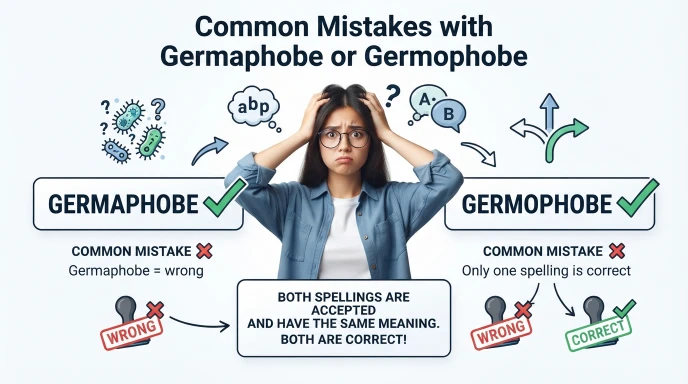
Mistake 1: Saying Germophobe Is Always Wrong
This is one of the most common mistakes.
Germophobe is an established word. Cambridge and Collins both recognize it.
Correct:
He is a germophobe.
Mistake 2: Saying Germaphobe Is the Only Correct Form
Germaphobe is also correct, but it is not the only recognized form.
Correct:
She is a germaphobe.
Also correct:
She is a germophobe.
Mistake 3: Assuming the Two Words Have Different Meanings
In normal usage, the two forms have essentially the same meaning.
The difference is mainly the spelling and word formation.
Mistake 4: Treating the Word as a Medical Diagnosis
Calling someone a germaphobe does not automatically diagnose a mentalif health condition.
Use the term as an everyday description unless a qualified source provides a specific clinical diagnosis.
Mistake 5: Confusing Germaphobe with Good Hygiene
A person who washes their hands or cleans their home is not automatically a germaphobe.
Good hygiene is a normal part of daily life.
Mistake 6: Using the Wrong Plural
The plural forms are:
- germaphobes
- germophobes
Example:
Several germaphobes shared their cleaning routines online.
Germaphobe or Germophobe in Everyday Examples
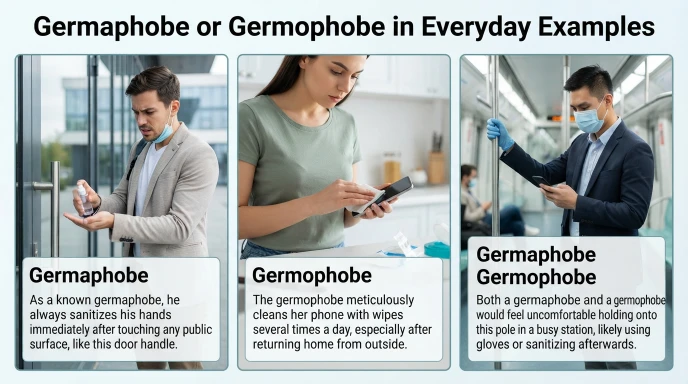
Seeing the words in context makes the difference easier to understand.
In an Email
Hi Sarah,
I’m a bit of a germaphobe, so could we please use the meeting room after it has been cleaned?
Thanks.
Here, germaphobe is used in a personal and informal way.
In a News Article
The actor has often described himself as a germophobe.
News writing may use either form, depending on the publication and its style.
On Social Media
I’m officially a germaphobe after touching that subway pole!
This use is casual and may be humorous.
In a Blog Post
If you are a germaphobe, carrying hand sanitizer may make travel more comfortable.
In Formal Writing
The word can appear in general formal writing, but a more precise description may sometimes be better.
Instead of:
The patient is a germaphobe.
A professional text might describe the specific behavior or concern when that detail matters.
More Everyday Examples
Germaphobe:
My sister is a germaphobe and wipes her phone every day.
Germophobe:
My brother is a germophobe and avoids sharing cups.
Plural:
The two germaphobes carried sanitizer during the trip.
Adjective forms:
She has become increasingly germophobic.
Cambridge also recognizes germophobic and germaphobic as related adjective forms.
Germaphobe or Germophobe :Google Trends & Usage Data
Search interest in word comparisons often reflects a simple user question: Which spelling should I use?
For this keyword, online usage is spread across both forms. Dictionary listings and examples from major publications show that germaphobe and germophobe are both actively understood and used.
Search behavior can vary by:
- Country
- English variety
- Writing context
- News coverage
- Health and hygiene discussions
- Social media usage
- Personal vocabulary
Country and Language Context
Englishif speaking users may encounter either spelling. The spelling used by a publication can depend on its editorial style.
American dictionaries and websites commonly show germaphobe, while British dictionary resources also recognize germophobe and germaphobe.
Search Intent Behind the Keyword
People searching for “germaphobe or germophobe” usually want one of these answers:
- Which spelling is correct?
- Is germophobe a real word?
- What does germaphobe mean?
- Are germaphobe and germophobe different?
- Which spelling should I use?
- Is germaphobe a medical term?
That makes this keyword a strong informational search query.
For an if page, the best approach is to answer the spelling question immediately and then explain the meaning, origin, usage, and differences.
Germaphobe vs Germophobe: Comparison Table
| Point | Germaphobe | Germophobe |
| Correct spelling? | Yes | Yes |
| Meaning | Strong fear or dislike of germs | Strong fear or dislike of germs |
| Noun | Yes | Yes |
| Plural | germaphobes | germophobes |
| Alternative spelling | if | germaphobe |
| Common usage | Widely recognized | Established variant |
| Used in dictionaries | Yes | Yes |
| Different meanings? | No major difference | No major difference |
| Suitable for everyday English | Yes | Yes |
The main takeaway is simple: these are spelling variants rather than two words with completely different meanings.
Related Words: Germaphobia and Germophobia
The noun forms also have two spelling patterns.
Germaphobia
Germaphobia refers to a strong fear or aversion to germs.
It follows the same if aif pattern as a germaphobe.
Germophobia
Germophobia has the same general meaning but uses the if oif pattern.
Dictionary.com lists both germaphobia and germophobia as related forms.
Similarly, the adjective forms include:
- germaphobic
- germophobic
Cambridge recognizes both forms.
FAQs About Germaphobe or Germophobe
Q1. Is it spelled germaphobe or germophobe?
Both germaphobe and germophobe are correct spellings. They have the same basic meaning and refer to someone who fears or dislikes germs.
Q2. What is another word for germophobe?
Another word for a germophobe is germaphobe. Related terms include germophobic and germaphobic.
Q3. What does germophobe mean?
A germophobe is someone who has a strong fear or dislike of germs and contamination. The term is commonly used in everyday English.
Q4. Who is a famous germaphobe?
Howard Hughes has often been described in historical accounts as having severe concerns about germs and contamination. His behaviors became widely discussed because of their intensity.
Q5. Is germaphobe a bad thing?
Being careful about germs is not necessarily a bad thing and can support good hygiene. However, extreme fear of germs can interfere with daily life.
Q6. Which celebrity has trypophobia?
Kendall Jenner has publicly discussed having trypophobia, a strong aversion to clusters of small holes or similar patterns. She has mentioned this fear in interviews and social media.
Q7. What is Johnny Depp’s phobia?
Johnny Depp has publicly spoken about a fear of clowns, known as coulrophobia. He has discussed this fear in interviews.
Q8. Who is the most shy celebrity?
There is no objective way to identify the “most shy” celebrity. Some celebrities are known for being private or reserved, but shyness is subjective.
Conclusion
Germaphobe and germophobe are both correct spellings, and they generally have the same meaning. Both words describe someone who has a strong fear, dislike, or concern about germs and contamination. Major dictionaries recognize both forms, so germophobe should not automatically be treated as a misspelling.
The main difference is the way the word is formed. Germaphobe uses the connecting if aif , while germophobe uses if oif . Both forms have a long history in English usage. Dictionary.com dates germaphobe to around 1890–1900 and records early uses of related forms in the 1890s.
For general writing, germaphobe is a familiar choice, especially for many American readers. However, germophobe is also fully understandable and established.
The best rule is simple: choose the spelling that fits your audience, dictionary, or style guide, and use it consistently. Most importantly, remember that neither word should automatically be treated as a medical diagnosis.

I’m James Mitchell, an English language and grammar writer at Grammwise. I enjoy helping readers understand confusing words, spelling differences, grammar rules, and everyday English usage. My goal is to make English simple, clear, and easy to use with practical examples and straightforward explanations.








1 thought on “Germaphobe or Germophobe: Which Spelling Is Correct?”