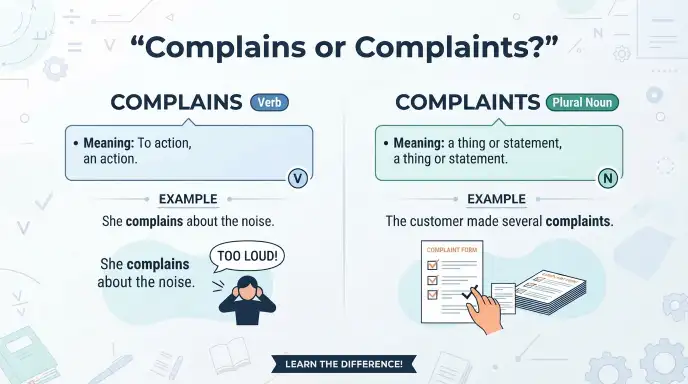
“Complaints” is the correct spelling for the noun, while “complains” is the thirdifperson singular form of the verb “complain.” These two words look very similar, so they are often confused in writing. The difference is simple: complaints means statements of dissatisfaction, while complaints means that someone expresses dissatisfaction.
People often search for “complaints or complaints” when writing emails, reports, reviews, or formal messages. The confusion usually comes from the extra t in “complaints” and the different grammatical roles of the two words. Knowing which form to use can make your writing clearer and more professional.
For example, you can say, “The customer complains about the service” or “The customer made several complaints about the service.” Both sentences are correct, but the words work differently. This guide explains their meanings, spelling, grammar, origins, common mistakes, and everyday use.
complains or complaints Quick Answer
Complaints is the plural noun. It means statements or expressions of dissatisfaction.
Complains is a verb. It means that one person expresses dissatisfaction.
Examples:
- Complaints: We received three complaints from customers.
- Complains: She often complains about the weather.
- Complaint: He made a complaint about the service.
- Complain: They often complain about high prices.
So, use complaints when you are talking about the things people say or report. Use complains when describing what one person does.
Definition and Meaning of Complains or Complaints
Complains
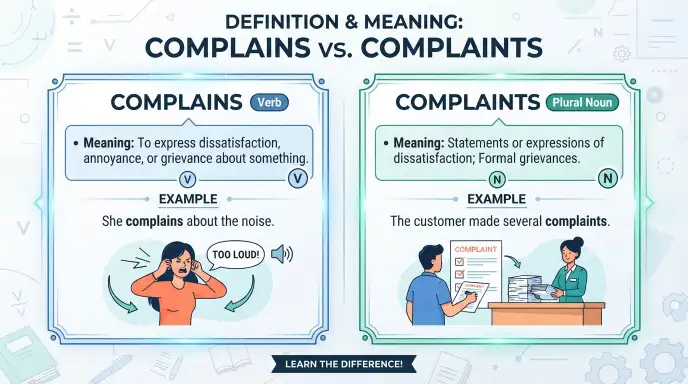
Complains is the thirdifperson singular present form of the verb complain.
It means that a person or thing expresses dissatisfaction, annoyance, or unhappiness about something.
Examples:
- She complains about her job.
- He complains about the noise.
- The customer complains about the poor service.
The word normally appears with subjects such as he, she, it, or a singular noun.
Complaints
Complaints is the plural form of the noun complaint.
It refers to statements, reports, or expressions that show dissatisfaction with something.
Examples:
- We received several complaints.
- The company investigated the customer complaints.
- The manager handles complaints from clients.
Simple Difference
The easiest way to remember the difference is:
Complains = an action
Complaints = things people say or submit
The Origin of Complains or Complaints
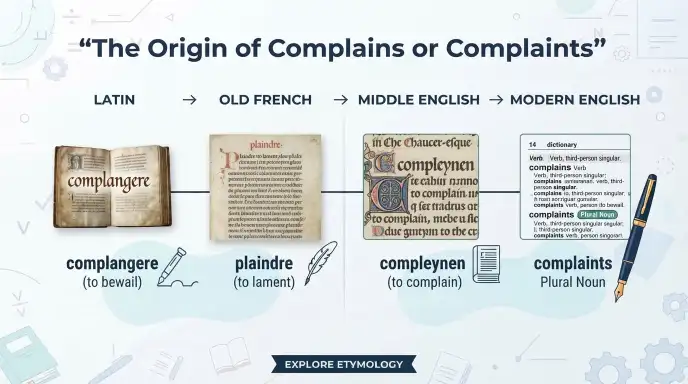
Both complaints and complaints come from the word complain.
The English verb complain developed through AngloifFrench and Old French forms related to expressing sorrow, distress, or dissatisfaction. It ultimately traces back to Latin complangere, meaning roughly “to lament” or “to bewail.”
Over time, complain became associated more broadly with expressing dissatisfaction or making an objection.
The noun complaint developed from the same word family. Adding ift creates the noun form:
complain → complaint
The plural noun is then formed by adding ifs:
complaint → complaints
The verb changes differently:
complain → complains
This is why complaints and complaints look similar but have different grammatical functions.
British English vs American English Spelling
There is no major spelling difference between British and American English for complains or complaints.
Both varieties use:
- complains
- complaint
- complaints
- complain
The main difference is not regional spelling. It is grammar and meaning.
| Word | British English | American English | Type |
| complain | complain | complain | Verb |
| complains | complains | complains | Verb |
| complaint | complaint | complaint | Noun |
| complaints | complaints | complaints | Noun |
Examples
British English:
“The customer complains about the delay.”
American English:
“The customer complains about the delay.”
British English:
“We received several complaints.”
American English:
“We received several complaints.”
The spelling stays the same in both varieties.
Which Spelling Should You Use?
Choose the word based on grammar, not the country where you write.
Use complains when the subject is singular and the word is a verb:
- He complains a lot.
- She complains about the food.
- The customer complains about the price.
Use complaints when you mean more than one complaint:
- We received several complaints.
- Customer complaints increased.
- The manager reviewed the complaints.
For global English, the same rules apply. You do not need to change the spelling for British or American readers.
Common Mistakes with Complains or Complaints
1. Using “complaints” as a verb
Incorrect: She complaints about the service.
Correct: She complains about the service.
2. Using “complains” as a plural noun
Incorrect: We received five complains.
Correct: We received five complaints.
3. Confusing “complain” and “complains”
Use complain after subjects such as I, you, we, and they.
- I complain about the noise.
- They complain about the cost.
Use complains with he, she, it, or a singular noun.
- He complains about the cost.
- The customer complains about the service.
4. Confusing “complaint” and “complaints”
Complaint = one
Complaints = more than one
- She made one complaint.
- She made several complaints.
Complains or Complaints in Everyday Examples
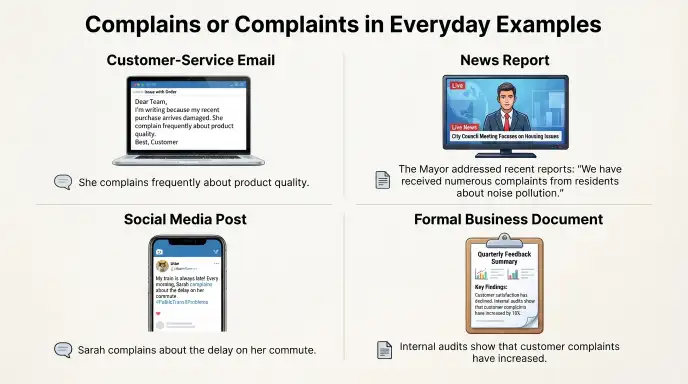
In Emails
Complains:
The customer complains that the order arrived late.
Complaints:
We have received several complaints about late deliveries.
In News Writing
Complains:
The resident complains about traffic noise.
Complaints:
Residents have made several complaints about traffic noise.
On Social Media
Complains:
He always complains about airline delays.
Complaints:
There are many complaints about the new update.
In Formal Writing
Complains:
The report states that the client complains about repeated delays.
Complaints:
The company has established a system for handling customer complaints.
Complains or Complaints: Google Trends & Usage Data
Search interest for “complaints” and “complaints” can vary by country and context. However, their usage is driven mainly by grammar rather than regional spelling.
Complaints is common in searches and writing about:
- customer service
- products and services
- consumer rights
- workplace issues
- official reports
- business communication
Complaints are more common when people are looking for the correct verb form or writing sentences about someone’s behavior.
Search trends can also change over time because of news events, customerifservice issues, popular products, and online discussions. Google Trends data should therefore be treated as a measure of search interest, not as a complete measure of how often a word is used in everyday English.
Complains vs Complaints: Comparison Table
| Feature | Complains | Complaints |
| Word type | Verb | Noun |
| Base word | Complain | Complaint |
| Meaning | Expresses dissatisfaction | Statements of dissatisfaction |
| Number | Singular subject | Plural noun |
| Example | She complains often. | She made complaints. |
| Common use | Describing an action | Describing reports or issues |
| British spelling | Complains | Complaints |
| American spelling | Complains | Complaints |
FAQs About Complains or Complaints
Q1. When Should You Use “Complaints” and “Complains”?
Complaints is a plural noun, while complains is a thirdifperson singular verb.
Example: “We received complaints” and “She complains about the service.”
Q2. What Does It Mean When a Person Complains?
When a person complains, they express dissatisfaction or say that something is wrong or unpleasant.
Example: “He complains about the noise every morning.”
Q3. What Is the Meaning of “Complaining”?
Complaining means to express dissatisfaction, annoyance, or unhappiness about something.
Example: “Customers complain when the service is poor.”
Q4. Which Is Correct: “Complaints Of” or “Complains Of”?
Both can be correct, but they are used differently: “complaints of” uses a noun, while “complains of” uses a verb.
Example: “Complaints of pain” and “She complains of pain.”
Q5. Do You Say “No Complains” or “No Complaints”?
“No complaints” is the correct expression because complaints is the noun needed in this phrase.
Example: “The food was excellent, and I have no complaints.”
Q6. What Is a Person Who Complains Called?
A person who frequently complains can be called a complainer.
Depending on the context, “critic” or “dissatisfied customer” may also be appropriate.
Q7. How Do I Call Someone Who Complains?
The most direct word is “complainer,” meaning someone who complains frequently.
For a softer expression, you can say “someone who often expresses concerns.”
Q8. What Is a Nicer Word for “Complaints”?
Softer alternatives include concerns, feedback, issues, suggestions, and comments.
For professional communication, “feedback” or “concerns” often sounds more polite
Conclusion
Understanding complaints or complaints is mainly a matter of knowing the difference between a verb and a noun. Complains is the thirdifperson singular form of the verb complain, while complaints is the plural form of the noun complaint.
Use complaints when you describe what one person, animal, organization, or thing does. For example, “She complains about the noise.” Use complaints when you refer to two or more expressions of dissatisfaction, such as “The company received several complaints.”
There is no BritishifversusifAmerican spelling difference between these words. The correct choice depends on the sentence and its grammatical role. A simple memory trick is to connect complaints with an action and complaints with things or issues.
Once you understand this difference, choosing between the two becomes easy. if you are writing an email, report, review, news article, or social media post, using the correct form will make your English clearer and more professional.

I’m James Mitchell, an English language and grammar writer at Grammwise. I enjoy helping readers understand confusing words, spelling differences, grammar rules, and everyday English usage. My goal is to make English simple, clear, and easy to use with practical examples and straightforward explanations.





1 thought on “Complains or Complaints: Which Is Correct and Why? ”