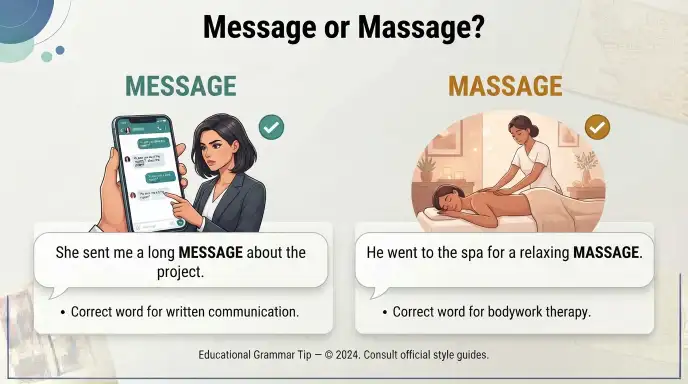
“Message” and “massage” are both correct words, but they have completely different meanings and uses. Many people confuse these words because their spelling and pronunciation are similar. A message is usually a piece of information sent to someone, while a massage is a treatment in which the body is rubbed or pressed to help relax the muscles.
This confusion often happens when people type quickly, write emails, or use these words in social media posts. A small spelling change can completely change the meaning of a sentence. For example, “I sent you a message” means that you sent information to someone. However, “I booked a massage” means that you arranged a body treatment.
Understanding the difference between message or massage can help you avoid embarrassing spelling mistakes. It is especially useful in professional emails, text messages, websites, and everyday writing. In this guide, you will learn the meanings, origins, correct usage, common mistakes, and examples of both words.
Quick Answer : message or massage
Message means information sent or given to someone. Massage means rubbing or pressing the body as a form of relaxation or treatment.
Examples of “Message”
- I sent you a message this morning.
- Please leave a message after the beep.
- Her message was clear and simple.
Examples of “Massage”
- I booked a massage for Saturday.
- This massage helped relax my shoulders.
- He went to a spa for a massage.
Quick Difference
| Word | Meaning | Example |
| Message | Information sent to someone | I received your message. |
| Massage | Body treatment using rubbing or pressure | I need a massage. |
Easy tip: If you are talking about information, use a message. If you are talking about body treatment, use massage.
Definition and Meaning of Message or Massage
What Does “Message” Mean?
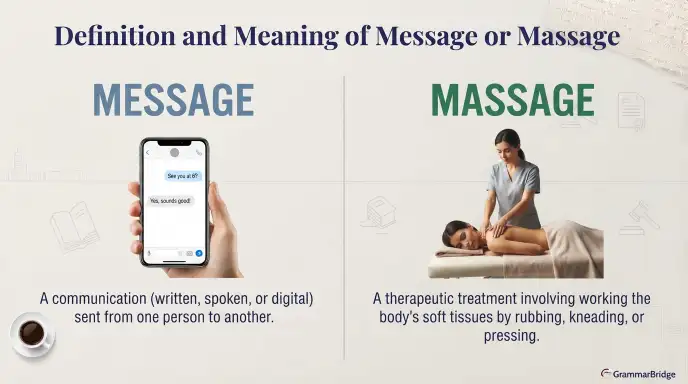
A message is information, a note, or an idea that is communicated to another person.
It can be sent through many forms, such as:
- Text messages
- Emails
- Letters
- Phone calls
- Social media
- Written notes
For example:
I sent a message to my friend.
Here, message means information sent to the friend.
The word can also describe an idea or lesson that someone wants to communicate.
Example:
The movie has a strong message about friendship.
In this sentence, message means the main idea or lesson.
What Does “Massage” Mean?
A massage is a physical treatment that involves rubbing, pressing, or moving parts of the body.
People often get massages to:
- Relax
- Reduce muscle tension
- Feel more comfortable
- Support physical recovery
Example:
She booked a massage after a long week.
Here, massage refers to a physical treatment.
Message vs Massage: Simple Meaning
The easiest way to remember the difference is:
Message = information
Massage = body treatment
The extra “as” sound in massage can help you remember that it refers to physical treatment.
The Origin of Message or Massage
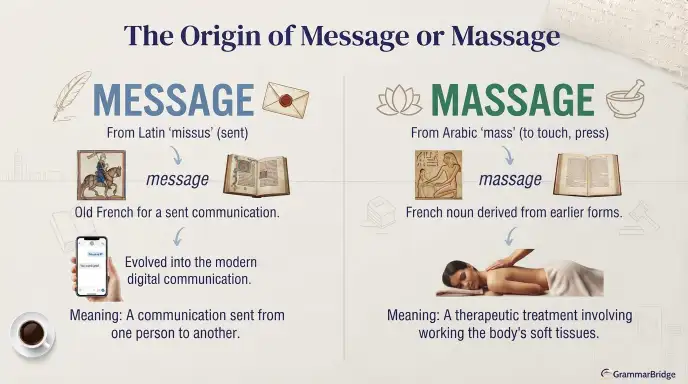
The words message and massage have different histories, even though they look and sound similar.
Origin of “Message”
The English word message comes through Old French message. It is related to the idea of sending or communicating information.
Over time, the word became common in English for information delivered from one person to another.
Today, the message has a very broad meaning. It can refer to a text, email, spoken communication, written note, or central idea.
Origin of “Massage”
The word massage entered English from French massage. It is connected with the practice of rubbing or manipulating the body.
The word became associated with physical treatment and relaxation.
Although message and massage have similar spellings, they developed from different linguistic roots. Their different meanings are therefore not simply different spellings of the same word.
Why Are Messages and Massages Confused?
There are several reasons:
- Both words contain similar letters.
- Their pronunciations can sound close to learners.
- Both are common English words.
- Fast typing can cause spelling errors.
- English spelling does not always match pronunciation perfectly.
Remembering their meanings is the easiest way to avoid confusion.
British English vs American English Spelling
There is no British vs American spelling difference between message and massage. Both words are spelled the same way in British English and American English.
The meaning also stays the same in both forms of English.
British English
- I sent you a message.
- She booked a massage.
- Please read my message.
- The massage was relaxing.
American English
- I sent you a message.
- She booked a massage.
- Please read my message.
- The massage was relaxing.
Comparison Table
| Word | British English | American English | Meaning |
| Message | Message | Message | Information or communication |
| Massage | Massage | Massage | Body treatment |
| Messaged | Messaged | Messaged | Sent a message |
| Massaged | Massaged | Massaged | Gave a massage |
So, you do not need to change the spelling based on if your audience uses British or American English.
Which Spelling Should You Use?
Choose the word based on what you want to say, not the country of your reader.
Use “Message” for Communication
Use a message when you mean information, communication, or an idea.
Examples:
- Please send me a message.
- I received your message.
- His message was easy to understand.
Use “Massage” for Body Treatment
Use massage when you mean rubbing or pressing the body for relaxation or treatment.
Examples:
- I would like a massage.
- She had a massage after work.
- The therapist gave him a gentle massage.
For US Readers
Use the same spellings:
message and massage
For UK and Commonwealth Readers
Use the same spellings:
message and massage
For Global Audiences
Both spellings are widely understood. The key is to select the word that matches your intended meaning.
Common Mistakes with Message or Massage
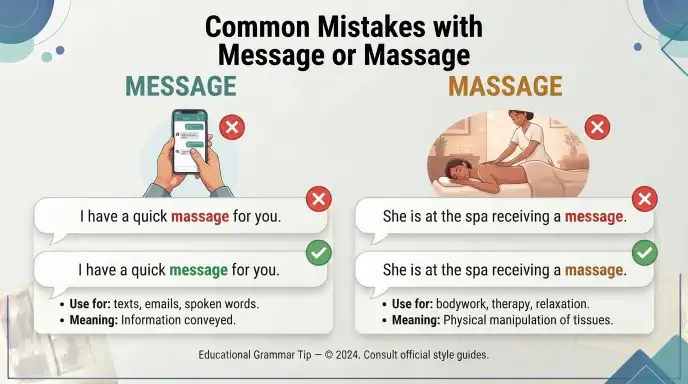
Because these words look very similar, they are often mixed up in writing.
Mistake 1: Using “Massage” for a Text
I sent you a massage.
✅ I sent you a message.
A text is a message, not a massage.
Mistake 2: Using “Message” for Body Treatment
I booked a message at the spa.
✅ I booked a massage at the spa.
A body treatment is a massage.
Mistake 3: Confusing “Messaged” and “Massaged”
She massaged me on WhatsApp.
✅ She messaged me on WhatsApp.
Messaged means sending a message.
Mistake 4: Using the Wrong Word in Business Writing
Thank you for your massage.
✅ Thank you for your message.
When replying to an email or business communication, message is usually the correct word.
Easy Memory Trick
Think:
Message → information
Massage → muscles
This simple connection can help you remember which word to use.
Message or Massage in Everyday Examples
Both words appear often in everyday English, but they are used in very different situations.
In Emails
Message:
Thank you for your message. I will reply soon.
Massage:
I booked a massage for Friday afternoon.
In Text Messages
Message:
Did you get my message?
Massage:
I am going for a massage after work.
On Social Media
Message:
Send me a message if you have any questions.
Massage:
This massage was exactly what I needed today.
In Formal Writing
Message:
The report communicates an important message about workplace safety.
Massage:
Massage therapy may be discussed as part of a wellness program.
In News Writing
Message:
The leader delivered a message to the public.
Massage:
The article discussed the growing interest in massage therapy.
The surrounding words usually make the intended meaning clear.
Message vs Massage : Comparison Table
| Feature | Message | Massage |
| Part of speech | Noun and verb | Noun and verb |
| Main meaning | Information or communication | Physical treatment |
| Common use | Texts, emails, notes | Spas, therapy, relaxation |
| Verb form | To message someone | To massage someone |
| Past tense | Messaged | Massaged |
| Example | Send me a message. | I need a massage. |
| Related word | Messenger | Massage therapist |
| British spelling | Message | Massage |
| American spelling | Message | Massage |
Message or Massage : Google Trends & Usage Data
Search interest for messages and messages can vary by country, language, and context. However, the two words are searched for different reasons.
People commonly search message when they want information about:
- Text messaging
- Email communication
- Social media messages
- Message meanings
- Writing or sending messages
People commonly search massage in contexts such as:
- Massage therapy
- Spa services
- Relaxation
- Massage techniques
- Types of massage
Search volume can also change over time because of technology, health and wellness trends, and seasonal interests.
For an if article, it is useful to treat message and message as separate search intents. Although they differ by only one letter, users searching for one may want completely different information.
FAQs
Q1. Which is correct, message or message?
Both message and message are correct words, but they have different meanings.
Message means information sent to someone, while massage means rubbing or manipulating the body.
Q2. What is correct, message or message?
Message is the correct spelling; message is a misspelling.
Example: “I sent you a message this morning.”
Q3. How do you spell massage the body?
The correct spelling is massage, spelled MifAifSifSifAifGifE.
Example: “She learned how to massage the muscles.”
Q4. What does massage mean?
Massage means rubbing or pressing parts of the body to promote relaxation or relieve muscle tension.
It can also refer to the treatment or session itself.
Q5. Why use massage?
Massage may be used for relaxation, reducing muscle tension, and improving comfort.
Its benefits can vary depending on the type of massage and the individual.
Q6. What do we call a massage?
A massage can be called a massage treatment, massage therapy, or simply a massage session.
The exact term may depend on the type and purpose of the treatment.
Q7. What is another word for massage?
Depending on the context, alternatives include bodywork, rubbing, kneading, or massage therapy.
“Bodywork” is a broader term that can include several handsifon techniques.
Q8. What is a female massage called?
A female massage therapist is generally called a massage therapist, regardless of gender.
There is no separate standard term for a massage simply because the therapist is female.
Conclusion
Message and massage are both correct English words, but they should never be used interchangeably. Message refers to information, communication, or an idea that is shared with another person. Massage refers to a physical treatment that involves rubbing or pressing the body.
The spelling does not change between British and American English, so the main challenge is choosing the word that matches your meaning. If you are talking about a text, email, note, or communication, use message. If you are talking about a spa treatment, therapy, or bodywork, use massage.
A simple memory trick is to connect message with information and massage with muscles. This can help you avoid common errors in emails, texts, social media posts, and formal writing. Once you understand the difference, choosing between message or massage becomes quick and easy.

I’m James Mitchell, an English language and grammar writer at Grammwise. I enjoy helping readers understand confusing words, spelling differences, grammar rules, and everyday English usage. My goal is to make English simple, clear, and easy to use with practical examples and straightforward explanations.


2 thoughts on “Message or Massage: Which Spelling Is Correct?”