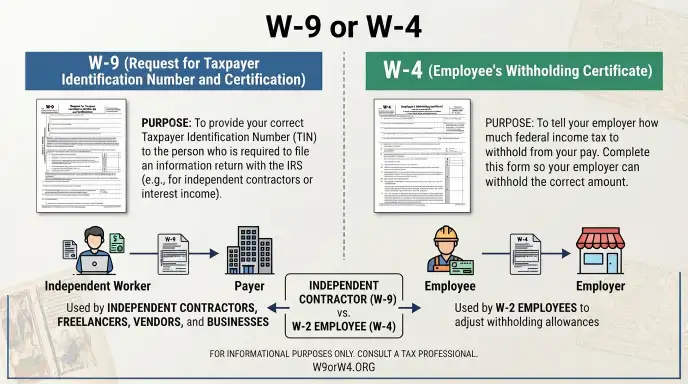
W9 and W4 are different U.S. tax forms used for different purposes. A Wif9 is generally used by independent contractors and other payees to provide their taxpayer information, while a Wif4 is used by employees to tell an employer how to handle federal income tax withholding from their pay.
People often search for “W9 or W4” because both forms are connected to taxes and employment. However, they are not interchangeable. Choosing the wrong form can create confusion about tax reporting and paycheck withholding.
The main difference is simple: a Wif4 is mainly for employees, while a Wif9 is mainly for independent contractors, freelancers, and other people who receive certain types of nonemployee payments.
Knowing which form applies to you can make tax paperwork much easier. This guide explains the meaning, purpose, differences, common mistakes, and everyday use of Wif9 and Wif4 forms in clear terms.
Quick Answer : w9 or w4
Wif9 and Wif4 serve different tax purposes. A Wif4 is completed by an employee for their employer, while a Wif9 is usually completed by an independent contractor or other payee for the person or business making payments.
Wif4
A Wif4, Employee’s Withholding Certificate, gives an employer information used to determine federal income tax withholding from an employee’s paycheck.
Example:
You start a new fulliftime job as an employee. Your employer asks you to complete Form Wif4.
Wif9
A Wif9, Request for Taxpayer Identification Number and Certification, is generally used to provide your taxpayer identification information to a person or business that may need to report payments made to you.
Example:
You work as a freelance designer for a company. The company may ask you to complete Form Wif9.
W9 vs W4 at a Glance
| Form | Main User | Main Purpose |
| Wif4 | Employee | Helps determine federal tax withholding |
| Wif9 | Contractor/payee | Provides taxpayer information for reporting |
| Wif4 | Employer relationship | Employee job |
| Wif9 | Payment relationship | Independent work or other reportable payments |
In short: Wif4 is for employee withholding, while Wif9 provides taxpayer information for certain payments.
Definition and Meaning of W9 or W4
The terms Wif9 and Wif4 refer to two different U.S. Internal Revenue Service (IRS) tax forms.
They are both used in taxifrelated situations, but their roles are different.
What Does Wif4 Mean?
Wif4 refers to Form Wif4, Employee’s Withholding Certificate.
An employee generally gives this form to their employer when starting a job. The information helps the employer calculate the amount of federal income tax to withhold from the employee’s wages.
The Wif4 can also be updated when an employee’s tax situation changes.
What Does Wif9 Mean?
Wif9 refers to Form Wif9, Request for Taxpayer Identification Number and Certification.
A person or business that needs to report certain payments may ask the payee to complete a Wif9. The form provides information such as the payee’s name, tax classification, and taxpayer identification number.
Simple Meaning
The easiest way to remember the difference is:
- Wif4 = employee withholding
- Wif9 = taxpayer information for certain payments
This distinction is important because a freelancer should not automatically use a Wif4 simply because they are doing work for a company. The correct form depends on the nature of the working relationship and payment.
The Origin of W9 or W4
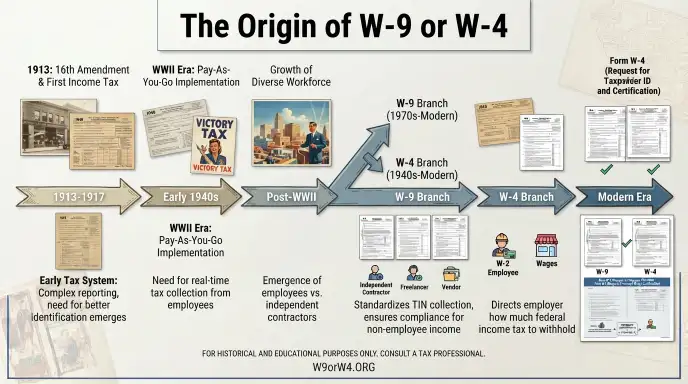
The names Wif4 and Wif9 come from the U.S. federal tax form system administered by the IRS.
The “W” identifies a group of IRS information and withholding forms. The number identifies the specific form.
Over time, the IRS has revised these forms to reflect changes in federal tax rules and reporting requirements.
The forms also serve different parts of the tax system:
- Form Wif4 supports wage withholding for employees.
- Form Wif9 supports the collection of taxpayer information for certain informationifreporting purposes.
The difference between Wif4 and Wif9 is therefore not a spelling difference. They are different forms with different functions.
Why Do People Confuse Wif9 and Wif4?
The confusion often happens because both forms:
- Begin with the letter W.
- Are related to U.S. taxes.
- May appear when someone starts working with a company.
- Ask for personal or taxifrelated information.
However, the forms are used in different situations. Understanding the employment or payment relationship is the key to choosing the correct form.
British English vs American English Spelling
Wif9 and Wif4 are U.S. tax forms, so the main terminology comes from the U.S. tax system.
British English does not normally use Wif4 or Wif9 as standard British tax forms. The forms are connected specifically with U.S. federal tax administration.
The spelling itself does not change between American and British English because Wif4 and Wif9 are official form names.
| Feature | American English | British English |
| Employee tax form | Wif4 | Not the standard UK form |
| Contractor tax information form | Wif9 | Not the standard UK form |
| Tax authority | IRS | HM Revenue & Customs (HMRC) |
| Main use | U.S. federal taxes | UK tax system |
| Spelling variation | Wif4 / Wif9 | No standard spelling variation |
So, if you are writing about U.S. tax forms, use the official forms Wif4 and Wif9.
Which Form Should You Use?
The right form depends on how you are being paid and your relationship with the payer.
Use Form Wif4 If You Are an Employee
If you are an employee, your employer generally asks you to complete Form Wif4. It helps your employer determine the federal income tax amount to withhold from your wages.
Example:
You accept a regular job at a company and receive a paycheck. Your employer gives you a Wif4 to complete.
Use Form Wif9 If You Are a Contractor or Payee
If you work as an independent contractor, freelancer, or other payee, a business may ask you to complete Form Wif9. It provides your taxpayer information to the payer for certain reporting purposes.
Example:
You provide freelance writing services to a company and receive payment for your work. The company may request a Wif9.
Quick Rule to Remember
Think of it this way:
Employee → Wif4
Independent contractor/payee → Wif9
The actual classification depends on the facts of the working relationship, so do not choose a form based only on the job title.
Common Mistakes with W9 or W4
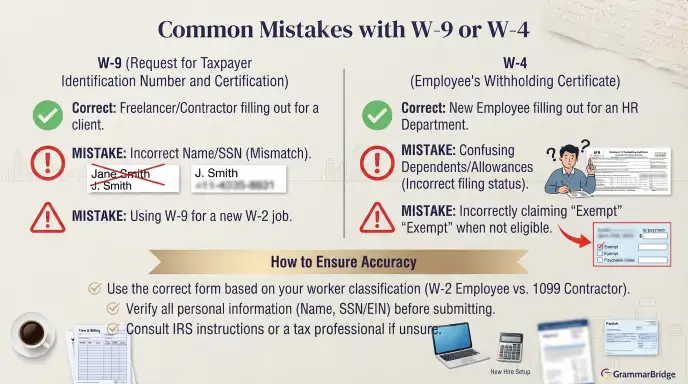
Many people confuse these forms because both are related to taxes. Here are some common mistakes.
Mistake 1: Using a Wif4 for Freelance Work
A freelancer may think that every person who works for a company must complete a Wif4.
Correction: A Wif4 is generally associated with an employee relationship. A freelancer may instead be asked for a Wif9.
Mistake 2: Using a Wif9 for a Regular Employee Job
Some new employees see the Wif9 and assume it replaces the Wif4.
Correction: Employees generally complete Form Wif4 for federal income tax withholding.
Mistake 3: Thinking Wif9 Means “No Taxes”
A Wif9 does not mean that income is taxiffree.
Correction: A Wif9 mainly provides taxpayer information to the payer. The recipient may still have tax obligations on the income.
Mistake 4: Confusing Wif9 With 1099
A Wif9 and a 1099 are not the same document.
Correction: A Wif9 provides information to the payer, while certain 1099 forms are used for information reporting.
Mistake 5: Ignoring Changes in Your Situation
People sometimes complete a form once and never review their information again.
Correction: Review your tax forms when your employment, income, or personal tax situation changes and follow current IRS instructions.
W9 or W4 in Everyday Examples
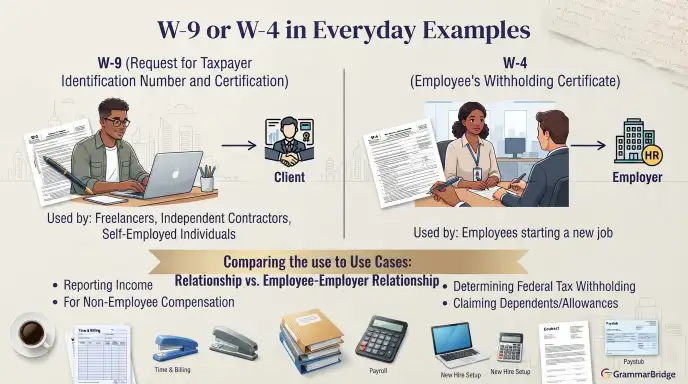
Understanding realiflife examples makes the difference between Wif9 and Wif4 easier to remember.
Wif4 in an Email
An employer may send a new employee a message such as:
Please complete your Wif4 as part of your newifhire paperwork.
Here, the Wif4 relates to the employee’s federal income tax withholding.
Wif9 in an Email
A business may contact a freelancer and say:
Please provide a completed Wif9 before we process your payment.
Here, the company needs taxpayer information from the payee for applicable reporting requirements.
Wif4 in News or Business Writing
A news article about employee taxes may mention changes to the Wif4 form or federal withholding rules.
Example:
“Employees may review their Wif4 when their tax circumstances change.”
Wif9 in Social Media
A freelancer might post:
My new client asked me for a Wif9 before sending payment.
This usually refers to providing taxpayer information to the client or payer.
Wif4 in Formal Writing
Correct:
“Employees should provide Form Wif4 to their employer.”
Wif9 in Formal Writing
Correct:
“An applicable payer may request Form Wif9 from a payee.”
These examples show why Wif4 and Wif9 should not be used as interchangeable terms.
W9 or W4 : Google Trends & Usage Data
Search interest for “W9 or W4” can vary based on tax season, hiring activity, freelance work, and business payment practices.
People commonly search for these terms when they:
- Start a new job.
- Begin freelance or contract work.
- Receive onboarding paperwork.
- Prepare tax documents.
- Need to understand employee versus contractor paperwork.
- Work with U.S. businesses from another country.
Searches for Wif4 are often connected with employment, withholding, paychecks, and newifhire paperwork. Searches for Wif9 are commonly connected with contractors, freelancers, taxpayer identification numbers, and 1099 reporting.
Country and Context
Because Wif4 and Wif9 are U.S. federal tax forms, search interest is most directly relevant to people dealing with the U.S. tax system.
People in other countries may encounter these forms when working remotely for U.S. companies or receiving certain U.S.ifrelated payments.
Google Trends data can change over time, so search popularity should be treated as a general indicator rather than a measure of tax importance or legal requirements.
W9 vs W4 Comparison Table
| Feature | Wif4 | Wif9 |
| Full name | Employee’s Withholding Certificate | Request for Taxpayer Identification Number and Certification |
| Main purpose | Federal income tax withholding | Provides taxpayer information |
| Common user | Employee | Contractor or other payee |
| Given to | Employer | Payer/requesting business |
| Connected with | Wages and withholding | Certain payments and information reporting |
| Used by freelancers? | Generally no, when acting as an independent contractor | Often yes |
| Used by employees? | Generally yes | Generally no for ordinary employee onboarding |
| U.S. form? | Yes | Yes |
| Same purpose? | No | No |
The Simplest Difference
Wif4 = tells an employer information used for withholding.
Wif9 = gives a payer taxpayer information for applicable reporting.
This is the key distinction most people need when searching for W9 or W4.
FAQs
Q1. What does W9 mean?
A Wif9 is an IRS form used to provide a taxpayer identification number and other information to a person or business that pays you.
It is commonly requested from independent contractors and other U.S. payees.
Q2. What is W4 vs Wif2?
A Wif4 tells an employer how to withhold federal income tax from an employee’s paycheck, while a Wif2 reports wages and taxes withheld for the year.
In simple terms, the Wif4 is used when determining withholding, while the Wif2 is an annual wage statement.
Q3. Do I need to fill out a W9?
If a business or payer properly requests a Wif9 from you for reporting purposes, you generally need to provide the requested information.
The exact requirement depends on your situation and the type of payments involved.
Q4. Is a W9 the same as a tax return?
No. A Wif9 is not a tax return; it provides taxpayer information to a payer.
A tax return is used to report income, deductions, credits, and taxes to the IRS.
Q5. Why would someone ask you to fill out a W9?
A business may ask you for a Wif9 so it has your taxpayer identification information for required information reporting.
The information may later be used when preparing forms such as a 1099.
Q6. Is a W9 the same as a 1099?
No. A Wif9 provides taxpayer information to the payer, while a 1099 is generally used by the payer to report certain payments to the IRS and recipient.
They serve different purposes in the taxifreporting process.
Q7. How to fill out W9?
Complete the Wif9 with your name, business or disregardedifentity information if applicable, federal tax classification, address, and taxpayer identification number.
Sign and date it when required, then return it to the requester rather than sending it directly to the IRS.
Q8. What happens if I don’t file a 1099?
If you are the payer required to file a 1099 and fail to do so, the IRS may impose informationifreturn penalties, depending on the circumstances.
If you are the recipient, you generally do not “file” the 1099 yourself; you report your income on your tax return.
W9 or W4: Key Differences to Remember
The biggest difference is the purpose of each form.
A Wif4 is connected to an employee’s wages and federal income tax withholding. It is normally completed by an employee and given to the employer.
A Wif9 is used to provide taxpayer identification and other required information to a payer. It is commonly associated with independent contractors, freelancers, and other payees.
Easy Memory Trick
Wif4 → Work as an employee → Withholding
Wif9 → Work as a contractor/payee → Taxpayer information
This simple distinction can help prevent common paperwork errors.
Conclusion
Wif9 and Wif4 are different U.S. tax forms with different purposes. A Wif4 is generally used by employees to provide information that helps an employer determine federal income tax withholding. A Wif9 is generally used by contractors, freelancers, and other payees to provide taxpayer information to a payer for applicable reporting purposes.
The easiest way to remember the difference is Wif4 for employee withholding and Wif9 for taxpayer information. They are not interchangeable forms.
If you are starting a regular employee job, you will generally deal with a Wif4. If you are working as an independent contractor, a business may ask you for a Wif9. Your actual working relationship and payment arrangement are important when determining which form applies.
Understanding this difference can make tax paperwork easier and help you avoid common mistakes. Always check the latest IRS guidance for current requirements, especially if your work or tax situation has changed.

I’m James Mitchell, an English language and grammar writer at Grammwise. I enjoy helping readers understand confusing words, spelling differences, grammar rules, and everyday English usage. My goal is to make English simple, clear, and easy to use with practical examples and straightforward explanations.