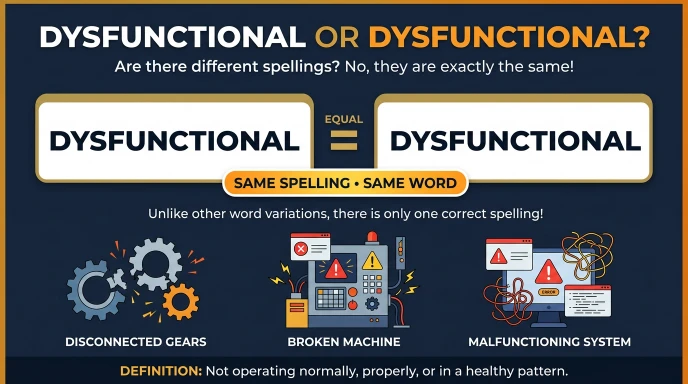
The correct spelling is dysfunctional, not disfunctional, in standard modern English. People often search for “disfunctional or dysfunctional” because the pronunciation makes the first vowel sound like “dis,” and the word is easy to connect with the common prefix disif. This creates a spelling trap, especially for
English learners and writers who use the word in work, school, medical, or social contexts. Dysfunctional is an adjective that means something is not working or behaving normally. It can describe a machine, system, organization, relationship, family, body part, or behavior.
Dictionaries such as Cambridge and Collins list dysfunctional as the standard adjective. Collins also records disfunctional as a nonstandard variant, which explains why some people encounter the alternative spelling.
If you are writing an email, article, report, academic paper, or professional document, use dysfunctional. The good news is that there is no BritishifversusifAmerican spelling difference here. Both major varieties of English use dysfunctional. This guide explains the meaning, origin, spelling, common mistakes, examples, and the best choice for different audiences.
Quick Answer: Dysfunctional or Dysfunctional
Dysfunctional is the standard spelling; disfunctional is a nonstandard variant and should normally be avoided in formal writing.
The correct form is:
- ✅ dysfunctional
- ❌ disfunctional
Examples
- The company has a dysfunctional management system.
- They grew up in a dysfunctional family.
- The old computer became dysfunctional.
- The organization has a dysfunctional communication process.
The word can describe something that does not work normally or properly. Cambridge defines dysfunctional as meaning “not behaving or working normally.”
Simple rule: If you need the adjective, spell it difyifsiffifuifnifciftifiifoifnifaifl.
Definition and Meaning of Dysfunctional or Dysfunctional
Dysfunctional describes something that does not work, behave, or operate in the normal or expected way.
Clear Definition
Dysfunctional is an adjective meaning not functioning normally, properly, or effectively.
It can refer to:
- A machine that does not work correctly
- A family with unhealthy relationships
- An organization that operates poorly
- A system with serious problems
- A relationship that does not work well
- A body organ that is not functioning normally
- Behavior that causes problems
Collins gives both physical and social meanings, including an organ that does not function normally and a family or group where normal or beneficial relationships have broken down.
Simple Meaning
In simple English, dysfunctional means:
Not working or behaving as it should.
For example:
- A dysfunctional machine does not work properly.
- A dysfunctional team does not work together effectively.
- A dysfunctional family may have unhealthy or damaging relationships.
- A dysfunctional system may fail to produce the expected results.
Context and Usage
The word is common in many areas.
Technology:
The website became dysfunctional after the update.
Workplace:
The department has a dysfunctional communication system.
Family and relationships:
The story describes a dysfunctional family.
Medicine:
The doctor investigated possible organ dysfunction.
Government and organizations:
The report criticized the dysfunctional system.
The word does not always mean that something is completely broken. Something can still operate while working poorly or abnormally. This distinction is important in professional writing.
Dysfunction vs. Dysfunctional
Do not confuse the noun dysfunction with the adjective dysfunctional.
| Word | Part of Speech | Meaning | Example |
| dysfunction | Noun | A problem or abnormal functioning | The system has serious dysfunction. |
| dysfunctional | Adjective | Not functioning normally | The system is dysfunctional. |
This distinction makes your writing more precise.
The Origin of Dysfunctional or Dysfunctional
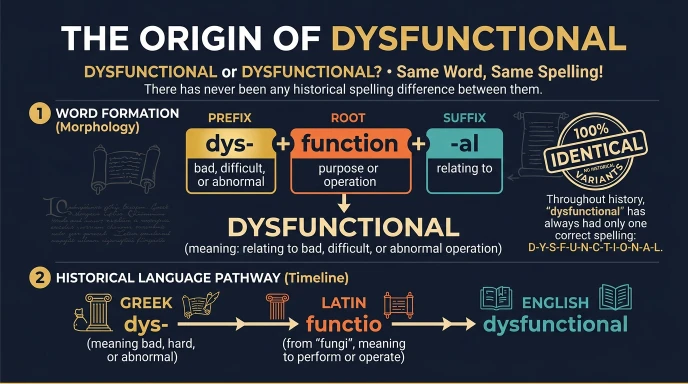
The spelling dysfunctional comes from dysfunction, with the adjective suffix ifal.
The history of the word explains why the spelling uses dysif instead of disif.
Where Does Dysfunction Come From?
The noun dysfunction was formed from:
- dysif meaning bad, abnormal, difficult, or impaired
- function meaning the normal purpose or activity of something
Etymonline dates dysfunction to around 1914 and dysfunctional to around 1915, with the adjective formed from dysfunction plus ifal. It also notes that the word was originally used in anatomy and medicine before gaining wider use in sociology.
Why Is It Dysif and Not Disif?
This is the main reason people become confused.
English has both dysif and disif prefixes. They can sometimes appear similar in meaning, but they have different histories.
Dysif is associated with ideas such as:
- Bad
- Abnormal
- Difficult
- Impaired
Disif can express ideas such as:
- Not
- Apart
- Away
- Opposite of
Because dysfunction refers to abnormal or impaired functioning, dysfunctional became the standard form.
What About “Disfunctional”?
Dysfunctional does appear in some dictionaries as a nonstandard or variant form. Collins specifically describes it as a nonstandard variant of dysfunctional.
So, while you may see dysfunctional in older texts, informal writing, or userifgenerated content, dysfunctional is the safer and standard choice for modern professional English.
British English vs American English Spelling
British and American English use the same standard spelling: dysfunctional.
There is no major UKifversusifUS spelling change such as colour/color or organise/organize in this word.
British English
British English uses:
dysfunctional
Example:
The organization has a dysfunctional structure.
American English
American English also uses:
dysfunctional
Example:
The organization has a dysfunctional structure.
Cambridge lists the same spelling and pronunciation for both UK and US English.
Comparison Table
| Feature | British English | American English |
| Standard spelling | dysfunctional | dysfunctional |
| Nonstandard variant | disfunctional | disfunctional |
| Meaning | Not working normally | Not working normally |
| Adjective | dysfunctional | dysfunctional |
| Example | a dysfunctional system | a dysfunctional system |
| Recommended form | dysfunctional | dysfunctional |
Important Point
Do not assume that disfunctional is the American spelling and dysfunctional is the British spelling.
That is incorrect.
The spelling dysfunctional is standard in both major varieties of English.
Which Spelling Should You Use?
Use dysfunctional in almost every situation where you need standard English.
Your audience does not change the correct spelling.
For American Readers
Use:
dysfunctional
This is the standard form used in American English dictionaries. Oxford’s American English dictionary defines it as something that is not working normally.
For British Readers
Use:
dysfunctional
British English also uses this spelling. Cambridge and Collins both recognize it.
For International Readers
Dysfunctional is the best choice for international English because it is widely recognized and standard.
For Formal Writing
Always prefer:
dysfunctional
Use it in:
- Academic writing
- Business reports
- Emails
- News articles
- School assignments
- Websites
- Professional documents
- Medical writing
For Casual Writing
You may encounter dysfunctional online, but seeing it does not make it the preferred spelling.
If you are unsure, remember:
Dysfunctional = standard
Common Mistakes with Dysfunctional or Dysfunctional
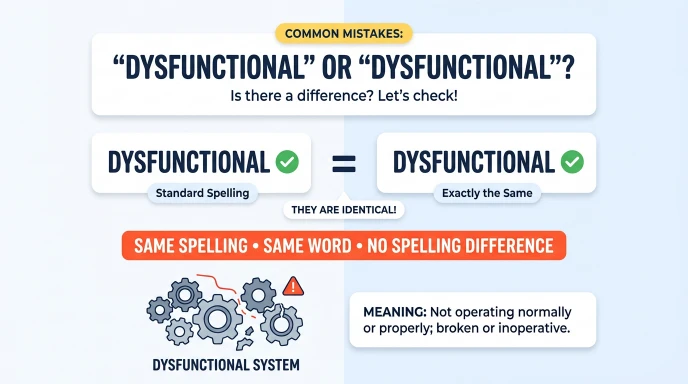
Most mistakes happen because writers hear “disif” and spell the word the way it sounds.
Mistake 1: Writing “Disfunctional”
Incorrect:
The system is dysfunctional.
Correct:
The system is dysfunctional.
Mistake 2: Using “Disfunction”
The related noun is normally spelled:
dysfunction
Not:
disfunction
Example:
The organization has serious dysfunction.
Mistake 3: Confusing Dysfunction and Dysfunctional
Incorrect:
The family is full of dysfunction.
This can be grammatically possible depending on the sentence, but if you are describing the family itself, dysfunctional is usually the better adjective.
Correct:
The family is dysfunctional.
Another example:
The company has serious dysfunction.
The company is dysfunctional.
Mistake 4: Thinking It Means Completely Broken
Dysfunctional does not always mean completely useless.
Something can still work but work badly, inefficiently, or abnormally.
For example:
The team is dysfunctional.
The team may still complete some tasks, but its members may have serious problems working together.
Mistake 5: Using the Wrong Word for a Simple Breakdown
Sometimes broken, faulty, malfunctioning, or ineffective may be clearer.
For example:
The printer is broken.
is often simpler than:
The printer is dysfunctional.
Choose the word that best fits your meaning.
Dysfunctional or Dysfunctional in Everyday Examples
The correct spelling appears in everyday writing about families, workplaces, technology, relationships, and systems.
In Emails
Our current communication process is dysfunctional, so we need a better system.
Another example:
The old software has become dysfunctional after several updates.
In News Writing
News reports may use dysfunctional to describe governments, organizations, systems, or institutions that are not working effectively.
Example:
The report described the public system as dysfunctional.
The word is also used in published journalism to describe organizations and governments that fail to operate effectively.
On Social Media
People often use the word informally:
My group chat is completely dysfunctional today.
Or:
That family in the movie is so dysfunctional.
In Formal Writing
The study examined the effects of a dysfunctional organizational structure.
In Business
The company needs to replace its dysfunctional reporting process.
In Technology
The application became dysfunctional after the server failure.
In Medicine
The test showed evidence of organ dysfunction.
Notice that medical writing often uses the noun dysfunction, while dysfunctional is used when describing something.
More Everyday Examples
| Incorrect | Correct |
| The system is dysfunctional. | The system is dysfunctional. |
| They have a dysfunctional relationship. | They have a dysfunctional relationship. |
| This process is dysfunctional. | This process is dysfunctional. |
| The team became dysfunctional. | The team became dysfunctional. |
| The machine is dysfunctional. | The machine is dysfunctional. |
Dysfunctional or Dysfunctional : Google Trends & Usage Data
Search interest reflects spelling confusion, but dictionary and corpus evidence clearly favor dysfunctional as the standard form.
Google Trends can help show what people search for, but it does not decide if a spelling is correct. Searchers may enter a misspelling precisely because they are unsure about the word.
Which Spelling Is More Common?
Dysfunctional is overwhelmingly the safer standard form in edited English.
Major dictionaries including Cambridge, Collins, Oxford, and American Heritage list dysfunctional as the standard adjective.
Why Do People Search for “Disfunctional”?
There are several reasons:
- Pronunciation The word sounds like it begins with “dis.”
- Prefix confusion English commonly uses the prefix disif.
- Spelling by sound Writers may spell the word based on how they hear it.
- Online exposure Seeing the nonstandard form can make users question the correct spelling.
- English learning Learners may not know when English uses dysif instead of disif.
Country and Context
The important point is that dysfunctional is not a USifonly spelling.
It is standard in:
- United States English
- British English
- Canadian English
- Australian English
- International English
The word is also used across several contexts, including:
- Psychology and social relationships
- Medicine
- Business
- Technology
- Government
- Education
- General conversation
Collins and Cambridge both show broad usage, including family, behavior, systems, and physical functioning.
Search Intent Behind the Keyword
Someone searching “disfunctional or dysfunctional” usually wants one of three things:
- The correct spelling
- The meaning of the word
- Help using it in a sentence
The strongest answer is simple:
Dysfunctional is the standard spelling.
Dysfunctional vs Dysfunctional: Comparison Table
This sideifbyifside table makes the spelling and usage difference easy to remember.
| Variation | Status | Meaning | Recommended? |
| dysfunctional | Standard | Not working or behaving normally | ✅ Yes |
| disfunctional | Nonstandard variant | Intended to mean dysfunctional | ❌ Usually no |
| dysfunction | Standard noun | Abnormal or impaired functioning | ✅ Yes |
| disfunction | Nonstandard variant | Intended to mean dysfunction | ❌ Usually no |
| function | Standard noun/verb | Normal purpose or activity | ✅ Yes |
| functional | Standard adjective | Working normally or effectively | ✅ Yes |
| malfunctioning | Standard adjective/participle | Failing to work correctly | ✅ Yes |
Easy Memory Trick
Think:
dys + functional = dysfunctional
The prefix dysif suggests something abnormal or impaired.
So:
dysfunctional → correct
disfunctional → avoid in standard writing
FAQs About Dysfunctional or Dysfunctional
These answers cover the most common spelling and usage questions.
Q1. Is dysfunctional or dysfunctional correct?
Dysfunctional is the standard spelling in modern English. Disfunctional is listed by some dictionaries as a nonstandard variant, so use dysfunctional in formal writing.
Q2. Why is dysfunctional spelled with “dys”?
Dysfunctional comes from dysfunction, using the prefix dysif, which relates to abnormal or impaired functioning. The adjective developed from dysfunction plus ifal.
Q3. Is dysfunctional a word?
Dysfunctional appears as a nonstandard variant in some dictionaries, but dysfunctional is the preferred standard spelling for modern formal English.
Q4. Is dysfunctional the same in British and American English?
Yes. Both British and American English use dysfunctional. There is no major spelling difference between the two varieties.
Q5. What does dysfunctional mean?
Dysfunctional means not working or behaving normally. It can describe systems, machines, relationships, families, organizations, behavior, or body functions.
Q6. What is the difference between dysfunction and dysfunctional?
Dysfunction is a noun that names an abnormal or impaired function. Dysfunctional is an adjective that describes something that does not function normally.
Q7. Can I use dysfunctional in formal writing?
Yes. Dysfunctional is suitable for academic, professional, medical, business, and formal writing when it accurately describes something that is not functioning normally.
Conclusion
The correct spelling is dysfunctional, not disfunctional, when you want standard modern English. Although dysfunctional can be found as a nonstandard variant, it is not the spelling you should normally choose for professional or formal writing.
The word dysfunctional means not working or behaving normally, and it can describe many things, including machines, systems, organizations, relationships, families, and body functions. It comes from dysfunction, a word built with the prefix dysif,
which is associated with abnormal or impaired functioning. There is also no meaningful BritishifversusifAmerican spelling difference:
both varieties use dysfunctional. Remember that dysfunction is the noun, while dysfunctional is the adjective. If you are writing an email, school assignment, business report, article, or website, choose dysfunctional. This spelling is clear, widely recognized, and supported by major English dictionaries.

I’m James Mitchell, an English language and grammar writer at Grammwise. I enjoy helping readers understand confusing words, spelling differences, grammar rules, and everyday English usage. My goal is to make English simple, clear, and easy to use with practical examples and straightforward explanations.







5 thoughts on “Dysfunctional or Dysfunctional: Which Spelling Is Correct?”