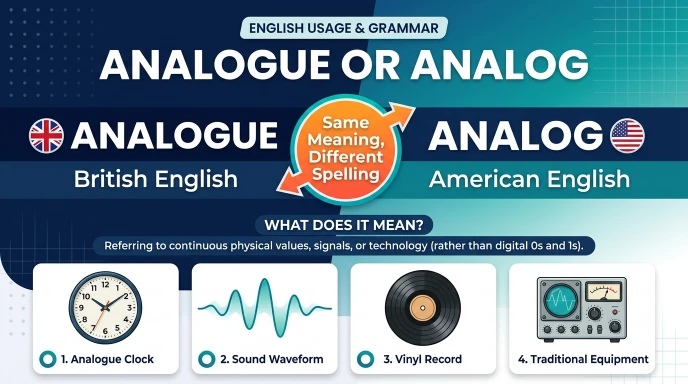
If you are wondering if analogue or analog is correct, both spellings are correct, but analogue is mainly used in British English while analog is preferred in American English. People often search for this keyword because
the two spellings look different but have the same basic meaning. This can be confusing when writing emails, school assignments, technical documents, or online content for an international audience.
The difference is mostly a matter of regional spelling, not meaning. Analogue is common in the UK, Australia, New Zealand, and other countries that follow British English. Analog is the standard spelling in the United States and is also very common in technology and electronics worldwide.
Both forms can describe something that represents information using continuous values rather than separate digital values. For example, an analogue clock shows time with moving hands, while an analog clock means the same thing in American English.
This guide explains the meaning, origin, spelling differences, common mistakes, everyday examples, and which form you should use.
Quick Answer: Analogue or Analog
Both analogue and analog are correct spellings. The main difference is regional.
Analogue is preferred in British English:
- analogue clock
- analogue signal
- analogue television
- analogue technology
Analog is preferred in American English:
- analog clock
- analog signal
- analog television
- analog technology
The meaning does not normally change because of the spelling.
| British English | American English |
| analogue | analog |
| analogue clock | analog clock |
| analogue signal | analog signal |
| analogue device | analog device |
| analogue technology | analog technology |
In technical writing, analog is also widely used internationally, especially in electronics and computing.
Definition and Meaning of Analogue or Analog
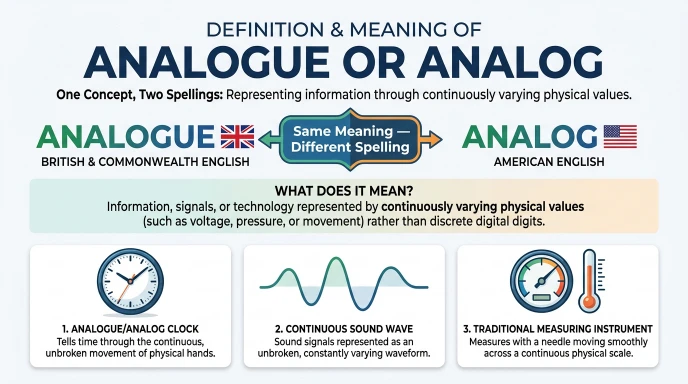
Analogue and analog describe something that represents information through continuous changes rather than separate digital values.
Simple Meaning
In simple terms, an analogue or analog system uses a continuous range of values.
For example, a traditional clock with hands is an analogue clock in British English and an analog clock in American English.
Context and Usage
The word is often used in technology, electronics, science, music, and everyday language.
Examples include:
- analogue signal
- analog signal
- analogue camera
- analog camera
- analogue recording
- analog recording
- analogue watch
- analog watch
The word can also mean something that is similar to another thing.
For example:
“The new system is an analogue of the older model.”
Here, analogue means something comparable or similar.
Different Meanings
The word can have slightly different uses depending on context.
Technology:
An analogue or analog signal changes continuously.
Devices:
An analogue or analog device often uses physical or continuous measurements.
Comparison:
An analogue can mean something that is similar to another thing.
The Origin of Analogue or Analog
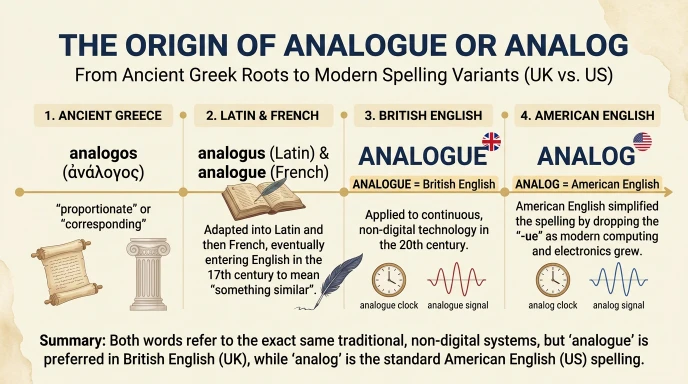
The word analogue comes from the Greek word analogos, meaning “proportionate” or “corresponding.” It entered English through French and Latin forms.
Over time, the word developed several related meanings involving similarity, correspondence, and representation.
The spelling analogue became established in British English. American English later adopted the shorter spelling analog.
The difference is similar to other British and American spelling differences. American English often uses shorter forms in certain words.
For example:
- catalogue → catalog
- dialogue → dialog
- analogue → analog
However, analogue and analog are not different words in the usual sense. They are mainly regional spelling variants.
The shorter analog spelling is especially common in American technical and electronics writing.
British English vs American English Spelling
British English generally uses analogue, while American English generally uses analog.
The pronunciation is essentially the same in normal usage.
British English
British English commonly uses:
- analogue clock
- analogue signal
- analogue device
- analogue recording
American English
American English commonly uses:
- analog clock
- analog signal
- analog device
- analog recording
Comparison Table
| Meaning | British English | American English |
| Continuous signal | analogue signal | analog signal |
| Traditional clock | analogue clock | analog clock |
| Older technology | analogue technology | analog technology |
| Recording method | analogue recording | analog recording |
| Device | analogue device | analog device |
| Similar or corresponding thing | analogue | analog |
The key point is simple: the spelling changes, but the basic meaning stays the same.
Which Spelling Should You Use?
Your audience should decide which spelling you choose.
Use “Analogue” for British English
Choose analogue when writing primarily for readers in:
- United Kingdom
- Australia
- New Zealand
- Other regions that commonly follow British English
For example:
“The company still uses analogue recording equipment.”
Use “Analog” for American English
Choose analog when writing for an American audience.
For example:
“The studio uses analog recording equipment.”
What About Global Audiences?
For international technology content, analog is very common because it is widely used in electronics, engineering, and computing.
The most important rule is consistency. Do not switch between analogue and analog randomly in the same article unless you are discussing the spelling difference.
Common Mistakes with Analogue or Analog
Several mistakes can happen when people use these words.
Mistake 1: Thinking One Spelling Is Wrong
Some writers think analogue or analog is incorrect.
Correction: Both are correct. The preferred form depends mainly on regional English.
Mistake 2: Mixing British and American Spelling
A document may use analogue in one paragraph and analog in another.
Correction: Choose one spelling style and use it consistently.
Mistake 3: Using “Analogue” for Every Technical Context
Some writers assume British English always requires analogue.
Correction: In technical fields, analog is also widely used internationally. Follow the style guide or terminology used by your field.
Mistake 4: Confusing Analog With Digital
Analog does not simply mean “old.”
Correction: Analog usually refers to information represented through continuous values, while digital systems represent information using discrete values.
Analogue or Analog in Everyday Examples
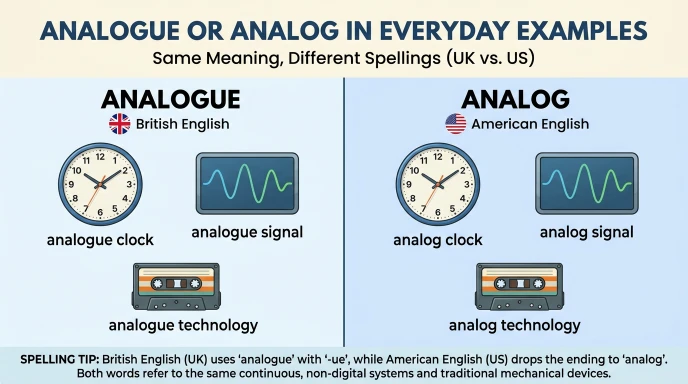
The spelling you use can change based on your audience.
In Emails
British English:
“Please check the analogue signal before the meeting.”
American English:
“Please check the analog signal before the meeting.”
In News Writing
British English:
“The broadcaster plans to improve its analogue services.”
American English:
“The broadcaster plans to improve its analog services.”
On Social Media
A British user might write:
“I still prefer my analogue camera.”
An American user might write:
“I still prefer my analog camera.”
In Formal Writing
British style:
“The research examined the use of analogue recording equipment.”
American style:
“The research examined the use of analog recording equipment.”
In Technology
Both forms can appear in technical discussions:
- analogue audio / analog audio
- analogue electronics / analog electronics
- analogue signal / analog signal
- analogue circuit / analog circuit
The intended meaning remains clear in both cases.
Analogue or Analog : Google Trends & Usage Data
Search interest for analogue and analog varies by country and audience.
In countries where British English is common, analogue tends to be more familiar. This includes the United Kingdom and several Commonwealth countries.
In the United States, analog is the standard spelling and is especially common in technology, engineering, electronics, and computing.
Search behavior can also depend on the topic. A person looking for an analog synthesizer, analog camera, or analog electronics may use the Americanifstyle spelling even outside the United States because technical terminology often favors analog.
For if, the best approach is to consider your target audience and search intent. If your website targets British readers, use analogue naturally. If you target American readers, use analog.
You can also mention both spellings in the title and article when your goal is to reach readers searching for either form.
Analogue vs Analog: SideifbyifSide Comparison
| Feature | Analogue | Analog |
| Main usage | British English | American English |
| Meaning | Continuous or corresponding | Continuous or corresponding |
| Common in UK | Yes | Less common |
| Common in US | Less common | Yes |
| Common in technology | Yes | Very common |
| Pronunciation | Usually the same | Usually the same |
| Correct spelling | Yes | Yes |
| Best for US readers | No | Yes |
| Best for UK readers | Yes | No |
FAQs About Analogue or Analog
Q1. What does analogue mean?
Analogue means something that represents information using continuous signals or changing values.
For example, an analogue clock uses moving hands to show time.
Q2. Is “analogue” spelled correctly in English?
Yes, analogue is a correct English spelling, mainly used in British English.
American English usually uses analog instead.
Q3. Is TV digital or analogue?
Modern television is mainly digital, but older television systems used analogue signals.
Today, most TV broadcasts and services use digital technology.
Q4. What is an analog example?
An analogue clock is a simple example because its hands move continuously around the clock face.
Other examples include vinyl records, thermometers, and traditional radios.
Q5. What are 5 examples of analog devices?
Five examples are analogue clocks, vinyl record players, thermometers, cassette players, and analogue radios.
These devices use continuously changing physical signals or measurements.
Q6. Is analog still used?
Yes, analog technology is still widely used in audio, electronics, sensors, music equipment, and some communication systems.
Many modern devices combine analog components with digital technology.
Q7. Why is Gen Z going analog?
Some Gen Z users enjoy analog products because they offer a more physical, simple, and nostalgic experience.
Film cameras, vinyl records, printed photos, and handwritten notes are examples of this trend.
Q8. Is WiifFi analog or digital?
WiifFi is a digital communication technology, although its radio signals are transmitted as physical electromagnetic waves.
The information carried over WiifFi is digitally encoded.
Conclusion
Analogue and analog are both correct spellings, and the main difference is regional rather than grammatical. Analogue is preferred in British English, while analog is the standard form in American English. Both words can describe continuous signals, traditional technology, clocks, recording systems, and other systems that use continuous values.
For British readers, analogue is usually the safest choice. For American readers, choose analog. If you are writing about electronics, engineering, computing, or technology for a global audience, analog is also widely recognized and commonly used.
The most important rule is consistency. Do not switch between the two forms without a reason. Consider your audience, publication style, and industry terminology before choosing a spelling. If your goal is if, including both analogue and analog naturally can help address searches from different Englishifspeaking audiences while keeping the article clear and useful.

I’m James Mitchell, an English language and grammar writer at Grammwise. I enjoy helping readers understand confusing words, spelling differences, grammar rules, and everyday English usage. My goal is to make English simple, clear, and easy to use with practical examples and straightforward explanations.







3 thoughts on “Analogue or Analog: Which Spelling Is Correct?”