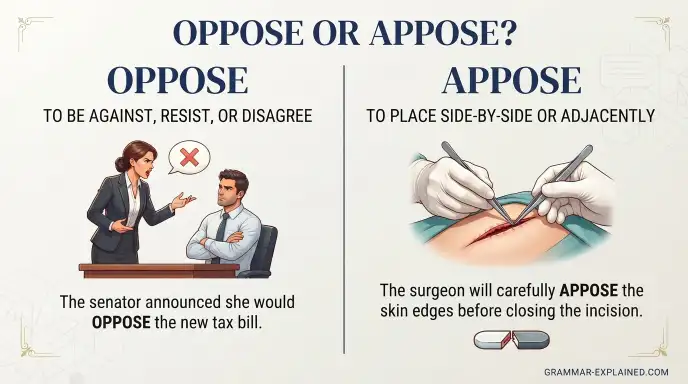
Choosing between oppose or appose can be confusing because the words look and sound similar. This guide explains their meanings, differences, and correct usage.Oppose is the correct word when you mean to disagree.
With, resist, or act against something, while appose means to place something beside or near another thing. These two words often confuse English learners because they look and sound very similar. However, they have different meanings and are used in different situations.
People often search for “oppose or appose” when writing emails, assignments, reports, or professional documents. A single letter can change the meaning of the sentence, so choosing the right spelling is important.
For example, you can oppose a new rule because you disagree with it. You can appose two objects when you place them side by side. Both words are valid English words, but they are not interchangeable.
In this guide, you will learn the simple difference between oppose and appose, their meanings, origins, spelling rules, common mistakes, and everyday uses. You will also see clear examples that make the difference easy to remember. By the end, you will know exactly when to use oppose and when to use appose.
Quick Answer : Oppose or Appose
Oppose and appose are both correct words, but they have different meanings.
- Oppose means to disagree with, resist, or act against something.
- Appose means to place one thing beside, near, or against another.
Examples
- I oppose the new rule.
- The researcher apposed the two samples for comparison.
If you mean “disagree with”, use oppose.
If you mean “place beside”, use appose.
In everyday English, oppose is much more common. Appose is mainly used in technical or specialized contexts.
Definition and Meaning of Oppose or Appose
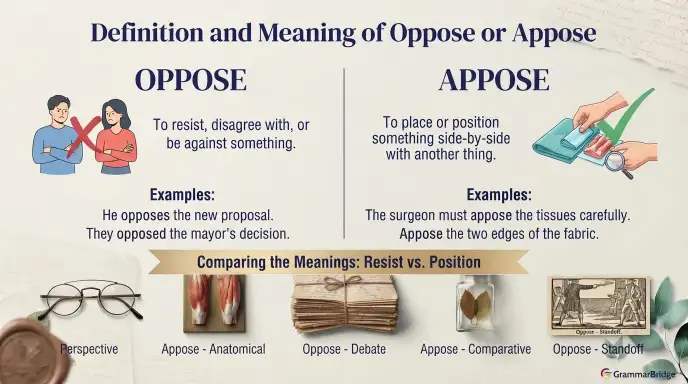
Understanding the meaning of each word makes the difference much easier.
What Does Oppose Mean?
Oppose is a verb that means to disagree with something, resist it, or try to stop it from happening.
It is commonly used when talking about:
- Rules
- Plans
- Decisions
- Ideas
- Policies
- Actions
- Proposals
Examples of Oppose
- I oppose the new school rule.
- Many workers oppose the proposed changes.
- She opposed the decision.
- They are opposing the plan.
In simple English, oppose = be against something.
What Does Appose Mean?
Appose is a verb that means to place one thing beside, near, or against another thing.
It is much less common than oppose. You may see it in scientific, medical, technical, or specialized writing.
Examples of Appose
- The researcher opposed the two samples.
- The technician opposed the parts for examination.
- The two surfaces were opposed carefully.
In simple English, appose = place beside something.
Oppose vs Appose at a Glance
| Word | Simple Meaning | Example |
| Oppose | Disagree or resist | I oppose the proposal. |
| Appose | Place beside or near | The samples were opposed. |
The easiest way to remember the difference is:
Oppose = against
Oppose beside
The Origin of Oppose or Appose
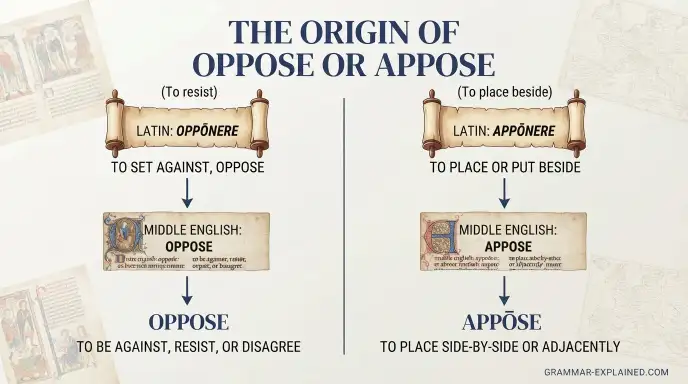
The two words have different historical paths, even though their spellings are very similar.
Origin of Oppose
Oppose comes through Old French and Middle English from the Latin opponere, meaning “to place against” or “set against.”
Over time, the word developed its modern meanings of resisting, disagreeing with, or acting against something.
This is why oppose is now commonly used for disagreement and resistance.
Origin of Appose
Appose comes from French apposer and is related to the Latin apponere, meaning “to place near” or “put beside.”
Its modern meaning still reflects this original idea of placing one thing next to another.
Why Do They Look So Similar?
Both words have Latin roots connected with the idea of placing something in relation to something else.
However, their meanings developed differently:
- Oppose → place against → resist or disagree
- Oppose → place beside → put things together
This historical connection helps explain why the words look similar while having different meanings.
British English vs American English Spelling
There is no major spelling difference between British and American English for oppose and appose. Both forms use the same spelling in the UK, US, and other Englishifspeaking countries.
| Word | British English | American English | Meaning |
| Oppose | Oppose | Oppose | Disagree or resist |
| Appose | Appose | Appose | Place beside or near |
| Opposed | Opposed | Opposed | Disagreed or resisted |
| Apposed | Apposed | Apposed | Placed beside or near |
| Opposing | Opposing | Opposing | Resisting or disagreeing |
| Apposing | Apposing | Apposing | Placing beside or near |
British English Examples
- Many residents oppose the new plan.
- The scientist opposed the two samples.
American English Examples
- The committee opposes the proposal.
- The researcher opposed the materials for comparison.
The main difference is not regional spelling. It is the meaning and frequency of use. Oppose is common in everyday English, while appose is uncommon and more specialized.
Which Spelling Should You Use?
Choose the word according to the meaning of your sentence.
For American English
Use oppose when you mean:
- Disagree
- Resist
- Be against
- Act against
Example:
“I oppose the proposed changes.”
Use appose only when you mean to place something beside or near something else.
For British English
The same rule applies.
Example:
“Several members oppose the decision.”
For placement:
Example:
“The two samples were opposed for examination.”
For Global English
If you write for a general audience, oppose will be the word you use most often.
If you need to describe physical or technical placement, appose can be correct. However, in simple writing, phrases such as “place side by side” may be easier for readers to understand.
Easy Rule to Remember
Oppose = be against
Appose = place beside
Common Mistakes with Oppose or Appose
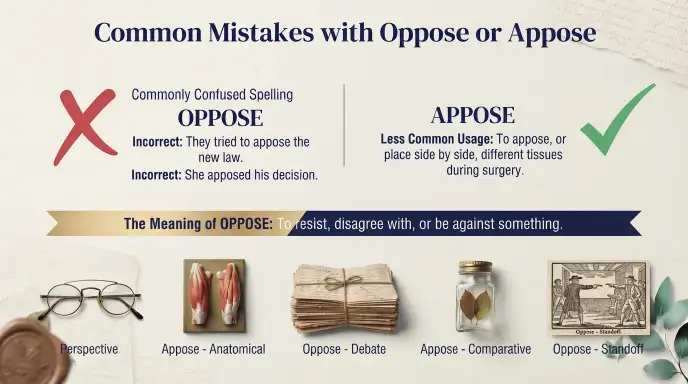
Because these words look and sound similar, writers sometimes use one when they mean the other.
Mistake 1: Using Appose for Disagreement
I appose the new policy.
✅ I oppose the new policy.
The sentence expresses disagreement, so oppose is correct.
Mistake 2: Using Oppose for Physical Placement
The scientist opposed the two samples together.
✅ The scientist apposed the two samples.
Here, the meaning is to place the samples together, so appose is appropriate.
Mistake 3: Thinking Appose Is a Misspelling
Appose is always wrong.
✅ Appose is a real English word.
It is less common than oppose, but it has its own meaning.
Mistake 4: Using Oppose When You Mean “Place Beside”
If your sentence describes putting two objects next to each other, appose may be the correct technical term.
For general readers, however, place beside or place side by side is often clearer.
Mistake 5: Confusing Their Verb Forms
| Base Word | Past Form | ifing Form |
| Oppose | Opposed | Opposing |
| Appose | Apposed | Apposing |
For example:
- They opposed the proposal.
- The researcher opposed the samples.
- The groups are opposing the plan.
- The technician is opposing the components.
Oppose or Oppose in Everyday Examples
Knowing the definition is useful, but seeing these words in real sentences makes the difference easier to remember.
1. Oppose or Oppose in Emails
Opposing is common in professional emails when someone disagrees with a plan or decision.
Example:
I oppose the proposed schedule because it may affect the project deadline.
Opposes may appear in a technical email when objects or samples need to be placed together.
Example:
Please oppose the two images for comparison.
For most everyday emails, oppose is much more likely to be needed.
2. Oppose or Oppose in News
News writing often uses oppose when describing disagreement or resistance.
Examples:
- Local residents oppose the new development.
- Several groups oppose the proposed changes.
- The organization opposed the decision.
Appose is much less common in general news because its meaning is more specialized.
3. Oppose or Oppose on Social Media
People commonly use oppose when sharing an opinion or expressing disagreement.
Examples:
- “I strongly oppose this idea.”
- “Why do they oppose the new rule?”
- “Many users oppose the change.”
You are unlikely to see opposition in casual social media posts unless the discussion involves a technical subject.
4. Oppose or Oppose in Formal Writing
Oppose is useful in reports, essays, academic writing, and formal documents when discussing disagreement.
Example:
The committee opposed the proposed amendment.
Appose can be used in specialized writing when the meaning is to place things beside or against each other.
Example:
The researchers opposed the samples before examining them.
5. Oppose or Oppose in Academic Writing
Both words can appear in academic writing, but their meanings remain different.
Oppose:
The author opposes the traditional interpretation.
Appose:
The researchers opposed the two specimens for comparison.
The first sentence is about disagreement. The second is about positioning.
Oppose or Oppose : Google Trends & Usage Data
People often search for “oppose or appose” because the words look and sound similar. Searchers may want to check spelling, meaning, pronunciation, or the correct word for a sentence.
Which Word Is More Common?
Oppose is far more common in general English because it is used in everyday conversations, news, essays, business writing, and discussions about disagreement.
Apposition is much less common. It is mainly found in specialized contexts where the meaning involves placing things beside or near each other.
This difference in everyday frequency is important for if content: someone searching “oppose or appose” is usually trying to understand if they should use the common word oppose or the less familiar appose.
Does British English Use a Different Form?
No. British and American English generally use the same spellings:
- Oppose
- Appose
- Opposed
- Apposed
- Opposing
- Apposing
The main difference is usage frequency, not regional spelling.
What Does Google Trends Show?
Google Trends can be used to compare search interest for terms such as oppose and oppose by country and time period. However, search interest does not tell you if a word is grammatically correct.
For example, a term can receive more searches because people are confused about it. Therefore, Google Trends should be used to understand search behavior, while dictionaries and context should be used to determine meaning and correct usage.
For an if article, avoid claiming exact search volumes or country rankings unless current Google Trends data has been checked for the specific date and region.
Oppose vs Oppose Comparison Table
| Feature | Oppose | Appose |
| Part of speech | Verb | Verb |
| Main meaning | Disagree or resist | Place beside or near |
| Everyday use | Very common | Uncommon |
| Formal use | Common | Specialized |
| Common context | Opinions, rules, plans, decisions | Technical or scientific contexts |
| Past tense | Opposed | Apposed |
| ifing form | Opposing | Apposing |
| British spelling | Oppose | Appose |
| American spelling | Oppose | Appose |
| Simple memory trick | Against | Beside |
| Example | I oppose the plan. | The samples were apposed. |
The Simplest Way to Remember
Oppose = against something
Oppose beside something
If you remember these two meanings, you can usually choose the correct word without confusion.
(FAQs)
Q1. What does “apposed” mean?
Opposed means placed next to or in contact with something else.
It is the past tense or past participle of appose, a less common word.
Q2. What does it mean to oppose something?
To oppose something means to disagree with it, resist it, or take action against it.
Example: “They oppose the proposed changes.”
Q3. How do you spell appose?
The correct spelling is appose, spelled AifPifPifOifSifE.
It is different from oppose, which means to resist or disagree with something.
Q4. What does “oppose” mean?
Oppose means to disagree with, resist, or be against a person, idea, plan, or action.
Example: “Many residents oppose the new policy.”
Q5. Which is correct: “oppose” or “opposed”?
Both oppose and oppose are correct, but they are used differently depending on grammar and tense.
“Oppose” is the base verb, while “opposed” is its past tense or past participle.
Q6. How to use oppose in a sentence?
You can use “oppose” when describing disagreement or resistance, such as: “She strongly opposes the proposal.”
Here, “opposes” means she is against the proposal.
Q7. What is another word for “oppose”?
Common synonyms for oppose include resist, reject, challenge, disagree with, and object to.
The best synonym depends on the context of the sentence.
Q8. What does oppose mean?
The standard expression is “oppose something,” not usually “oppose to something.”
For example, say “I oppose the plan” rather than “I oppose the plan.”
Conclusion
The difference between oppose or appose is simple once you understand their meanings. Oppose means to disagree with, resist, or act against something. Appose means to place one thing beside or near another. Although the words look and sound similar, they cannot normally be used interchangeably.
For everyday English, oppose is the word you will use much more often. It works well when discussing opinions, plans, rules, decisions, proposals, and disagreements. Appose is a less common word that is mainly useful in technical or specialized contexts where the idea of placing things together is important.
There is no major British English versus American English spelling difference for these words. Both varieties use oppose and oppose with the same basic meanings.
The easiest memory trick is “oppose = against” and “appose = beside.” If you mean disagreement, choose oppose. If you mean placing things next to each other, choose appose. This simple distinction will help you use both words accurately in professional and everyday writing.

I’m James Mitchell, an English language and grammar writer at Grammwise. I enjoy helping readers understand confusing words, spelling differences, grammar rules, and everyday English usage. My goal is to make English simple, clear, and easy to use with practical examples and straightforward explanations.



1 thought on “Oppose or Appose: Which Spelling Is Correct? ”