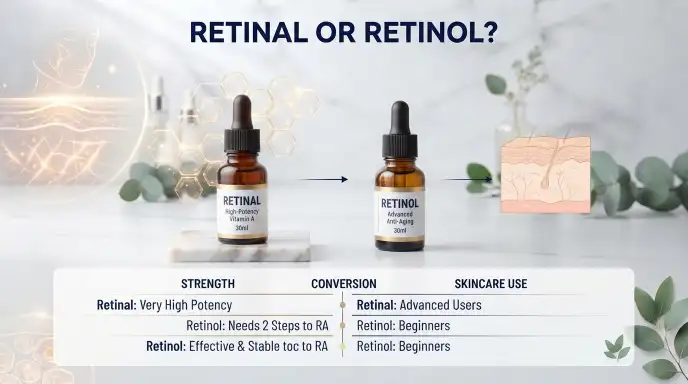
Retinal and retinol are both vitamin A derivatives used in skincare, but they are not the same ingredient. Retinol is converted into retinaldehyde and then retinoic acid, while retinal (retinaldehyde) needs only one conversion step to reach retinoic acid.
People often search for “retinal or retinol” because the names look almost identical and both appear in antiifaging and acne skincare products. This can make it hard to know which ingredient a product contains and how the two differ.
The main difference is their position in the vitamin A pathway. Retinol is one step farther from retinoic acid, while retinal is closer. Both can support skin renewal, but their strength, irritation potential, and product formulations can differ. Retinol is widely available in overiftheifcounter skincare, while retinal is also used in cosmetic products.
This guide explains the meaning, spelling, origin, usage, common mistakes, and practical difference between retinal and retinol in simple English.
Quick Answer : retinal or retinol
Retinal and retinol are different vitamin A derivatives, not spelling variations of the same word.
- Retinol: A vitamin A form that converts to retinaldehyde and then retinoic acid.
- Retinal: Short for retinaldehyde, which converts to retinoic acid in one step.
- Retinol: Usually written retinol in both American and British English.
- Retinal: Usually written retinal in both American and British English.
- A scientific review notes that retinaldehyde requires one conversion step, compared with two for retinol.
Example:
“This serum contains retinol.”
“This night cream contains the retinal.”
These sentences refer to two different skincare ingredients.
Definition and Meaning of Retinal or Retinol
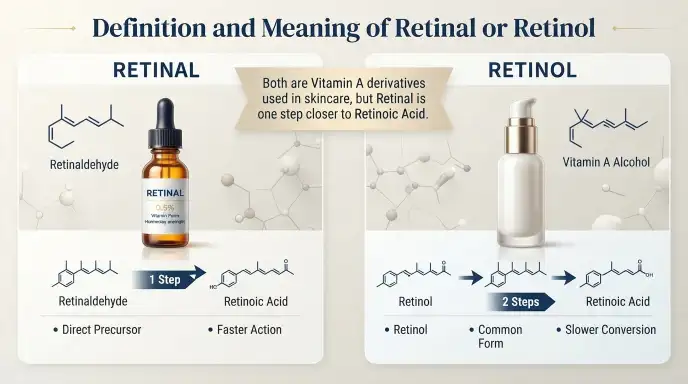
What Does Retinol Mean?
Retinol is a form of vitamin A. It is widely used in skincare products such as creams, lotions, and serums.
It can help improve the appearance of skin texture, fine lines, wrinkles, and some acne concerns. Retinol is available in many overiftheifcounter skincare products
What Does Retinal Mean?
Retinal, also called retinaldehyde, is another vitamin A derivative.
In the body’s vitamin A pathway, retinol can be oxidized to retinaldehyde. Retinaldehyde can then be converted into retinoic acid.
Retinal vs Retinol in Simple Terms
Think of the pathway like this:
Retinol → Retinal → Retinoic Acid
This helps explain why retinal and retinol are related but different.
A skincare product labeled retinol contains retinol. A product labeled retinal generally contains retinaldehyde.
Why the Difference Matters
The difference matters because the ingredients take different steps before becoming retinoic acid.
A clinical review describes retinol as requiring two conversion steps, while retinaldehyde requires one
The Origin of Retinal or Retinol
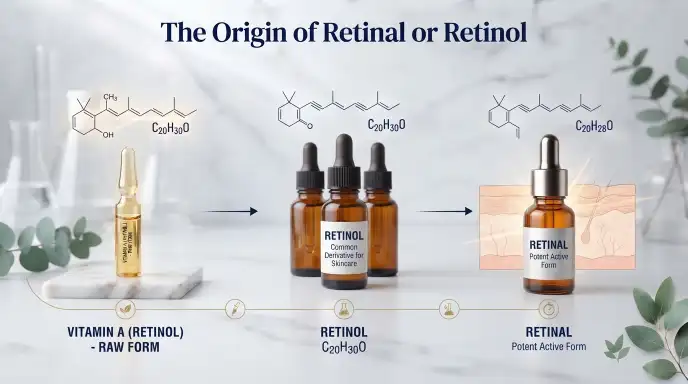
The words retinal and retinol come from the scientific naming of vitamin A compounds.
Retinol is associated with vitamin A and the retinoid family. Retinal is the shorter name commonly used for retinaldehyde, an aldehyde form of vitamin A.
The names can look confusing because both belong to the same vitamin A pathway.
Scientifically, retinoids are natural or synthetic derivatives of vitamin
The spelling difference is therefore not a BritishifversusifAmerican spelling issue. It reflects two different chemical compounds.
British English vs American English Spelling
Unlike words such as colour/color or centre/center, retinal and retinol do not normally change spelling between British and American English.
| Term | American English | British English | Meaning |
| Retinol | Retinol | Retinol | Vitamin A derivative |
| Retinal | Retinal | Retinal | Retinaldehyde |
| Retinaldehyde | Retinaldehyde | Retinaldehyde | Chemical name for retinal |
| Retinoid | Retinoid | Retinoid | Vitamin Aifrelated compound |
Examples
American English:
British English:
“Retinol is used in many skincare products.”
The spelling stays the same.
Important Point
If you are writing for a US, UK, Canadian, Australian, or international audience, use retinal and retinol according to the ingredient you mean.
Do not change one into the other because of regional spelling rules.
Which Spelling Should You Use?
Use the word that matches the ingredient you are discussing.
For Retinol
Use retinol when you mean the vitamin A derivative commonly found in skincare products.
For Retinal
Use retinal when you mean retinaldehyde.
For US Readers
Use the standard scientific terms:
retinol and retinal.
For UK and Commonwealth Readers
The same spellings are normally used:
retinol and retinal.
For Global Content
Use both terms when explaining their difference. This can help readers who search for “retinal or retinol” understand the topic quickly.
Common Mistakes with Retinal or Retinol
Here are some common mistakes to avoid.
Mistake 1: Treating Them as the Same Ingredient
Incorrect: Retinal and retinol are simply two spellings of the same product.
Correct: Retinal and retinol are different vitamin A derivatives.
Mistake 2: Calling Retinal a Misspelling
Incorrect: “Retinal is a wrong spelling of retinol.”
Correct: Retinal is a valid scientific term for retinaldehyde.
Mistake 3: Confusing Retinal With Retinoid
Retinal is one vitamin A derivative. The American Academy of Dermatology describes retinoid as a broad term covering vitamin Aifbased products.
Mistake 4: Assuming Stronger Always Means Better
Retinal may require fewer conversion steps than retinol, but that does not mean it is automatically the right choice for every person.
Skin tolerance, formulation, concentration, and personal skincare needs all matter.
Mistake 5: Using the Terms Interchangeably
When writing product reviews or skincare guides, check the ingredient label before using retinal or retinol.
Retinal or Retinol in Everyday Examples
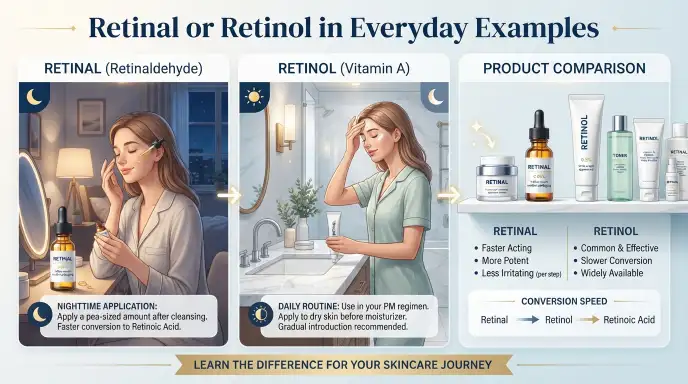
Knowing how to use both words correctly makes skincare writing clearer.
In Emails
“Could you confirm if the serum contains retinal or retinol?”
In News Articles
“The skincare industry continues to develop products containing vitamin A derivatives such as retinol and retinal.”
On Social Media
“Should you use retinal or retinol in your nighttime routine?”
In Product Reviews
“This product contains retinol and is designed for nighttime skincare.”
In Formal Writing
“Retinaldehyde is an intermediate in the conversion of retinol to retinoic acid.”
In Everyday Conversation
“What is the difference between retinal and retinol?”
This is a natural way to ask about the two ingredients.
Retinal or Retinol : Google Trends & Usage Data
Google Trends measures relative search interest, not the exact number of searches. It also allows users to compare search terms across locations and time periods.
Interest in retinol is closely linked to skincare topics such as acne, wrinkles, fine lines, skin texture, and antiifaging routines. The American Academy of Dermatology and Cleveland Clinic both discuss retinol in these skincare contexts.
Searches for retinal can also appear in skincare discussions, especially when users compare retinaldehyde with retinol.
Because Google Trends results change over time, country, and search category, a fixed ranking should not be presented as permanent. For current research, compare retinal, retinol, and related terms directly in Google Trends for your target country
Search Context Comparison
| Search Term | Common Search Intent |
| Retinol | Skincare, acne, wrinkles, antiifaging |
| Retinal | Skincare, retinaldehyde, retinoid comparisons |
| Retinal vs retinol | Ingredient comparison |
| Retinol vs retinal | Product and skincare research |
| Retinaldehyde | Scientific and skincare information |
| Retinoid | Broader vitamin A skincare category |
Retinal vs Retinol Comparison Table
| Feature | Retinal | Retinol |
| Full name | Retinaldehyde | Retinol |
| Vitamin A derivative | Yes | Yes |
| Skincare use | Yes | Yes |
| Conversion to retinoic acid | One step | Two steps |
| Common product type | Serums, creams | Serums, creams, lotions |
| Same spelling in US/UK | Yes | Yes |
| Common search intent | Retinal skincare | Retinol skincare |
| Related term | Retinoid | Retinoid |
The conversion difference is supported by dermatology literature describing retinol → retinaldehyde → retinoic acid.
FAQs
Q1. Is retinal really better than retinol?
Retinal can work faster than retinol because it needs fewer conversion steps to become retinoic acid.
However, retinol may be easier for beginners or sensitive skin to tolerate.
Q2. Is 1% retinol the same as 1% retinal?
No, 1% retinol and 1% retinal are not equivalent in strength or formulation.
The retinal is generally more potent because it is one conversion step closer to retinoic acid.
Q3. Can I use the retina every night?
Some people can gradually use the retina every night once their skin has adjusted.
Beginners may start a few nights per week and increase frequency as tolerated.
Q4. Is 0.2% retinaldehyde stronger than 1% retinol?
Concentration alone cannot determine which product will be stronger because formulations and delivery systems also matter.
Retinaldehyde is generally more potent per percentage than retinol because it requires fewer conversion steps.
Q5. What works 11 times faster than retinol?
Retinal is sometimes described in skincare marketing as working significantly faster than retinol, but “11 times faster” is not a universal clinical rule.
The actual results depend on the formulation, concentration, skin, and study conditions.
Q6. Is 0.1% retinal too strong for beginners?
A 0.1% retinal product can be potent for someone new to retinoids, particularly if the skin is sensitive.
Starting slowly and using moisturizer can help improve tolerance.
Q7. Is 0.5% retinal stronger than 1% retinol?
A higher percentage does not automatically mean a product is stronger because retinal and retinol have different potencies.
Retinal generally acts more directly than retinol, but the complete formulation also matters.
Q8. What do Koreans use instead of retinol?
Korean skincare routines commonly include ingredients such as retinal, retinol, bakuchiol, and peptides.
There is no single ingredient that all Koreans use instead of retinol.
Conclusion
Retinal and retinol are not spelling variations. They are different vitamin A derivatives used in skincare. Retinol is converted to retinaldehyde and then to retinoic acid, while retinaldehyde is one step closer to retinoic acid.
The most important point is to use the correct word for the ingredient you mean. Retinol refers to retinol, while retinal commonly refers to retinaldehyde. Neither term changes spelling simply because you are writing for an American or British audience.
For if content, product descriptions, emails, and skincare guides, keeping the two terms separate makes your writing more accurate. Readers searching “retinal or retinol” usually want to understand the difference, not choose between two spellings.
If you are comparing skincare products, check the ingredient label and consider the product’s concentration and your skin’s tolerance. Dermatology sources also note that retinoid products can cause irritation, so gradual use and appropriate skincare guidance can be helpful.

I’m James Mitchell, an English language and grammar writer at Grammwise. I enjoy helping readers understand confusing words, spelling differences, grammar rules, and everyday English usage. My goal is to make English simple, clear, and easy to use with practical examples and straightforward explanations.