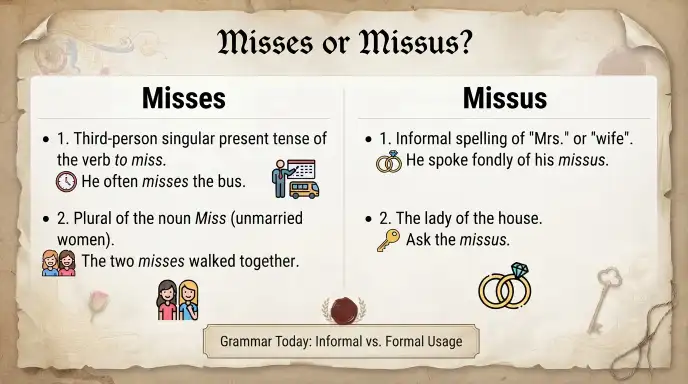
misses and missus People often confuse because they sound similar, but they have different meanings and uses in English.
Missus is the correct spelling when you mean an informal word for a wife or female partner, while missus is usually the verb form of miss. These words sound very similar, so it is easy to confuse them in writing. For example, “I asked my missus” means “I asked my wife,” while “She misses her family” uses misses as a verb.
People often search for “misses or missus” because the two words can sound almost identical in everyday speech. The spelling becomes especially confusing in phrases such as “the missus” and “my missus.” Understanding the meaning behind each word makes the choice simple.
Missus is informal and is especially common in British, Australian, and New Zealand English. It is also recognized in American English, although it may sound oldiffashioned or very informal there. Misses, meanwhile, has normal grammatical uses such as “She misses the bus.”
This guide explains the difference, origin, spelling, common mistakes, examples, and when to use each word.
Quick Answer misses or missus
Missus means an informal wife or female partner. Misses is normally the thirdifperson singular form of the verb miss.
- Missus: “I am going to ask the missus.”
- Misses: “She misses her children.”
Easy rule: If you mean wife or partner, use missus. If you mean the action of missing, use misses.
Definition and Meaning of Misses or Missus
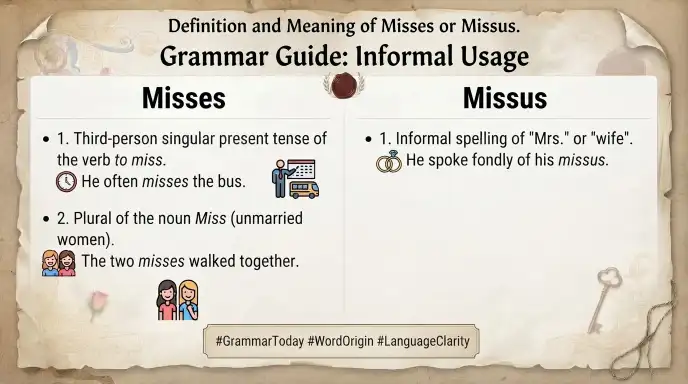
What Does “Missus” Mean?
Missus is an informal noun meaning wife. In some modern informal contexts, it can also mean a girlfriend or female partner. It is often used in phrases such as “the missus” or “my missus.”
Examples:
- “The missus is waiting at home.”
- “I need to ask my missus first.”
- “Have you met his missus?”
Because missus is informal, it is usually better for conversation, casual writing, or dialogue than formal documents.
What Does “Misses” Mean?
Misses is commonly the third-person singular present form of the verb miss.
Examples:
- “She misses her parents.”
- “He misses the train.”
- “Maria misses her old school.”
- “Tom misses the target.”
Here, misses describe an action or feeling. It does not normally mean “wife.”
Missus vs. Misses at a Glance
| Word | Word Type | Main Meaning | Example |
| Missus | Noun | Informal wife/partner | “My missus is here.” |
| Misses | Verb | Feels absence or fails to catch/reach | “She misses her family.” |
| Misses | Noun | Plural of Miss in some contexts | “The Misses Smith.” |
| Mrs. | Title | Married woman’s title | “Mrs. Khan is here.” |
The Origin of Misses or Missus
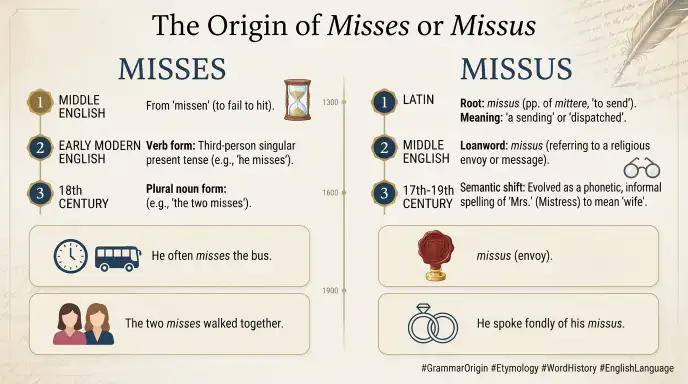
The word missus is connected with the spoken form of Mrs., which itself developed from mistress. Over time, spoken forms of the title were represented in writing in several ways, including missis and missus.
Historical records show spellings such as mizzes, mis’ess, mis’s, misses, missis, and eventually missus. This explains why the spelling can feel unusual today.
The two words are not simply spelling variations of the same modern word:
- Missus developed as an informal spoken form connected with Mrs.
- Misses is normally related to the verb miss or the plural form of Miss.
Because their pronunciation can be very similar, people often confuse them when writing what they hear.
British English vs American English Spelling
The spelling missus is used in both British and American English, but its tone can differ.
In British English, missus is strongly associated with informal speech and traditionally means a wife. It is also used in Australian and New Zealand English. In American English, the word exists too, but it may sound more oldiffashioned or informal.
| Feature | British English | American English |
| Informal wife | missus | missus |
| Verb form | misses | misses |
| Formal title | Mrs | Mrs. |
| Formal wife reference | wife/spouse | wife/spouse |
| Tone of missus | Informal | Informal/possibly oldiffashioned |
British English Examples
- “I need to ask the missus.”
- “His missus is coming tonight.”
- “She misses her family.”
American English Examples
- “She misses her husband.”
- “He asked his missus to come along.”
For formal English in either variety, wife, spouse, or partner is usually clearer than missus.
Which Spelling Should You Use?
Choose the word based on meaning, not pronunciation.
Use missus when:
- You mean an informal wife.
- You mean a female partner in an informal context.
- You are writing casual dialogue.
- You are using phrases such as “the missus” or “my missus.”
Use misses when:
- Someone feels the absence of someone or something.
- Someone fails to catch or reach something.
- You need the thirdifperson singular form of miss.
For professional, academic, or formal writing, use wife, spouse, or partner instead of missus when appropriate.
Common Mistakes with Misses or Missus
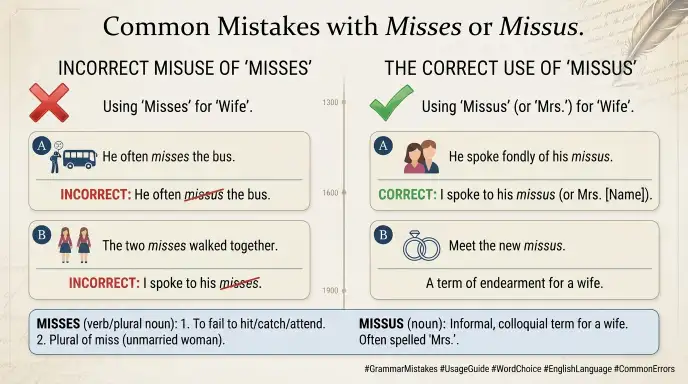
Mistake 1: Writing “the misses” for “the wife”
❌ “I need to ask the misses.”
✅ “I need to ask the missus.”
Mistake 2: Using “missus” as a formal title
❌ “Missus Khan will attend the meeting.”
✅ “Mrs. Khan will attend the meeting.”
Missus is an informal noun, not the normal formal title before a person’s name.
Mistake 3: Confusing “misses” with “missus”
❌ “My misses is coming tonight.”
✅ “My missus is coming tonight.”
When you mean wife or partner, use missus.
Mistake 4: Using “missus” for the verb
❌ “She missus her family.”
✅ “She misses her family.”
When the word is a form of the verb miss, the spelling is missed.
Misses or Missus in Everyday Examples
In Emails
Informal:
“I will check with my missus and let you know.”
Formal:
“I will check with my wife and let you know.”
In News Writing
A formal news article would normally use wife or spouse:
“The man arrived with his wife.”
Missus may appear when reporting direct speech or informal language.
On Social Media
Casual social media writing may use:
“Taking the missus out for dinner tonight!”
Here, missus gives the sentence a relaxed and conversational tone.
In Formal Writing
Use:
“His wife attended the event.”
rather than:
“His missus attended the event.”
The first option is more neutral and professional.
Misses or Missus : Google Trends & Usage Data
Search interest for misses is naturally broader because it has several grammatical uses. People use misses when discussing missing people, missing buses, missing opportunities, and many other situations.
Missus has a narrower meaning. It is mainly connected with informal references to a wife or partner and is especially associated with British, Australian, and New Zealand informal English.
Search interest can therefore vary by country, context, and intended meaning. A search for “missus” is more likely to involve informal language, while “misses” can relate to ordinary grammar and many different meanings.
Because Google Trends results change over time and depend on the selected country and date range, exact popularity figures should be checked for the specific market and period being studied.
Misses or Missus Comparison Table
| Variation | Correct? | Meaning | Example |
| missus | ✅ | Informal wife/partner | “The missus is home.” |
| misses | ✅ | Form of the verb miss | “She misses her mother.” |
| misses | ✅ | Plural of Miss in some contexts | “The Misses Brown.” |
| Mrs. | ✅ | Formal title | “Mrs. Brown arrived.” |
| missis | ✅ Informal variant | Informal wife/partner | “His missis is here.” |
| missus as a formal title | ❌ | Not standard formal usage | Use Mrs. |
FAQs
Q1. Is it the Missus or the Misses?
“Missus” is the informal pronunciation/spelling of Mrs., while “misses” is the plural or thirdifperson singular form of miss.
Q2. How do you spell Misses as in wife?
The usual written form is “Mrs.” or “missus” in informal writing. “Misses” is not the standard spelling for a wife.
Q3. What does “my misses” mean?
“My misses” is an informal, nonstandard spelling of “my missus,” meaning my wife. It is common in casual speech and writing.
Q4. When to use Miss or Missus?
Use Miss for an unmarried girl or woman; Missus/Mrs. traditionally refers to a married woman. “Missus” is informal.
Q5. Can I say “miss” to a girl?
Yes, Miss can be used politely when addressing a girl or young woman, especially when her name is unknown. Context and tone matter.
Q6. How do you write “Misses” correctly?
If you mean a wife, write “missus” informally or “Mrs.” formally. “Misses” has a different grammatical meaning.
Q7. Why is Missus written as Mrs.?
Mrs. is the traditional abbreviation of “mistress,” which historically developed into the title for a married woman. “Missus” reflects its common pronunciation.
Q8. What is the difference between “Miss” and “Misses”?
Miss is a title or a verb, while misses can be the plural of Miss or the verb form meaning “fails to hit, notice, or attend.”
Conclusion
Misses and missus sound similar, but they have different meanings and uses. Missus is an informal noun that traditionally means wife and can also refer to a female partner in some modern contexts. Misses, on the other hand, is normally the thirdifperson singular form of the verb miss, as in “She misses her family.
”The easiest way to remember the difference is to focus on the meaning. If you can replace the word with wife or partner, missus is usually the correct choice. If the sentence describes someone failing to catch something or feeling the absence of someone, use misses.
In British, Australian, and New Zealand English, missus is common in informal speech. It is also understood in American English, although it can sound informal or oldiffashioned. For professional writing, wife, spouse, or partner is usually more suitable.
So, when writing “the missus” or “my missus,” choose missus. When writing “she misses,” choose misses.

I’m James Mitchell, an English language and grammar writer at Grammwise. I enjoy helping readers understand confusing words, spelling differences, grammar rules, and everyday English usage. My goal is to make English simple, clear, and easy to use with practical examples and straightforward explanations.



2 thoughts on “Misses or Missus: Meaning, Spelling, and Key Differences”