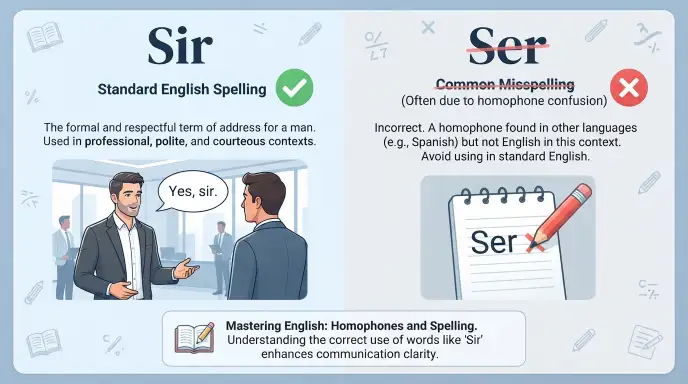
“Sir” is the correct English word used as a respectful form of address, while “ser” is generally not a standard English spelling for the same meaning. Many people search for “ser or sir” because the two words sound similar,
especially in spoken English. This creates confusion when writing emails, addressing teachers, speaking to respected people, or using formal language.
The confusion becomes even stronger because “ser” can exist as a word, abbreviation, name, or term in specific contexts, while “Sir” is the widely recognized English honorific. For example, you would write.
,“Yes, sir,” when speaking respectfully to a man. You would not normally write, “Yes, ser,” in standard English.
Understanding the difference between ser and sir can help you avoid spelling mistakes and communicate more clearly. This article explains their meanings, origins, spelling differences, correct usage, common mistakes, and everyday examples.
Quick Answer ser or sir:
The correct word for respectfully addressing a man is “Sir.”
Sir is commonly used:
- To show respect
- To address a teacher or authority figure
- To speak politely to an unknown man
- As an official title before a knight’s name
Examples
- Yes, sir.
- Excuse me, sir.
- Good morning, sir.
- Sir John is a famous author.
In contrast, “ser” is not the standard spelling of “sir” in modern English.
Simple Rule
| Word | Main Meaning | Correct Usage |
| Sir | Respectful form of address | Standard English |
| Ser | Used in limited or special contexts | Not normally used instead of “sir” |
What Does Sir Mean?
Sir is a polite and respectful term used when speaking to or referring to a man.
It can be used in several situations.
1. As a Respectful Form of Address
You can use sir when speaking politely to a man.
Examples:
- Yes, sir.
- Thank you, sir.
- How can I help you, sir?
2. For Teachers or Authority Figures
In some schools and countries, students use sir when addressing male teachers.
Example:
- Excuse me, sir. Can you explain this question?
3. As an Official Title
Sir is also used before the name of a man who has received a British knighthood.
Example:
- Sir Arthur Conan Doyle
In this situation, Sir becomes part of an official title.
What Does Ser Mean?
Ser is not normally used as a replacement for sir in standard modern English.
However, the word may appear in specific situations.
For example, ser may be:
- A name or surname
- A word used in another language
- A fictional title
- An abbreviation in a specific field
This is why seeing the word “ser” does not automatically mean it is a spelling mistake. However, if you want to respectfully address a man in English, “sir” is the correct choice.
Example
✅ Yes, sir.
The Origin of Ser or Sir
The word “sir” has a long history connected to older forms of respectful address.
It developed through historical European languages and became associated with titles of respect and honor. Over time, English adopted sir as a common polite form of address.
Originally, the term was often connected with men of high social status, authority, or honor. Today, however, sir is widely used in everyday polite communication.
The spelling “ser” may appear in historical, fictional, linguistic, or specialized contexts. However, it did not become the standard English spelling for the modern respectful title “sir.”
This explains why the two words may sometimes appear similar but have different uses.
British English vs American English Spelling
Unlike some English words that have different spellings in British and American English, “sir” is spelled the same way in both.
There is no standard American English version that changes sir to ser.
Comparison Table
| English Version | Correct Spelling | Example |
| British English | Sir | Yes, sir. |
| American English | Sir | Excuse me, sir. |
| Australian English | Sir | Thank you, sir. |
| Canadian English | Sir | Good morning, sir. |
| Standard Global English | Sir | How are you, sir? |
Important Point
Words such as color/colour or center/centre may have spelling differences between countries.
However:
- ✅ Sir = correct standard spelling
Which Spelling Should You Use?
For standard English writing, you should use “Sir” when respectfully addressing a man.
If Your Audience Is in the United States
Use sir.
Example:
- Thank you, sir.
If Your Audience Is in the United Kingdom
Use sir.
Example:
- Yes, sir.
If Your Audience Is in Australia, Canada, or Other Commonwealth Countries
Use sir.
For Global English
Use sir because it is widely understood and accepted.
The simple answer is that “sir” works correctly across standard English varieties.
Common Mistakes with Ser or Sir
Many mistakes happen because ser and sir may sound similar when spoken.
Here are some common errors.
Mistake 1: Writing “Ser” Instead of “Sir”
✅ Yes, sir.
Correction: Use sir when showing respect to a man.
Mistake 2: Assuming Ser Is American English
Some people think ser might be an American spelling.
This is incorrect.
Both British and American English use:
✅ Sir
Mistake 3: Using Sir in Every Formal Situation
Although sir is respectful, it is not always necessary.
For example, in a professional email, you may know the person’s name.
Instead of:
Dear Sir,
You can write:
Dear Mr. Smith,
Using a person’s name can sometimes sound more natural and personal.
Mistake 4: Capitalizing Sir Incorrectly
The capitalization of sir depends on how it is used.
Lowercase:
- Yes, sir.
- Thank you, sir.
Capitalized as part of a title:
- Sir Arthur Conan Doyle
Mistake 5: Confusing Sir with Other Respectful Titles
Sir is not the same as:
- Mr.
- Mister
- Lord
- Doctor
- Professor
Each title has its own purpose.
For example:
- Mr. Ahmed → general title for a man
- Dr. Ahmed → medical or academic title
- Sir Ahmed → may be used in specific official or honorary contexts
Ser or Sir in Everyday Examples
Understanding a word becomes easier when you see it in everyday situations.
At School
- Excuse me, sir. I have a question.
- Thank you, sir, for your help.
At Work
- Good morning, sir.
- Would you like some assistance, sir?
In Customer Service
- How can I help you, sir?
- Thank you for visiting, sir.
- Dear Sir,
- Yes, sir, I understand.
- No problem, sir.
- Of course, sir.
When Should You Use Sir?
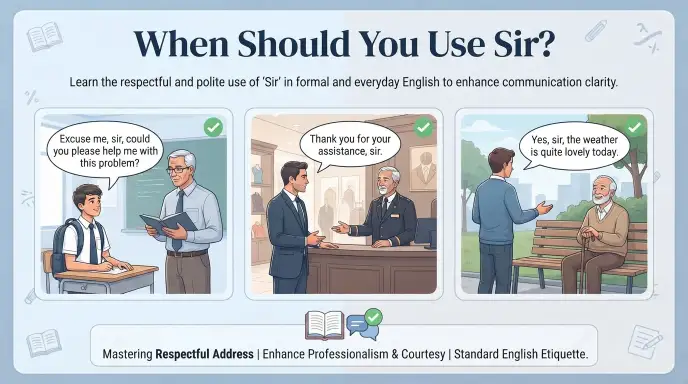
You should use sir when you want to show politeness or respect to a man.
Common situations include:
- Speaking to a teacher
- Speaking to an older person
- Talking to a customer
- Addressing an authority figure
- Using formal communication
However, the use of sir can depend on culture and location.
In some places, it is used frequently. In others, using a person’s name may sound more natural.
Example
Formal:
Good afternoon, sir.
More personal:
Good afternoon, Mr. Johnson.
Both can be polite depending on the situation.
Is “Dear Sir” Still Correct?
Yes, “Dear Sir” is grammatically correct.
It is traditionally used in formal letters when you do not know the man’s name.
Example
Dear Sir,
I am writing to request more information about your services.
However, modern communication often prefers more specific greetings when possible.
For example:
- Dear Mr. Khan,
- Dear Hiring Manager,
- Dear Customer Support Team,
These greetings can be clearer when you know who you are writing to.
Sir vs Mister
Another common question is the difference between sir and mister.
Sir
Sir is used to show respect.
Example:
- Yes, sir.
Mister
Mister, usually written as Mr., is placed before a man’s surname.
Example:
- Mr. Ali
- Mr. Smith
Comparison Table
| Word | Main Use | Example |
| Sir | Respectful address | Thank you, sir. |
| Mr. | Title before a surname | Mr. Ali |
| Mister | Full form of Mr. | Mister Johnson |
You generally do not say:
unless the person officially holds a title that allows the use of Sir before their name.
Why Do People Confuse Ser and Sir?
People commonly confuse ser and sir for several reasons.
Similar Pronunciation
The words can sound similar, especially depending on accent or pronunciation.
Typing Errors
People may accidentally type ser instead of sir.
Influence from Other Languages
English learners may be influenced by similariflooking or similarifsounding words from other languages.
Informal Internet Writing
Online communication often contains spelling mistakes, which can make incorrect spellings appear more common.
The best solution is simple:
When addressing a man respectfully in English, use “sir.”
Ser or Sir: Quick Comparison
| Feature | Sir | Ser |
| Standard English respectful title | Yes | No |
| Used to address a man politely | Yes | No |
| Used in British English | Yes | Not as a replacement |
| Used in American English | Yes | Not as a replacement |
| Common in formal communication | Yes | No |
| Can appear in special contexts | Yes | Yes |
How to Remember the Correct Spelling
A simple way to remember the correct spelling is:
Respect = Sir
Think of sentences such as:
- Yes, sir.
- Thank you, sir.
- Excuse me, sir.
If you are writing a polite form of address for a man, choose SifIifR.
Easy Memory Tip
Sir is the standard spelling for respect.
Frequently Asked Questions (FAQs)
1. Is it ser or sir?
The correct standard English spelling for respectfully addressing a man is sir.
2. Is ser a correct spelling of sir?
No. Ser is not the standard English spelling of sir when used as a respectful form of address.
3. Is sir used in American English?
Yes. Sir is used in American English as well as British English.
4. Is sir used in British English?
Yes. Sir is the standard spelling and is commonly used in British English.
5. Can I write “Yes, ser”?
No. The correct sentence is:
Yes, sir.
6. What does sir mean?
Sir is a polite and respectful way to address or refer to a man.
7. Should sir be capitalized?
Usually, sir is lowercase when used in a sentence.
Example:
- Yes, sir.
It may be capitalized when used as part of an official title.
8. What is the difference between sir and Mr.?
Sir is a respectful form of address, while Mr. is a title placed before a man’s surname.
Conclusion
The difference between ser or sir is simple once you understand their uses. “Sir” is the correct standard English word for politely and respectfully addressing a man. It is used in British English, American English, and other varieties of English.
“Ser” is not the standard alternative spelling of “sir.” While it may appear in names, other languages, fictional settings, or specialized contexts, you should not normally use it when writing a respectful English address.
So, if you are wondering which spelling to use in a sentence like “Yes,if the correct answer is always:
Yes, sir.

Hi, I’m Dylan Foster. I’m a passionate writer who enjoys creating clear, helpful, and engaging content. My goal is to provide readers with simple answers and useful information on a wide range of topics.



4 thoughts on “Ser or Sir: Meaning and Correct Usage”