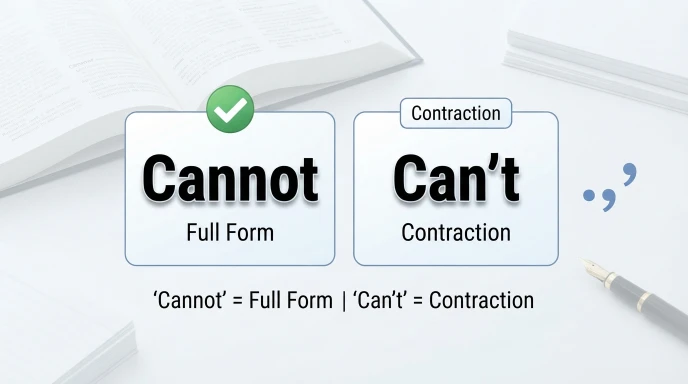
Cannot and can’t are both correct, but they are used differently depending on the situation and tone. Cannot is the full form, while can’t is its contraction. Both usually mean that someone is unable to do something, something is impossible, or something is not allowed.
People often search for “cannot or can’t” because these forms look different even though they have almost the same meaning. The main question is usually if one is grammatically correct or if one should be used in formal writing.
For example, you can say, “I cannot attend the meeting,” or “I can’t attend the meeting.” Both sentences are correct. However, the first sounds more formal, while the second sounds more natural and conversational.
Understanding this small difference can improve your emails, essays, reports, messages, and everyday conversations. In this guide, we will explain the meaning, spelling, history, common mistakes, and correct usage of cannot and can’t with simple examples.
Quick Answer : cannot or can’t
Cannot and can’t are both correct. Can’t is the shortened form of cannot.
- Cannot = full form
- Can’t = contraction
- Cannot = usually more formal
- Can’t = usually more conversational
Examples
Formal:
I cannot attend the meeting today.
Informal:
I can’t attend the meeting today.
Both sentences mean that the person is unable to attend the meeting.
When to Use Cannot
Use cannot when writing:
- Academic papers
- Business documents
- Formal emails
- Reports
- Official notices
- Professional communication
When to Use Can’t
Use can’t in:
- Conversations
- Text messages
- Social media
- Casual emails
- Friendly communication
Quick rule: If you want a more formal tone, choose cannot. If you want a natural, conversational tone, choose can’t.
Definition and Meaning of Cannot or Can’t
What Does Cannot Mean?
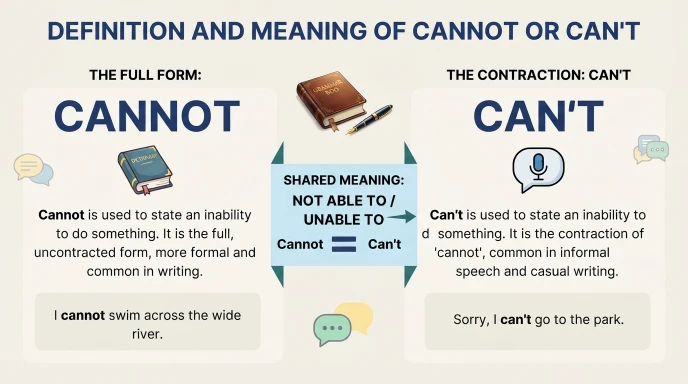
Cannot is a modal verb form that expresses inability, impossibility, or lack of permission.
Examples:
- I cannot swim.
- She cannot come today.
- You cannot enter this room.
- That cannot be true.
What Does Can’t Mean?
Can’t is the contraction of cannot. The apostrophe shows that letters have been removed from the full form.
Cannot → Can’t
For example:
- I cannot drive.
- I can’t drive.
The meaning remains essentially the same.
Simple Meaning
The simplest meaning of cannot or can’t is:
“Not able to” or “not possible.”
For example:
I can’t open the door.
This means:
I am not able to open the door.
Context and Usage
The meaning can change slightly depending on the sentence.
Ability:
I cannot speak French.
Permission:
You cannot park here.
Possibility:
This cannot be true.
Strong disbelief:
He can’t be serious.
So, cannot and can’t can be used for several related ideas, including inability, impossibility, and lack of permission.
The Origin of Cannot or Can’t
Origin of “Cannot”
The word cannot come from the combination of can and not. The word can has roots in Old English, where related forms expressed ideas such as knowing, being able, or having the ability to do something.
Over time, can + not developed into the familiar negative form cannot. In modern English, cannot is normally written as one word when it means “not be able to.”
Example:
- I cannot swim.
- She cannot attend the meeting.
- We cannot accept the offer.
Origin of “Can’t”
Can’t is a contraction of cannot. English speakers have used contractions for centuries to make speech and writing shorter and more natural.
The apostrophe in can’t shows that letters have been omitted.
Cannot → Can’t
For example:
I cannot help you.
becomes:
I can’t help you.
The meaning stays essentially the same, but can’t usually sounds more conversational.
Why Are the Spellings Different?
The difference exists because cannot is the full form, while can’t is a shortened form.
| Form | Type | Example |
| Cannot | Full form | I cannot stay. |
| Can’t | Contraction | I can’t stay. |
Both forms are grammatically correct. The main difference is style and formality, not meaning.
British English vs American English Spelling
Is Cannot Different in British and American English?
No. Cannot is spelled the same in both British and American English.
British English:
I cannot attend.
American English:
I cannot attend.
Is Can’t Be Different in British and American English?
No. Can’t is also spelled the same in both varieties.
British English:
I can’t attend.
American English:
I can’t attend.
The difference is mainly related to when speakers choose to use the full form or contraction.
Comparison Table
| Feature | British English | American English |
| Cannot | Correct | Correct |
| Can’t | Correct | Correct |
| Spelling difference | None | None |
| Formal use | Cannot is common | Cannot is common |
| Casual use | Can’t is common | Can’t is common |
| Apostrophe in can’t | Required | Required |
Examples in Both Varieties
Formal:
We cannot complete the project today.
Conversational:
We can’t complete the project today.
Both sentences are correct in British and American English. The choice depends mainly on the level of formality you want.
Which Spelling Should You Use?
Use Cannot in Formal Writing
Cannot is usually the better choice when you want your writing to sound formal and professional.
Use cannot in:
- Academic essays
- Business reports
- Official documents
- Formal emails
- Professional letters
- Applications
- Research writing
Example:
We cannot approve your request without the required documents.
This sounds clear and professional.
Use Can’t in Informal Writing
Can’t is more natural in casual communication. It is common in everyday speech and informal writing.
Use can’t in:
- Text messages
- Social media posts
- Friendly emails
- Online chats
- Casual conversations
Example:
I can’t come to the party tonight.
This sounds natural and friendly.
What Should You Use for a Global Audience?
If your content is written for an international audience, cannot is a safe choice when you want a neutral and professional tone.
However, can’t is also widely understood in Englishifspeaking countries. You do not need to avoid it completely.
Quick Usage Guide
| Situation | Recommended Form |
| Academic essay | Cannot |
| Business report | Cannot |
| Formal email | Cannot |
| Official document | Cannot |
| Friendly email | Can’t |
| Text message | Can’t |
| Social media | Can’t |
| Everyday conversation | Can’t |
| Professional website | Cannot |
Common Mistakes with Cannot or Can’t
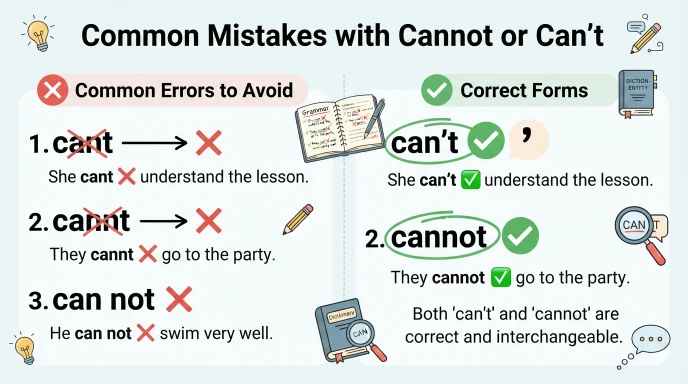
Mistake 1: Writing “Cant”
❌ I cant understand this.
✅ I can’t understand this.
The contraction requires an apostrophe.
Mistake 2: Writing “Cannt”
❌ She cannt attend the meeting.
✅ She cannot attend the meeting.
“Cannt” is not a standard English spelling.
Mistake 3: Using “Can Not” Instead of “Cannot”
When you mean “not be able to,” cannot be normally written as one word.
❌ I can not drive.
✅ I cannot drive.
Mistake 4: Thinking “Can’t” Is Incorrect
❌ Can’t is not proper English.
✅ Can’t is grammatically correct English.
It is simply a contraction and usually has a more informal tone.
Mistake 5: Using Can’t in Very Formal Writing
Although can’t is correct, cannot may fit better in highly formal writing.
Casual:
We can’t accept your application.
Formal:
We cannot accept your application.
The meaning is the same, but the tone is different.
Cannot or Can’t in Everyday Examples
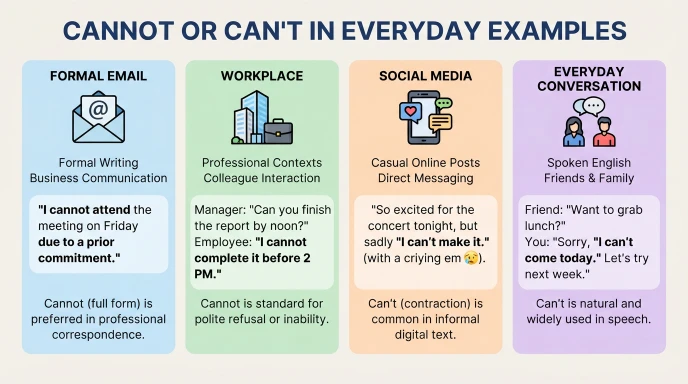
Cannot or Can’t in Emails
The choice depends on the type of email you are writing.
Formal email:
I cannot attend the meeting scheduled for Monday.
Casual email:
I can’t attend the meeting on Monday.
Use cannot when writing to a manager, client, teacher, or official organization. Use can’t when communicating casually with friends or familiar colleagues.
Cannot or Can’t in News
News writing often cannot because it can create a more formal and professional tone.
Example:
Officials said the road cannot reopen until repairs are complete.
However, can’t may appear when a news article directly quotes someone.
Example:
“We can’t reopen the road yet,” the official said.
Cannot or Can’t on Social Media
Can’t is very common on social media because posts usually have a conversational style.
Examples:
- I can’t believe the weekend is already over!
- Can’t wait for the concert!
- I can’t stop laughing at this video.
Using cannot is also grammatically correct, but it can sound more formal.
Cannot or Can’t in Formal Writing
In academic, professional, and official writing, cannot is often preferred.
Examples:
- The results cannot be confirmed at this stage.
- Students cannot submit the assignment after the deadline.
- The company cannot guarantee delivery on the requested date.
Cannot or Can’t in Everyday Speech
In normal conversation, can’t is very natural.
Examples:
- I can’t hear you.
- I can’t remember his name.
- We can’t stay here.
- She can’t come today.
People often use contractions such as can’t in speech because they make sentences shorter and more natural.
Cannot or Can’t : Google Trends & Usage Data
Search interest for cannot and can’t can vary depending on the country, languageiflearning needs, and search context.
People searching for “cannot or can’t” are often looking for grammar guidance, formalifwriting advice, or the difference between the full form and its contraction.
Common Search Contexts
Cannot may appear more often in searches related to:
- Formal English
- Academic writing
- Grammar rules
- Professional writing
- English learning
Can’t is strongly associated with:
- Conversational English
- Informal writing
- Social media
- Text messages
- Everyday speech
Google Trends measures relative search interest, so its numbers do not represent the total number of times a word is used. Search patterns can also change by country and time period.
Cannot vs Can’t: SideifbyifSide Comparison
| Variation | Meaning | Tone | Best Use |
| Cannot | Not able to | Formal | Essays, reports, official writing |
| Can’t | Not able to | Informal | Speech, chats, social media |
| Can not | Can + separate not | Special contexts | Only when grammar requires separate words |
| Cant | Not standard contraction | Incorrect | Avoid |
| Cannot | Not a standard word | Incorrect | Avoid |
Simple Rule to Remember
Cannot = full form
Can’t = contraction
If you are unsure which one to use in professional writing, cannot is generally the safer choice.
FAQs
Q1. Is it correct to say “cannot”?
Yes, “cannot” is correct English. It is the standard full form used to express inability, impossibility, or lack of permission.
Q2. What does “I cannot” mean?
“I cannot” means “I am not able to” or “I am unable to.” For example, “I cannot swim” means “I am not able to swim.”
Q3. What does “can’t” mean?
“Can’t” is the contraction of “cannot.” It means someone is unable to do something or something is not possible.
Q4. Is “I can’t” grammatically correct?
Yes, “I can’t” is grammatically correct. It is the informal contraction of “I cannot” and is common in everyday speech and writing.
Q5. Which is correct: “cannot” or “can’t”?
Both “cannot” and “can’t” are correct. “Cannot” is more formal, while “can’t” is more common in casual communication.
Q6. Is n’t it correct?
“I ain’t” is used in informal speech and some dialects, but it is not considered standard English for formal writing. Use “I am not” instead.
Q7. How do British people say “isn’t it”?
British speakers commonly use “isn’t it?” as a question tag, but the tag changes with the sentence: “It’s cold, isn’t it?”
Q8. Is “ain’t” a black word?
No. “Ain’t” is not a word belonging to one race. It is a nonstandard English contraction used in various dialects and informal speech by people from different backgrounds.
Conclusion
Cannot and can’t are both correct forms, and they usually have the same basic meaning. The main difference is how they sound and where they are used. Cannot is the full form and is often preferred in formal situations such as academic writing, professional documents, reports, and official communication. Can’t is the contraction and is especially common in conversations, text messages, social media, and casual emails.
Remember that cannot is normally written as one word when it means “not be able to.” The contraction must be written as can’t, with an apostrophe. Neither British nor American English changes the spelling of these forms.
If you are writing for a professional or formal audience, it isnot a clear choice. For relaxed, everyday communication, it doesn’t sound natural and familiar. Understanding this difference helps you choose the right form and tone for your writing.

I’m James Mitchell, an English language and grammar writer at Grammwise. I enjoy helping readers understand confusing words, spelling differences, grammar rules, and everyday English usage. My goal is to make English simple, clear, and easy to use with practical examples and straightforward explanations.

2 thoughts on “Cannot or Can’t: Which Is Correct and When to Use Each?”