Sync is the preferred and more common spelling, while synch is also correct as an alternative form with the same basic meaning.
People often search for “synch or sync” because both spellings appear in English, especially in technology, music, film, and everyday communication. This can make it hard to know if one is wrong or if the two words have different meanings. The good news is that the difference is simple: sync is the modern, widely preferred form, while sync is an accepted variant.
You may see “sync” when a phone updates data, when audio matches video, or when two people agree. For example, “Sync your contacts” and “The audio is out of sync” are both natural uses. “Synch” can also appear in phrases such as “in synch,” but it is less common.
This guide explains the meaning, origin, spelling, regional usage, common mistakes, and everyday examples of synch or sync. By the end, you will know which form to choose in professional, technical, and general writing.
Quick Answer: synch or sync
Sync is the best choice for most modern English writing. Synch is a valid alternative spelling, but it is less common. Oxford, Cambridge, and Collins all recognize synch as a variant of sync.
Examples:
- Preferred: Please sync your phone.
- Also correct: Please synch your phone.
- Preferred: The audio is out of sync.
- Also correct: The audio is out of synch.
- Preferred: The dancers moved in sync.
- Also correct: The dancers moved in synch.
For most readers, sync looks more familiar, especially in technology and digital writing.
Definition and Meaning of Synch or Sync
Definition
Sync is a shortened form of synchronize or synchronization. It means to make things happen together, work at the same time, or keep information matched between devices.
Synch has the same basic meaning and is an alternative spelling.
Simple Meaning
In simple terms, sync means “to match or work together at the same time.”
For example:
The music and video are in sync.
This means the music matches the video correctly.
Context and Usage
The word appears in several common contexts:
Technology:
“Sync your files across your devices.”
Music and video:
“The sound is out of sync with the picture.”
People and teamwork:
“The team is in sync.”
Agreement:
“We are in sync about the project.”
As a verb, sync can mean to connect or update information between devices. Dictionary.com also lists this computerifrelated meaning.
Different Meanings
| Use | Meaning | Example |
| Technology | Keep data matched | Sync your phone |
| Audio/video | Match timing | Sync the sound |
| Teamwork | Work together | We are in sync |
| Agreement | Share the same view | Their ideas are in sync |
The Origin of Sync or Sync
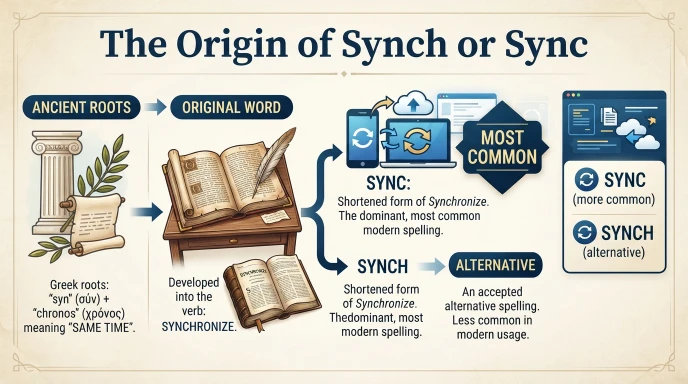
Sync comes from synchronize, while synch developed as an alternative shortened spelling. Oxford dates sync to the 1920s and identifies it as an abbreviation.
The longer word synchronize comes from Greek roots associated with things happening at the same time. Over time, speakers and writers shortened synchronization to sync for easier everyday use.
The spelling synch also became established. It reflects the ifch spelling found in words such as synchronize.
Historical dictionary evidence shows that both forms have been recognized for many years. Modern dictionaries continue to list synch as a variant of sync.
The main difference today is not meaning. It is frequency and style. The shorter spelling sync has become the dominant choice, especially with the rise of computers, phones, apps, and cloud services.
British English vs American English Spelling
Unlike color/colour or organize/organise, sync and sync are not a major BritishifversusifAmerican spelling difference.
Both forms can be found in British and American English. Cambridge lists sync as an alternative to sync, and Collins gives both forms in British and American English.
| Form | American English | British English | Usage |
| sync | Common | Common | Preferred modern form |
| synch | Used | Used | Alternative form |
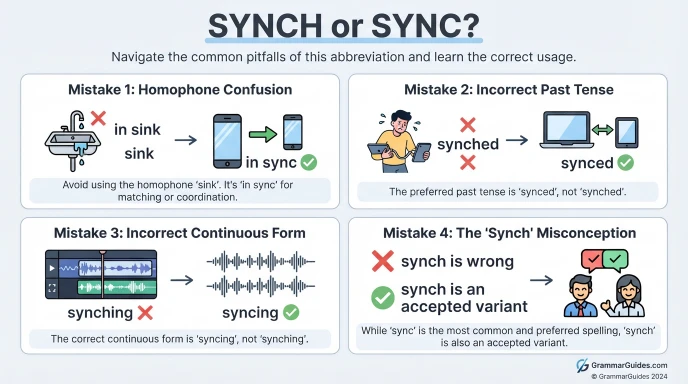
| synced | Common | Common | Preferred past form |
| synched | Used | Used | Alternative past form |
| syncing | Common | Common | Preferred ifing form |
| synching | Used | Used | Alternative ifing form |
For technology writing, sync, synced, and syncing are usually the clearest choices. Microsoft, for example, specifically recommends sync, syncs, synced, and syncing, rather than the forms with h.
Which Spelling Should You Use?
For American English
Use sync in most situations. It is familiar and widely used in technology, business, media, and casual writing.
Example:
“Please sync the files before the meeting.”
For British English
You can use either sync or synch, but sync is a strong general choice. British dictionaries recognize both.
For Commonwealth English
Sync is also a safe choice for international readers. It avoids unnecessary variation and is easy to recognize.
For Global or Professional Writing
Choose sync.
It is shorter, clearer, and more common in modern digital communication. This is especially useful for websites, software instructions, business documents, and technical content.
Common Mistakes with Sync or Sync
Mistake 1: Thinking “synch” is always wrong
Sync is not simply a spelling error. Major dictionaries recognize it as an alternative form.
Correct:
“The audio is out of sync.”
More common:
“The audio is out of sync.”
Mistake 2: Using “sink”
The pronunciation of sync is /sɪŋk/, but sink is a different word.
❌ “The devices are in sink.”
✅ “The devices are in sync.”
Mistake 3: Mixing forms
Writers sometimes use sync, synched, and synching without a clear reason.
For simple modern writing, keep the family consistent:
- sync
- syncs
- synced
- syncing
Mistake 4: Writing “in sync” incorrectly
The common expression is:
✅ in sync
✅ out of sync
These mean coordinated and not coordinated.
Mistake 5: Confusing sync with synchronous
Sync is an informal short form related to synchronization. It should not automatically be used as an abbreviation for every use of synchronous. Microsoft specifically advises against using sync to abbreviate synchronous.
Sync or Sync in Everyday Examples
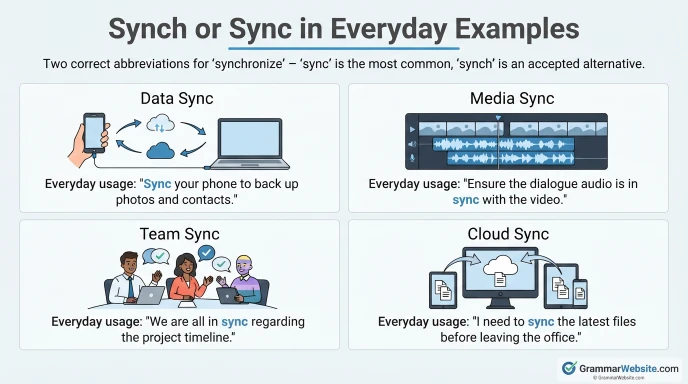
In Emails
Please sync the latest files before our meeting.
This is clear and professional.
In News Writing
The two teams appeared to be in sync throughout the match.
Here, in sync means coordinated.
On Social Media
These two dancers are completely in sync!
This informal use is common online.
In Technology
Your contacts will sync automatically.
This is one of the most common modern uses of the word.
In Formal Writing
The two systems must remain in sync to prevent data errors.
Although sync is informal in origin, it is widely accepted in technical and professional contexts. Oxford labels it informal, while Microsoft actively uses and recommends the form in technology writing.
In Music and Film
The soundtrack was not in sync with the video.
Both sync and sync can be used in this context.
Sync or Sync : Google Trends & Usage Data
Search interest and word usage are not exactly the same thing, so Google Trends should be treated as an indicator of search popularity, not a dictionary rule.
The available dictionary and usage evidence strongly points to sync as the dominant modern spelling. Oxford lists synch as an alternative, while Collins lists both forms.
Usage also varies by context:
- Technology: sync is strongly preferred.
- Software: sync is standard in many interfaces and style guides.
- Music and film: both sync and sync appear.
- General writing: sync is usually more familiar.
- Informal communication: both can occur.
Microsoft’s current style guidance recommends sync rather than synch for technology content.
So, if your goal is broad readability and modern usage, sync is the safer choice.
Sync vs Sync Comparison Table
| Feature | Sync | Synch |
| Meaning | Synchronize / synchronization | Same |
| Correct? | Yes | Yes |
| Part of speech | Noun and verb | Noun and verb |
| Modern usage | More common | Less common |
| Technology | Preferred | Less common |
| British English | Used | Used |
| American English | Used | Used |
| “Inif ” | in sync | in synch |
| “Out of if | out of sync | out of synch |
| Professional recommendation | Usually preferred | Acceptable variant |
FAQs
Q1. Is it spelled sync or sync?
Both sync and sync are correct spellings. However, sync is more common and preferred in modern writing.
Q2. What is synch used for?
Synch is used to mean synchronize or to make things happen at the same time. It can describe technology, music, video, or teamwork.
Q3. Is it sync or synch for a meeting?
Use sync for a meeting, especially in phrases like “quick sync” or “sync meeting.” It means a short meeting to share updates.
Q4. What does “sync” mean?
Sync means to make two or more things match or work together at the same time. It is often used for devices, data, people, and media.
Q5. Is “sync” a word?
Yes, sync is a recognized English word. It is a shortened form of “synchronize” and is commonly used as both a noun and a verb.
Q6. Why do we sync?
We sync things to keep information, actions, or timing matched. For example, devices sync data so the latest information appears on each device.
Q7. What is an example of sync?
An example is, “Please sync your phone with your computer.” This means keeping the information on both devices updated and matched.
Q8. What is another word for “sync”?
Common alternatives include synchronize, coordinate, match, align, and harmonize. The best choice depends on the context.
Conclusion
Sync and synch are both correct spellings, and they usually have the same meaning. Both are shortened forms related to synchronize or synchronization. The key difference is usage: sync is the more common and modern form, while synch is an accepted but less common alternative.
For websites, emails, software instructions, business writing, and technical content, sync is usually the best choice. It is familiar to readers and is widely used in modern technology. Microsoft also recommends sync, synced, and syncing instead of their forms with h.
You can still use synch when you encounter it in established writing, especially in music, film, or other contexts where the variant has been used traditionally. It is not automatically a spelling mistake.
The easiest rule is simple: choose sync for modern, clear, and broadly understood writing. If you see synch, understand it as a valid alternative rather than an entirely different word.

I’m James Mitchell, an English language and grammar writer at Grammwise. I enjoy helping readers understand confusing words, spelling differences, grammar rules, and everyday English usage. My goal is to make English simple, clear, and easy to use with practical examples and straightforward explanations.