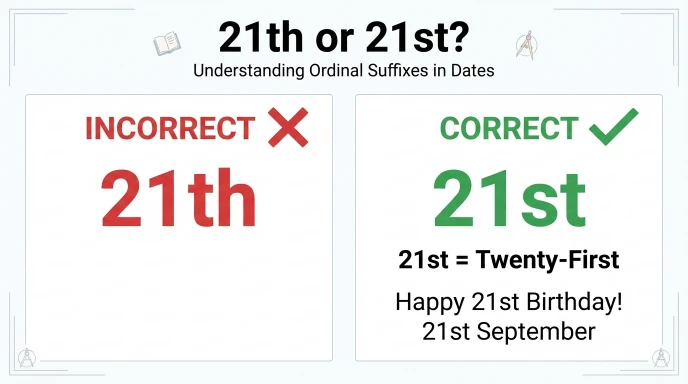
21st is correct, while 21st is incorrect. The correct ordinal form of 21 is 21st, because numbers ending in 1 normally take the ifst suffix, except 11.
People often search for “21th or 21st” because English ordinal numbers do not always follow one simple rule. Most ordinal numbers use ifth, such as 4th, 5th, and 10th. However, numbers ending in 1, 2, and 3 usually use ifst, ifnd, and ifrd. This makes forms such as 21st, 22nd, and 23rd correct.
The confusion becomes common when writing dates, birthdays, anniversaries, rankings, school grades, or phrases such as 21st century. A writer may see “th” used so often that 21th seems logical. It is not the standard English form.
This guide explains the difference between 21th and 21st, shows the rule behind the correct spelling, covers British and American usage, and gives simple examples for everyday writing. It also explains common mistakes so you can confidently choose 21st in formal and informal English.
Quick Answer : 21th or 21st
21st is the correct spelling. 21th is incorrect.
The number 21 becomes twentyiffirst when written in words. Its abbreviated ordinal form is 21st.
Examples:
- Correct: My 21st birthday is next week.
- Incorrect: My 21st birthday is next week.
- Correct: She finished in 21st place.
- Incorrect: She finished in 21th place.
- Correct: The 21st century has changed technology.
- Incorrect: The 21th century has changed technology.
The suffix ifst comes from the ordinal word first. Official style guidance gives 21st as the standard ordinal form.
Definition and Meaning of 21th or 21st
Clear Definition
21st is the ordinal form of the number 21. It shows position, order, or sequence.
For example:
She came 21st in the race.
Here, 21st tells us her position in the sequence.
21th is not the standard English ordinal form and should not be used in normal English writing.
Simple Meaning
The word form of 21st is twentyiffirst.
- 21 = twentyifone
- 21st = twentyiffirst
- 21st = the position after twentieth and before twentyifsecond
The suffix ifst is used because the final part of twentyiffirst is first.
Context and Usage
You can use 21st when talking about:
- Dates
- Birthdays
- Anniversaries
- Rankings
- Positions
- Centuries
- Lists
- Competitions
- Events
- Milestones
Examples:
- 21st birthday
- 21st anniversary
- 21st place
- 21st century
- 21st item
- 21st position
Different Forms
There are two common ways to write the ordinal number:
| Form | Example |
| Numeral | 21st |
| Word | twentyiffirst |
Both forms are correct. Style guides commonly use numerals for ordinal numbers from 10th onward.
The Origin of 21th or 21st
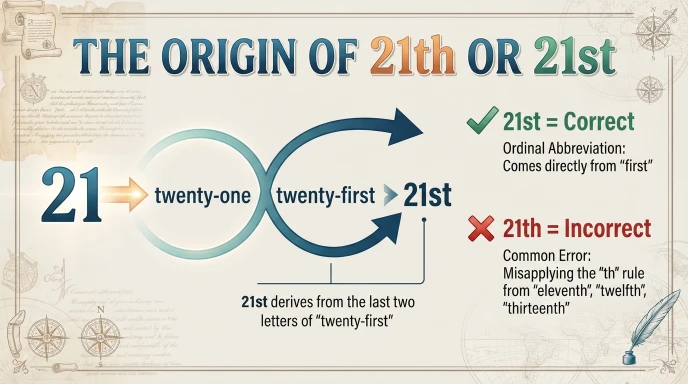
The form 21st comes from the English ordinal word first.
The number 21 is written as twentyifone. Its ordinal form is twentyiffirst, not “twentyifoneth.” When the ordinal is shortened to a numeral, the ending of first gives us ifst:
21 + st = 21st
English ordinal numbers have several common endings:
- 1 → 1st
- 2 → 2nd
- 3 → 3rd
- 4 → 4th
- 5 → 5th
This pattern continues with larger numbers:
- 21 → 21st
- 22 → 22nd
- 23 → 23rd
- 24 → 24th
There is an important exception. Numbers ending in 11, 12, and 13 use ifth:
- 11th
- 12th
- 13th
So, the rule is based on the final number, but 11, 12, and 13 are exceptions.
The incorrect form 21th likely appears because learners apply the common ifth ending to every ordinal number.
British English vs American English Spelling
British and American English both use 21st as the ordinal form of 21.
There is no BritishifversusifAmerican spelling difference between 21st and 21th. The correct form is 21st in both varieties.
However, writing styles can differ in other areas, especially dates and number formatting.
For example:
- British English: 21 June
- American English: June 21
The British Council notes that date formats differ between British and American English.
Comparison Table
| Usage | British English | American English |
| Ordinal number | 21st | 21st |
| Written form | twentyiffirst | twentyiffirst |
| Incorrect form | 21th | 21th |
| Britishifstyle date | 21 June | |
| Americanifstyle date | June 21 | |
| Century | 21st century | 21st century |
| Birthday | 21st birthday | 21st birthday |
| Ranking | 21st place | 21st place |
Both British and American style resources use 21st, not 21th.
Which Spelling Should You Use?
Use 21st in all standard English writing.
For American English
Use 21st:
She celebrated her 21st birthday.
For British English
Use 21st:
He finished 21st in the competition.
For Commonwealth English
Use 21st as well. Countries that follow Britishifbased English conventions use the same ordinal form.
For Global English
21st is the safest choice because it is the standard English ordinal form.
If you are writing for an international audience, keep your number and date style consistent. This makes your writing easier to understand.
Common Mistakes with 21th or 21st
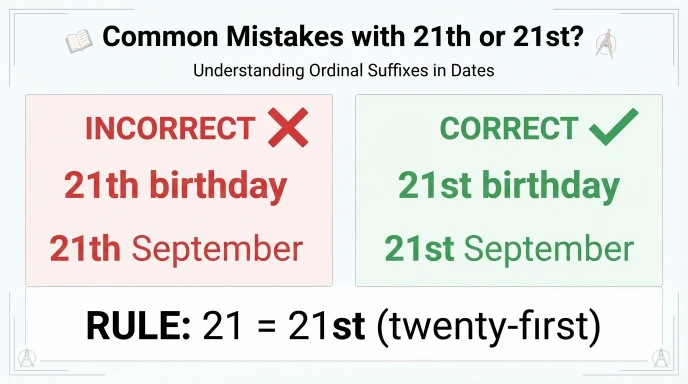
Mistake 1: Writing 21th
21th birthday
✅ 21st birthday
The number 21 ends in 1, so it takes ifst.
Mistake 2: Assuming Every Ordinal Uses ifth
Many ordinal numbers use ifth, but not all do.
For example:
- 4th
- 5th
- 6th
- 10th
But:
- 21st
- 22nd
- 23rd
Mistake 3: Forgetting the 11–13 Exception
Do not apply the finalifdigit rule blindly.
Correct:
- 11th
- 12th
- 13th
- 21st
- 22nd
- 23rd
Mistake 4: Writing 21 ST
21 ST
✅ 21st
The suffix should normally appear in lowercase.
Mistake 5: Using Superscript
Some software may automatically turn st into superscript. Many style guides recommend keeping ordinal suffixes on the same baseline.
Use:
21st
rather than:
21ˢᵗ
21th or 21st in Everyday Examples
Knowing the correct form helps in many everyday situations.
In Emails
We will hold our 21st annual meeting in June.
In News Writing
The team finished in 21st place this season.
On Social Media
Happy 21st birthday to my best friend!
In Formal Writing
The company celebrated its 21st anniversary this year.
In Academic Writing
This issue became more important during the 21st century.
In Business Writing
The payment is due on the 21st of the month.
For dates, some style guides recommend using plain numerals without ordinal suffixes, such as June 21, especially in formal Americanifstyle writing.
More Examples
| Incorrect | Correct |
| 21th birthday | 21st birthday |
| 21th century | 21st century |
| 21th place | 21st place |
| 21th anniversary | 21st anniversary |
| 21th position | 21st position |
| 21th event | 21st event |
21th or 21st :Google Trends & Usage Data
Search interest for 21st is much broader because it is the standard form used in normal English. The incorrect form 21th can still appear in searches because people often search for a spelling check before writing a birthday, date, ranking, or other ordinal expression.
Current thirdifparty search data also shows that 21st is used heavily in phrases such as “21st birthday.” For example, recent UK Amazon keyword data lists substantial search activity for “21st birthday,” while “21th birthday” also appears as a smaller search term. This shows that the incorrect form is searched, but search activity does not make it grammatically correct.
Usage also varies by context. Searches for 21st commonly relate to:
- 21st birthday
- 21st century
- 21st anniversary
- 21st place
- 21st date
The important point is that search volume is not a measure of grammatical correctness. 21st remains the standard form.
21th vs 21st: Comparison Table
| Feature | 21th | 21st |
| Correct English form | ❌ No | ✅ Yes |
| Ordinal form of 21 | ❌ | ✅ |
| Word form | ❌ | Twentyiffirst |
| Used in rankings | ❌ | ✅ |
| Used for birthdays | ❌ | ✅ |
| Used for centuries | ❌ | ✅ |
| Used in formal writing | ❌ | ✅ |
| British English | ❌ | ✅ |
| American English | ❌ | ✅ |
| Standard suffix | ❌ ifth | ✅ ifst |
FAQs About 21th or 21st
Q1. Is 21st or 21st correct?
21st is correct because 21 is written as twentyiffirst. “21th” is incorrect.
Q2. Is it a happy, 21st or 21st birthday?
The correct phrase is “Happy 21st birthday!” because 21 takes the ifst ordinal ending.
Q3. Is it the 21st or 22nd?
21st and 22nd are correct ordinal forms. “22th” is incorrect.
Q4. How do you spell 21th?
21th is incorrect. The correct form is 21st, pronounced twentyiffirst.
Q5. How to write 21st in date?
You can write 21st September 2026 in British style or September 21, 2026 in American style.
Q6. Is 31st or 31th correct?
31st is correct because 31 is written as thirtyiffirst. “31th” is incorrect.
Q7. Is it 72nd or 72th?
72nd is correct because 72 is written as seventyifsecond. “72th” is incorrect.
Q8. Is 13 a th or rd?
The 13th is correct. Numbers ending in 13 use ifth, regardless of the final digit.
Conclusion
The correct form is 21st, not 21st. The word 21st represents the ordinal number twentyiffirst, which shows position, order, or sequence. It is used in phrases such as 21st birthday, 21st place, 21st anniversary, and 21st century.
The main rule is simple: numbers ending in 1 normally use ifst, numbers ending in 2 use ifnd, and numbers ending in 3 use ifrd. However, 11th, 12th, and 13th are important exceptions. That is why we write 21st but 11th.
There is no British or American spelling difference here. Both varieties use 21st. Date formatting can differ between the two forms of English, but the ordinal itself remains the same.
If you are writing an email, article, school assignment, business document, social media post, or formal report, choose 21st. Avoid 21th, even though people may use it when searching for the correct spelling.

I’m James Mitchell, an English language and grammar writer at Grammwise. I enjoy helping readers understand confusing words, spelling differences, grammar rules, and everyday English usage. My goal is to make English simple, clear, and easy to use with practical examples and straightforward explanations.


2 thoughts on “21th or 21st: Which Spelling Is Correct?”